Trolling on 7-3-2012, 7-5 and 7-6

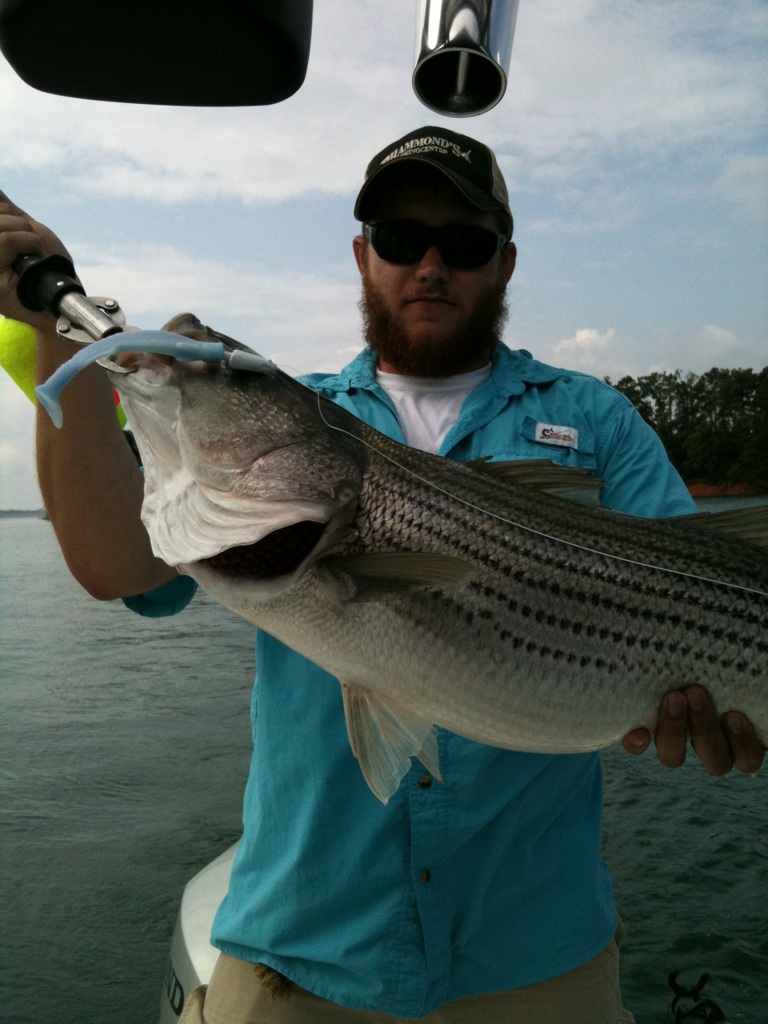
The pattern is getting stronger now for trolling. Our trips are seeing more fish per hour than in previous weeks and overall the numbers have been very good this year. There are loose schools of stripers up further north where most of the fleet of guides have been and there are a lot of singles and double lurking around bait in the thermocline over very deep water, relating to the river channel. The most prevelent baits have been the new Fire Shad Custom Troller and the big shad bodies with 1 ounce and ounce and a half shad head jigs. Here’s some videos of our recent trips:


Trolling on 7-2-2012

I got out this morning to try a couple of new jigs and try and locate some new fish to work on. I started out up north around the six mile area and worked my way south. I caught 2 smaller fish up north and then worked the Bald Ridge area, then over to the dam. I found a few fish suspended over deep water and was able to pick off a few more before finding more fish at the mouth of Shoal Creek and getting a nice fish or two. Most of the fish came off of the blue shad heads and pearl blue shad body and my new Fire Shad troller in a 1 ounce size. I ran up to 9 colors back. Here’s a couple of videos from today.


Trolling with Alex 6-26-2012

Late last summer I took Alex out on a trolling trip and it was one of those slow days. I promised Alex we’d get out again on my nickel, so today was the day. We caught fish from about 8 am till a little after lunch. I think we ended up with 8-10 nice stripers and 11 nice spots. We started out with 1 ounce Custom Trollers on leadcore and caught a couple of nice fish then we switched over to my 1 and a half and two ounce big shad head swimbaits when the sun got higher and caught most of our fish. I was using a couple of new colors today that made the difference in the shad head trollers. I used a hand poured pearl with blue highlighted swimbait and a blue pearl colored swimbait. They were loving them colors. Needless to say, we had a blast. Thanks for the company Alex! Here’s a video of some of the action.
 

Trolling on 6-24-2012

I got out early this morning with a few very special guests; Legendary Outdoor writer Don Baldwin, his son-in-law Kevin and granddaughter Madison joined me for a early morning troll on Lanier. There was a very pleasant morning bite before the traffic invaded the lake. We were able to manage a few fish, mostly stripers and all were caught while trolling. We caught fish on a Blueback color pattern, chartruese over white and plain white, all 1 ounce and one and a half. Here’s a little video from this morning.

Winter Fishing Forecast

Well, it’s here. Winter is upon us and the striper bite is picking up after a transitional period. Fish are popping on top and feeding below the surface. This is the time of year stripers work together to feed on the massive schools of bait scattered throughout the lake.
I expect a great winter fishing season for stripers with the water levels way down and dropping. With the levels being down, the stripers will be more concentrated in areas throughout the lake. The bait will be less scattered due to the decline of shoreline and structure for bait to move around in.
My tackle strategy this winter is pretty simple. My winter set-up consists of a minimum of 4 planer boards with an assortment of bait. I will weight and freeline bluebacks, gizzards, threadfin and trout. I’ll freeline the biggest trout and gizzards I can find on ballons or straight out the back at least 100 feet. I’ll also run a small gizzard right behind the boat to swim back and forth, this is called a transom bait and is very effective to pick up a striper or two close to the boat. Sometimes a bait will use the shelter of being around a boat to get away from a hungry striper. Stripers know this and they will not hesitate to come right up to the back of the boat for a quick meal.
I vary the distance of my baits behind my planer boards, but if I’m fishing very shallow water my rule of thumb is the average distance of the bait behind the board is about the same distance as the depth unless I’m using bluebacks as they like to stay near the surface and the don’t usually stray to the bottom like a gizzard or trout. I aways make sure I put out a variety of bait sizes and slowly transition the majority of my baits to what is working the best for me.
I also run 4 downlines with varied baits and various depths. Don’t get stuck on one depth. Your shallower or lighter downline baits should go out the back and your heavier weighted baits in the front of the boat and the depths should be varied until you find a good pattern to stay with.

I’m probably going to have 3 types of artificial tied on. First is some kind of topwater bait. That usually varies acording to what’s laying around the boat. Second is a small bucktail. Winter stripers usually key on the smaller stuff so I use a 3/8 to 1/2 ounce bucktail and thirdly, some kind of jig that I can cast a long way or do some verical jigging. Two years ago we were fishing a big tournament in the middle of winter and ran across a big school of fish. They didn’t hit the downines or planer and freelines so after two passes on the fish I dropped a little verical jig on them and imediately hooked up with a white bass. Dropped back down in them again with the same result. I’m glad I had the little jig tied on or we may have wasted more precious tournament time on those fish. On another occasion my partner broke out a little Flex-it spoon when he saw a few big hybrids surface. As soon as the spoon hit the water one of the big hybrids slammed the jig and that fish won us a top 5 finish 4 years ago in the Striped Bass National Championship landing a 9 pound hybrid with minutes left in the tournament. sometimes a little casting jig can really save the day.

That’s a little bit about my tackle. As far as my fishing strategy, it’s simple in the winter; find the bait and you’ll find the fish. Not every school of bait will hold fish but if you find a creek that has a good concentration of bait, the fish won’t be far away. I like fishing bends in the river if I’m river fishing or fishing a narrow lake in the winter. I also like pulling points and creek channels in the lakes. Sometimes pulling your big baits right down the center of a creek channel will net a big fish. You have to be patient but there’s usually a big striper or two cruising just below the surface or deeper in the channel waiting to greet bait on the way in or out of the creek.

Watch the birds!!! Fast moving groups of gulls headed in one direction and diving or circling gull indicate fish. Loons are a good indicator of bait. Loons are generally working around the lake looking for bait to eat while gulls are more like opportunists sitting around waiting on the fish do the work for them so they can dive in and get a free meal.
Enjoy the winter striper fishing!
Jim

Trolling Report from 8-6-2011

After working on tackle for the first half of the week I finally got caught up and was able to get out for both Thursday and Friday. On Thursday I got out with David O. David made a tackle purchase a few weeks back and we had been texting and emailing back and forth on tactics and techniques. David sent me a picture early last week of a 23 lber he had caught on a Bleed’n Shad paddletail trolling. He scheduled a instructional trip with me last Thursday and I finally was able to put a face with a name.
We left the dock at around 10 am. The bite had been later in the morning throught mid afternoon. I kinda figured we were going to have a good day. I had checked the barometric pressure earlier and it was hanging around 29.94. From my past experiences, low or falling barometric pressure means good fishing. Here is my philosophy concerning barometric pressure. “The higher the pressure, the lower and slower the fish are in the column (Deeper lathargic fish)”. “The lower the pressure, the higher and more active the fish are in the column (Topwater and sub-surface feeding)”. This rule applies to bait as well.
So off we went, heading to our first stop. As we got to the mouth of the creek we marked active fish feeding on balls of threadfin. They were up in the water column, with most of the feeders and bait around the 30ft mark in depth. Perfect for leadcore and downriggers. We put out our leadcore and downriggers and started making passed through the feeding fish. I watched the graph and saw big groups of fish feeding and cutting through the bait balls. I thought it would be cool to get a camera down there and watch the stripers slicing through the bait balls and bigger fish below picking up the scrapes. With feeding fish that high in the column, it wasn’t long till we had our first fish. It was a nice fat 12 lber on the downrigger. We were running big shad head swim baits on the leadcore and monster bucktails on the downriggers. I generally use my downriggers to pull baits deeper in the water column to target the larger stripers. Fishing the river channel is the perfect spot to use this technique because of the lack of structure (no trees). It worked well for us. We marked and caught feeding fish at every stop. They were just very active during this period.
We basically left them biting as I had to get back to work. I attributed the good day to the passing weather disturbance we had. It had rained earlier in the morning before light and the wind kicked up out of the NW and skies were kind of overcast the whole time we were fishing. David and I had a great time and we pretty much mopped up on em. Our best baits were the big Cast Away Shad Head jig in the ounce and a half size, the chartreuse Monster bucktail in the 1 ounce size and we used a big 2 and a half ounce chartreuse chipmunk with a 5 inch paddletail.
Here’s the videos from Thursday.


Friday I was back at it with Keith. Keith is one our Pastor’s right here in Cumming. He wanted to learn a little more about trolling so he and his father-in-law could get out on their own and do a little trolling. We got to the water at around 10 am and quickly found out what a difference a day makes. Everywhere we searched the fish were either very very scattered or down in the trees. They were not in an eating mood. Keith and I searched and trolled and troller and searched for two hours without putting a fish in the boat. We picked up a big magnum spot down by the dam which brightened our spirits for a few minutes. We made a quick shot back up north a mile or two and started searching humps. Sometimes in the summer when stripers are deep, they will cruise the humps and valleys in search of bait. I finally found a small group of fish in a valley that was feeding on a school of bait. We ran the baits over the feeding fish and we were able to pick off a fish on the leadcore with a big chartreuse swimbait. We worked the fish for the next half hour and picked up one more on the leadcore before the fish scattered. As much as we worked the fish we found, we had very little action to show for it. I had to get back to work so we called it a day with 2 stripers on leadcore and 1 big spot. I got a little video of Keith and his fish.

Trolling report from 7-29-2011

I got out with Glenn who contacted me about riding along for a leadcore and downrigger instructional trip out. I needed to test some tackle and invited him to climb aboard. The day started slow but we were able to find a few fish here and there. We marked a lot of fish eating bait over deeper water from Bald Ridge to Six Mile. We were able to find our fish in the same places I’ve been finding them for the past two weeks. This time they were a little reluctant to hit the jigs. We finally got a call from a buddy I made some big swimbait for and he said they had caught 2 on the big 7 inch swim bait. Glenn and I tied on a 2 ounce Shad Head jig and 7 inch swim Bait body in a Blueback pattern and we had a fish within minutes of dropping the bait back. We also caught 2 nice fish on a chartreuse color. We caught 2 fish on the downriggers, one on a 1 and a half ounce Monster Bucktail in a Cast Away Blueback pattern. The fish we were marking were very very deep which made it tough to troll them up. We were letting out 9 colors of leadcore with a 2 ounce jig in the river channel. That was the ticket to get the bait deep enough.
Here’s a little video of the trip.

Trolling Tackle Talk and Tactics

Here is a piece I wrote for one of our local forums concerning trolling leadcore and downriggers:

Gear:
On leadcore I’m using #36 lb test and I’m also using 30-50 feet of 25 lb Big Game clear mono for a leader. I used flouro leaders for the past 2 years and went back to mono leaders. I don’t think the leader type matters much (mono vs flouro). I’ve caught fish on both and don’t see a significant difference in the two. The only difference that makes mono a little better is the fact that mono is tougher than flouro. If I hang a good fish and he takes me to the trees, I’ve got more of a chance of getting the fish out with mono. It has more stretch and is more tolerent to abrasions. When you are using leaders at 30-50 feet at a time, a good mono is far more cost effective than using flouro.

I have one Accu-Depth 57LC and a Okuma Classic Pro for my leadcore reels. I don’t pay much attention to the line counter. I use colors to get the bait where I want it.

For my downrigger reels I use Accu-Depth 47LC’s. I use 30 lb Big Game green line and a 30-50 foot 25 lb Big Game leader. I don’t really use the line counter for the downrigger applications either. I just run it out about 20-40 feet past the leader and hook it up to the ball.

All of my rods are Power Plus Trophy Class 7 footers (med heavy). They are tough and I’ve never had a problem with the rods. They are made for trolling 1/2 ounce to 2 ounce jigs. I’ve also used my Tiger rods for leadcore and downriggers. They work great also, just a little more flex than the Power Pro.

Tactics:
When I’m trolling, I’m looking for active fish on the graph. Over the summer months the thermocline on Lanier usually sets up in July and the top is around 27 to 35 feet. The top is where the bait likes to hang out. They have the safety of being at the edge of the thermocline and they are still getting some oxygen rich water. That’s usually where the action is, right at the top of the thermocline. That’s where the stripers like to feed. Sometimes the stripers work together on a school of bait. A small bunch of stripers will attack the bait sending it scattering and lurker stripers nail the scattering bait from the outskirts of the main bait school. Because of this feeding scenerio, trolling single baits on leadcore and downriggers work well. The single jig looks like a fleeing bait as it goes through the feeding zone.
Right now the most popular feeding zone is 25 to 45 feet on Lanier. When I see fish feeding in the 35-45 depth I want to get my baits down to that area. I set my downrigger weights at 25 and 30-35 feet with a small jig and a larger jig. That’s when I start working the baits up and down. I believe that if you put action on your jigs and get them running up and down in the feeding zone you’re going to catch more fish. I achieve this by slowing, speeding up and turning the boat. Very Important: Keep in mind that you are pulling 275-300 feet of lead filled line. It takes a while for the action you create to get to the jig. You are actually putting waves in the leadcore line and it takes the waves a little while to get out to the jig. Start your action early and often.

Another important topic is baits. I’ve heard a lot of folks say they are running leadcore at the proper depth but not catching the feeding fish. The tackle your using is important. I’ve always said you can catch feeding stripers on a dog turd placed in the right area at the right time, but the dog turd has to be the right shape and size and color. Size matters when trolling. If the fish you are targeting are eating 3-4 inch Threadfin, you’re probably not going to get many running a 7 inch paddletail through the feeding area. That’s why I use different size jigs when trolling. If something is working better, I’ll switch my baits to that size.
At the depths that are being targeted, jig color is less important. I think that color tones are more important. Two tone baits work better for me. Flash is something that always helps in reaction strikes. I use a lot of flash on my jigs to help create a reaction. Sometimes flash helps for lathargic fish. Especially if fishing a group of inactive fish.

Another important tactic I use is marking a school of feeding fish on my graph. As I get over the feeding fish, I’ll lay a mark on my GPS and work that area from different angles. Sometime you won’t get them the first or even the second time through so trying coming from different directions and varying speeds as you go. Very Important: Make sure you keep the baits in line with the fish you marked. I use dead reconing. I usually look at my heading and what’s behind me to stay in line and keep my baits in the right zone. I’ll make left and right turns but always coming back to the imaginary line I made to keep my baits in the right area.

Here are my thoughts on summer mortality. If you put every striper you catch in your cooler those fish have zero chance of survival. One of the reasons I keep the boat moving while catching fish is to keep water flushing through the fishes gills. If you’ve ever Sail or Marlin fished, this same procedure is used to insure the fishes survival. It works and it’s the best chance for the fish to survive. I also slowly turn the boat into the fish to speed up the process of getting the fish to the boat. Almost every fish I catch has a good bit of fight left in him when getting to the boat, and swiftly getting the fish back into the water betters the chance of that fishes survival. If I see a fish swim away strong, I feel better about his chances. I don’t believe that every fish you catch in the summer is doomed to the bottom.

Trolling report from 7-22-2011

I got out with Bruce B aka B-Bro from one of our local fishing forums. Bruce had contacted me about learning more about summer trolling on Lanier. I have been doing some tackle testing on Fridays and ask Bruce if he would like to ride along. Bruce agreed so we hit the water Friday morning at 9 or so. The bite was slow as the fish we marked were scattered and inside the trees. We managed a couple of stripers early and then we had to search for a while to find more active fish. We finally found fish coming out of the trees to feed and we worked the area for the next hour picking up 5 more stripers. Most of the fish came off the Cast Away blueback pattern. The color pattern that has worked well is a pattern I came up with early this spring. It’s a tri-colored pattern with a blend of silver, blue and white. It’s been a great color pattern on various jigs I’ve made. I’ve also been doing well with the Chartreuese pattern. My Cast Away chartreuese pattern is a mix of a special chartreuese color combination with holographic dust in thew finish. The color stands out in the water very well. Here’s a video of our trip out last Friday

I just got an e-mail from a good friend Brandon with a nice 16 lber caught on a 2 ounce Shad Head with a big shad body. Here’s a pic of the troller and the fish:

Trolling Action on 7-14-2011

I got out yesterday to try and track down a few stripers with the trolling gear. It started a little slow but the bite picked up along with the wind. Most of the fish I found were suspended over deeper water and hanging around bait pods out in the wind. I caught most of my fish on the leadcore this morning with a couple hitting the downrigger. I fished the downrigger at 30 feet with a single bucktail and I used double bucktails at 7-8 colors on the leadcore. I think I ended up with 8 nice stripers for the morning. The chartreuese over white and blueback patterns worked the best for me.
One of the reasons single bucktail trolling works well right now is because of the pattern these fish are on. Right now a lot of stripers are picking off single baits straying from a pod of bait over deeper water. I can see small groups of stripers doing the work of busting bait pods up and then single stripers hanging around the outside of the pod reeping the benefits. Stripers are notorious for working together to feed in this fashion. Trolling a bucktail through these feeding areas resembles a straying single bait and the stripers react to the moving bait. The trick is to have the right size and color tones for the clear summer water. Two tone bucktails have worked the best for me. Trolling doesn’t always work well. There are times when it just won’t catch fish. One thing that will improve your success rate is to match the size of what the stripers are feeding on. Right now it’s early in the summer. Bait is still growing and 1 ounce bucktails are just the right size. As summer progresses the bait will get larger. By summers end Stripers will be keying on much larger baits. I look for the trolling bite to be strong through Sept.
The first video is about the tackle and the second is fish catchin. Have a safe weekend!