Trolling Tackle Talk and Tactics

Here is a piece I wrote for one of our local forums concerning trolling leadcore and downriggers:

Gear:
On leadcore I’m using #36 lb test and I’m also using 30-50 feet of 25 lb Big Game clear mono for a leader. I used flouro leaders for the past 2 years and went back to mono leaders. I don’t think the leader type matters much (mono vs flouro). I’ve caught fish on both and don’t see a significant difference in the two. The only difference that makes mono a little better is the fact that mono is tougher than flouro. If I hang a good fish and he takes me to the trees, I’ve got more of a chance of getting the fish out with mono. It has more stretch and is more tolerent to abrasions. When you are using leaders at 30-50 feet at a time, a good mono is far more cost effective than using flouro.

I have one Accu-Depth 57LC and a Okuma Classic Pro for my leadcore reels. I don’t pay much attention to the line counter. I use colors to get the bait where I want it.

For my downrigger reels I use Accu-Depth 47LC’s. I use 30 lb Big Game green line and a 30-50 foot 25 lb Big Game leader. I don’t really use the line counter for the downrigger applications either. I just run it out about 20-40 feet past the leader and hook it up to the ball.

All of my rods are Power Plus Trophy Class 7 footers (med heavy). They are tough and I’ve never had a problem with the rods. They are made for trolling 1/2 ounce to 2 ounce jigs. I’ve also used my Tiger rods for leadcore and downriggers. They work great also, just a little more flex than the Power Pro.

Tactics:
When I’m trolling, I’m looking for active fish on the graph. Over the summer months the thermocline on Lanier usually sets up in July and the top is around 27 to 35 feet. The top is where the bait likes to hang out. They have the safety of being at the edge of the thermocline and they are still getting some oxygen rich water. That’s usually where the action is, right at the top of the thermocline. That’s where the stripers like to feed. Sometimes the stripers work together on a school of bait. A small bunch of stripers will attack the bait sending it scattering and lurker stripers nail the scattering bait from the outskirts of the main bait school. Because of this feeding scenerio, trolling single baits on leadcore and downriggers work well. The single jig looks like a fleeing bait as it goes through the feeding zone.
Right now the most popular feeding zone is 25 to 45 feet on Lanier. When I see fish feeding in the 35-45 depth I want to get my baits down to that area. I set my downrigger weights at 25 and 30-35 feet with a small jig and a larger jig. That’s when I start working the baits up and down. I believe that if you put action on your jigs and get them running up and down in the feeding zone you’re going to catch more fish. I achieve this by slowing, speeding up and turning the boat. Very Important: Keep in mind that you are pulling 275-300 feet of lead filled line. It takes a while for the action you create to get to the jig. You are actually putting waves in the leadcore line and it takes the waves a little while to get out to the jig. Start your action early and often.

Another important topic is baits. I’ve heard a lot of folks say they are running leadcore at the proper depth but not catching the feeding fish. The tackle your using is important. I’ve always said you can catch feeding stripers on a dog turd placed in the right area at the right time, but the dog turd has to be the right shape and size and color. Size matters when trolling. If the fish you are targeting are eating 3-4 inch Threadfin, you’re probably not going to get many running a 7 inch paddletail through the feeding area. That’s why I use different size jigs when trolling. If something is working better, I’ll switch my baits to that size.
At the depths that are being targeted, jig color is less important. I think that color tones are more important. Two tone baits work better for me. Flash is something that always helps in reaction strikes. I use a lot of flash on my jigs to help create a reaction. Sometimes flash helps for lathargic fish. Especially if fishing a group of inactive fish.

Another important tactic I use is marking a school of feeding fish on my graph. As I get over the feeding fish, I’ll lay a mark on my GPS and work that area from different angles. Sometime you won’t get them the first or even the second time through so trying coming from different directions and varying speeds as you go. Very Important: Make sure you keep the baits in line with the fish you marked. I use dead reconing. I usually look at my heading and what’s behind me to stay in line and keep my baits in the right zone. I’ll make left and right turns but always coming back to the imaginary line I made to keep my baits in the right area.

Here are my thoughts on summer mortality. If you put every striper you catch in your cooler those fish have zero chance of survival. One of the reasons I keep the boat moving while catching fish is to keep water flushing through the fishes gills. If you’ve ever Sail or Marlin fished, this same procedure is used to insure the fishes survival. It works and it’s the best chance for the fish to survive. I also slowly turn the boat into the fish to speed up the process of getting the fish to the boat. Almost every fish I catch has a good bit of fight left in him when getting to the boat, and swiftly getting the fish back into the water betters the chance of that fishes survival. If I see a fish swim away strong, I feel better about his chances. I don’t believe that every fish you catch in the summer is doomed to the bottom.
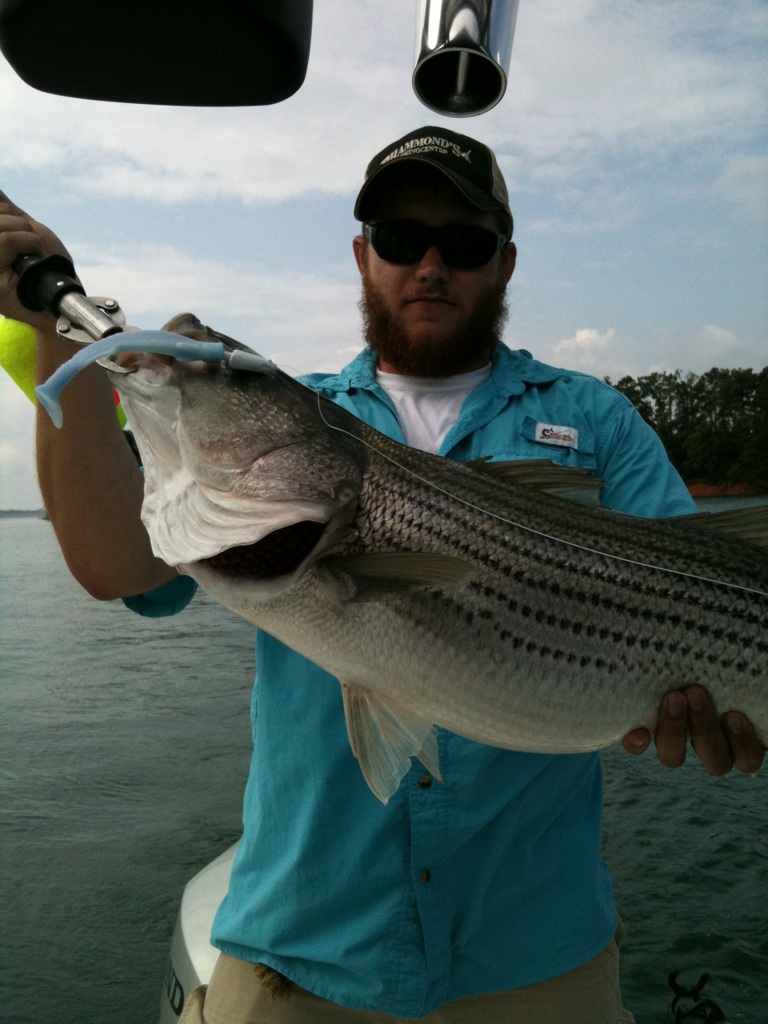
Trolling report from 7-22-2011

I got out with Bruce B aka B-Bro from one of our local fishing forums. Bruce had contacted me about learning more about summer trolling on Lanier. I have been doing some tackle testing on Fridays and ask Bruce if he would like to ride along. Bruce agreed so we hit the water Friday morning at 9 or so. The bite was slow as the fish we marked were scattered and inside the trees. We managed a couple of stripers early and then we had to search for a while to find more active fish. We finally found fish coming out of the trees to feed and we worked the area for the next hour picking up 5 more stripers. Most of the fish came off the Cast Away blueback pattern. The color pattern that has worked well is a pattern I came up with early this spring. It’s a tri-colored pattern with a blend of silver, blue and white. It’s been a great color pattern on various jigs I’ve made. I’ve also been doing well with the Chartreuese pattern. My Cast Away chartreuese pattern is a mix of a special chartreuese color combination with holographic dust in thew finish. The color stands out in the water very well. Here’s a video of our trip out last Friday

I just got an e-mail from a good friend Brandon with a nice 16 lber caught on a 2 ounce Shad Head with a big shad body. Here’s a pic of the troller and the fish:

Trolling Action on 7-14-2011

I got out yesterday to try and track down a few stripers with the trolling gear. It started a little slow but the bite picked up along with the wind. Most of the fish I found were suspended over deeper water and hanging around bait pods out in the wind. I caught most of my fish on the leadcore this morning with a couple hitting the downrigger. I fished the downrigger at 30 feet with a single bucktail and I used double bucktails at 7-8 colors on the leadcore. I think I ended up with 8 nice stripers for the morning. The chartreuese over white and blueback patterns worked the best for me.
One of the reasons single bucktail trolling works well right now is because of the pattern these fish are on. Right now a lot of stripers are picking off single baits straying from a pod of bait over deeper water. I can see small groups of stripers doing the work of busting bait pods up and then single stripers hanging around the outside of the pod reeping the benefits. Stripers are notorious for working together to feed in this fashion. Trolling a bucktail through these feeding areas resembles a straying single bait and the stripers react to the moving bait. The trick is to have the right size and color tones for the clear summer water. Two tone bucktails have worked the best for me. Trolling doesn’t always work well. There are times when it just won’t catch fish. One thing that will improve your success rate is to match the size of what the stripers are feeding on. Right now it’s early in the summer. Bait is still growing and 1 ounce bucktails are just the right size. As summer progresses the bait will get larger. By summers end Stripers will be keying on much larger baits. I look for the trolling bite to be strong through Sept.
The first video is about the tackle and the second is fish catchin. Have a safe weekend!

Fishing report w/videos for 7-5 and 7-7

I had a couple of good days trolling this week. Early week produced a few fish on the south end but Thursday was wide open. It started out slow down by the dam but when the generation cycle started I could see fish coming out of the deep timber to feed on the moving bait. Chartuese and blueback patterns caught the fish this week. In my opinion chartruese is the most effective color under bluebird skies. The blueback pattern runs a close second. I didn’t take any bait with me this week but it looks like the bait droppers are still doing well over bigger schools. Here’s a few videos I took this week.


Early Summer Trolling

The summer trolling bite is starting to pick up and the stripers are moving south. The summertime trolling pattern is starting to set up as I’m seeing more and more fish moving over deeper water and and hanging out around clouds of threadfin shad. Find the bait and start looking for fish hanging around the bait balls. My rule of thumb is if I see more than 4 fish on my graph at one time I’m probably going to fish that area. Here are a couple of early summer trolling videos.


Late Spring and Early Summer Forcast

Late Spring:

As I write this, the pattern on Lake Lanier is changing. The water temps are getting warmer as the days get longer and the fish get deeper. By late May the fish relate to deeper water as well as cruising around in 20 to 35 foot depths. Fish are starting to group up and prepare for the warmer months. Small through teenagers tend to work together on schools of bluebacks and shad on main lake humps and points. Some of the ways to target these late spring fish include just about every tactic in the arsenal. Planer boards will still work, especially in the early morning and late evening. I would use bluebacks out on the main lake and gizzards up the rivers. This time of year if I’m using planer boards with herring, I like to use a quarter to half ounce egg sinker at the swivel to get the bait down into the strike zone. Downlines work well as the fish start relating to deeper areas. As the spring rains subside and the lake water clears, you may want to size down those flourocarbon leaders to 12-15 lb test and be sure to paint those 2 ounce sinkers a flat color to cut down on the window shoppers. One thing I really like to do this time of year is drifting or slow trolling downlined bluebacks on main lake humps in the late evening till shortly after dark.

If you can fish a point that is holding fish early in the morning, pitching a blueback up to a point on spinning gear is a good way to catch a late spring striper mixing in with the spotted bass. Put a little split shot a couple of feet up from the bait to help get the bait down and help with longer casts. U-rigs will work better and better as we get into June. Groups of fish on main lake humps will be a great target for using u-rigs. Two of my favorite colors are white and chartuese. Four arm, two ounce, 20 inch u-rig frame rigged up with 1/2 to 3/4 ounce bucktails with or without curltail trailers will work fine. Since most of the fish will be in 20-30 feet of water you can run your rigs 75-100 feet behind the boat at around 3.0 mph. This should get the rigs into the strike zone.

Early Summer:

Early to late summer is a favorite time to fish Lanier for me. This is the time when I start putting away the bulk of my live bait gear and start concentrating on artificials. Don’t get me wrong, I’ll still be hauling around a few bluebacks to drop on a active bunch of stripers on a couple downlines. In june, one of my favorite tactics is to locate active schools trolling 1/2 to 3/4 ounce bucktails on my downriggers. The 2 basic colors work well for this application. When I find an active school, if the artificals aren’t working well I go to the downlined herring. U-rigs are peaking out during June as the fish are spending the last of early summer on the humps. I think we”ll start seeing fish moving closer and closer to the river channel and the bite will work it’s way south more and more through mid to late June. Using curltails on your artificials is a good option for trolling bucktails on the downriggers and on the u-rigs. As the summer progresses, the fish will start committing to paddletails more so than curltails.

Typically, this is the time of year when just about any tactic may work. With a few stray frontal systems still dropping into our area, during these periods of changing barometric pressure fishing just about any pattern will work in pre and post front conditions.

Spring Fishing Report

Well, spring is here and the freeline and planer board bite is in full swing. We’ve been catching some very nice fish on Bluebacks behind Planer Boards in mid-lake pockets and points. The water has been pretty clear where we’ve been fishing so be sure to set those baits 75-100 feet behind the boards and if freelining baits I like to run the baits a least 100 feet behind the boat. Here’s a little video of our fishing last weekend.

Hints of Spring

Last Sunday Lisa and I were in the backyard taking advantage of the beautiful day we had. While I was working around the yard I caught a glimpse of a few Jonquils coming up through the ground behind my boat shed. Those flowers are a good indicator that the days are getting longer and spring is right around the corner.
I call this time period “the dog days” of winter striper fishing. If there ever was a slow time of year to catch stripers, this is the time. The stripers have slowed down with surface feeding and when they have been eating, they’ve been gorging themselves on the plentiful shad kill. Sometimes we can entice a striper to chase a u-rig or gulp down a quick small bait if it is strategically placed in their strike zone. For the most part, right now the stripers are getting fat and very selective about their eating habits.

In just a few short weeks, things will start to change. We can finally add another pattern to striper fishing on Lake Lanier. As our days continue to get longer, the shores of the lake will begin to warm. The shad kill will be a thing of the past and stripers will start searching the warmer shallow water for food. The baits that survived the kill will move to the warmer shallow shoreline. Stripers will be patrolling those areas in search of an opportunity for a quick meal. This is the time of year I like to get my baits right up in the shallow water. Planer boards are a must for the spring. Stripers will be more in tune with shallow water moving up and down points and waiting in ambush in shallow structure close to the shore. I’m going to be fishing a combination of herring and big trout along the shoreline. That’s where the bigger fish will be.
Keep in mind, when you’re putting out your planer board spread, make sure your planer board closest to the shore is the longest line out. By this I mean when a larger striper hits a bait close to the shore, generally the first thing the striper does is head for the safety of deeper water. If the rest of your planer board spread is out further than the board closest to shore, the striper will gather every other board and bait on his way to deeper water (I hope that makes sense). That will cause a problem when trying to deal with a large striper. I’ve been burned by that mistake before.

In the early spring, stripers have big bellies and big appetites. When they decide to take a bait, it’s usually “game on” with planer boards flying through the air or skimming across the waters surface at break neck speeds. This is a time of year when drags need to be set and leaders need to be in good shape. These fish will be strong and they will test your gear. If there is a warming trend in March, some fish will move up river. One day they will be in the river and the next day they could be miles down lake. With the water warming, larger fish that don’t go up river will be on the move to stake their claim to a point or pocket waiting for an opportunity for an easy meal. Herring will become a popular bait for these fish. Another popular bait will be Gizzards, really big ones as well as BIG trout. Just remember, when fishing with big bait, make sure your gear can handle the kind of fish that eats big bait. You need big leaders. I use a 20lb Vicious flouro leader with 30lb+ Big Game. Sometimes I don’t even use a leader with really big baits. The bottom line is when bait fishing in the spring, be ready for some great pull downs and pull backs.

Using artificials during the early spring can be a lot of fun. Not only during the day but Bomber fishing at night can be an eye opening blast. My first suggestion for artificials is keeping my old standby the bucktail tied and at the ready. My color of choice would be white or off white in a half ounce size. Casting bucktails in shallow water a dawn is an effective way to hook up with a nice striper or two. I like working points with bucktails in the spring. A lot of times when a striper is on a point, he becomes very territorial and will strike a passing bucktail just for trespassing on his turf. The outer edge of grassy areas will often hold an early morning striper waiting for a bait or two to leave the confines of the grass line. I try and cast just into the weed line and work the bucktail back to the boat with a quick but steady retrieve.

Topwater type swimbaits are a good option in the shallows also. Just cast up onto the point with your topwater bait and slowly retrieve creating a “V” wake on the water. I recommend holding your rod very tightly when fishing “V” waked topwater baits. The strikes can be quick and brutal.
I know we’re all pretty burned out on u-rigs, but they will still work well in early spring. Fish will be moving up and down columns of water from 35 feet up to 2-3 of water. U-rigs work well in the deeper staging afternoon areas and the shallow points in late morning. For me, cooler cloudy days are days I generally break out the u-rigs in the spring. A color that will start to work well in the spring is Chartreuse. To me the Chartreuse color is more of a spring and summer color. I’d rather pull small baits in the shallows than pull u-rigs in the spring, but they will definitely work at times.

These are a few of my thoughts as I see signs of spring approaching and I’m looking forward to some great striper fishing!