Pasta has always been a must for me, especially as a competitive distance runner, the carbohydrates from pasta was always a must the night before a race or a long training run. In this recipe I’ve combined a hint of Louisiana with a lot of cheesy goodness stuffed inside pasta. Enjoy!
Ingredients:
12-ounce bag of clean cooked crawfish tails
1/4 stick of melted margarine (optional)
1/2 cup of chopped sweet onion
1/2 cup of fresh or thawed chopped broccoli tops
1 tbsp. minced garlic
1tbsp. Worcestershire sauce
1 tsp. Cajun seasoning
1 tsp. Old Bay seasoning
1 8-ounce pack of softened cream cheese
1 jar of garlic alfredo
1/2 cup grated mild cheddar cheese
1/2 cup of grated parmesan cheese
1 box of large pasta shells
1 tbsp. parsley topped for garnish (optional)
salt and pepper to taste
This recipe was created from me digging around the kitchen pantry to put something together for dinner years ago. Since I first started stuffing pasta shells, I’ve used chicken, shrimp and ground beef as well as crawfish. By all means make adjustments, additions or subtractions as necessary.
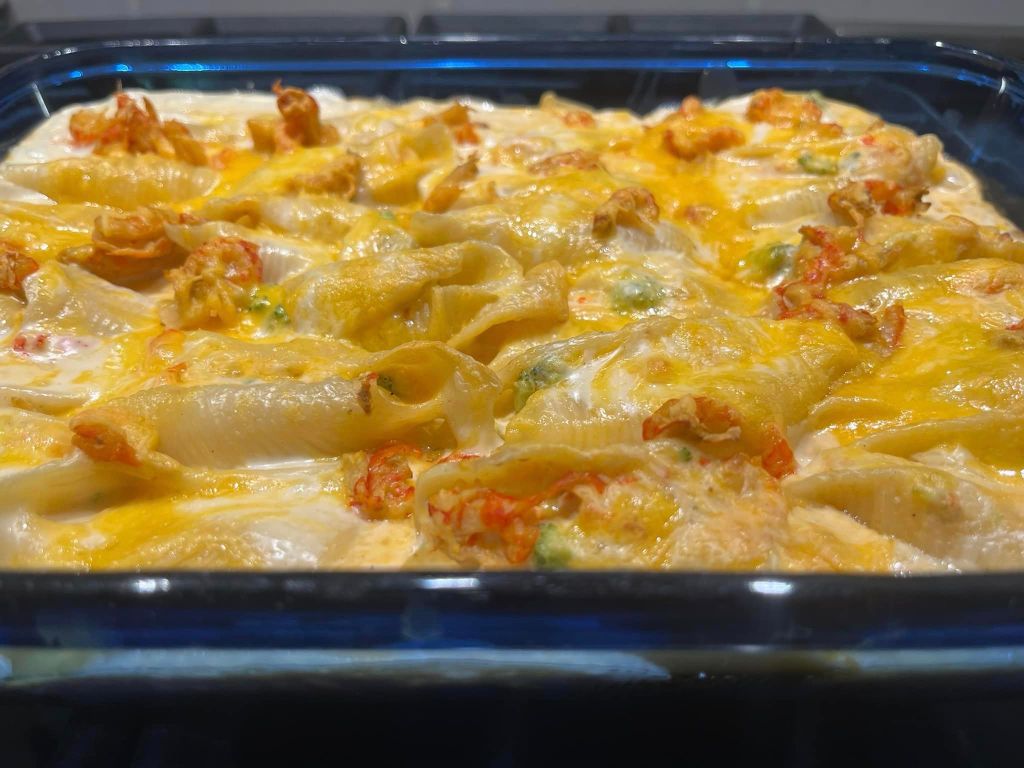
First, I boiled the pasta according to the directions on the box, stirring gently so you don’t tear the shells when they boil. I also preheat the oven to 375 degrees. Next, I mix my ingredients for the stuffing adding just about everything listed above except the shells, but I save some crawfish to use as topping at the end. I only add a quarter of the jar of alfredo to the stuffing mixture and one quarter of the jar to coat the bottom of my 9×13 baking dish. Once everything is mixed, I start stuffing the shells and lining them up in the pan.
Once I’ve filled the pan with the stuffed shells, I top it off with the remaining alfredo sauce, the remaining crawfish tails and lightly cover with some grated cheddar cheese.
I bake them uncovered at 375 degrees for 35 minutes and let it cool for a few minutes before serving. I usually serve it with garlic or French bread on the side. Enjoy!
It had to be 15 to 20 years ago when I was fishing a tournament in a local Lainer striper club. I’d been in the club for a year or two and we were having our monthly club striper tournament on Lanier. Our club had a blind draw every month and boaters were paired up with non-boaters according to who you drew for the tournament. I liked the blind draw concept because you couldn’t fish with the same partner twice in a 3-month period, so everybody got to learn from a lot of different anglers in the club. I was a boater at the time and I drew a guy by the name of “Dale Sprayberry” to be my partner that month. I’m guessing it was a cool fall morning and we were just finishing up our spread of freelines, downlines and planer boards to start our first morning run shortly after dawn. I still remember it pretty plainly, even after a lot of years have passed. We were fishing the Longhollow area of the lake, and we were moving along slowly with the trolling motor on autopilot. The boat was pointed toward the west, and I was sitting behind the wheel of my Carolina Skiff staring up at what remained of the moon setting in the western sky. It was right then that Dale, who was seated right next to me, turned to me and said, “you know Jim, the old timers say that when the moon and the sun are in the sky at the same time, the fish bite the best”. At the time, I didn’t know Dale very well other than the fact that he was a karaoke sensation and sang a lot of country western music. I knew Dale was well respected in the club and had been around a long time, so I considered him a pretty knowledgeable striper fisherman. After Dale made the statement, I acknowledged what he had said, and I went back to looking at the moon. It couldn’t have been 2 minutes later I heard a loud popping sound and before I could figure out that the popping noise was the 25lb Big Game line popping out of the loop knot in the balloon where we had a big gizzard shad attached, Dale was on the rod like a rat on a Cheeto. We had our first striper of the morning, and it was a big 19lber on a balloon with a freelined gizzard shad. Shortly after that we followed it up with another high teens’ striper to give us our limit and we never caught another striper that day. We wound up winning the tournament with our 2 big stripers and Dale brought to my attention that once the moon had set the bite had died. I never forgot that day or that statement Dale had made, and to this day, when the sun and moon are in the sky at the same time, I call it “The Sprayberry Effect”.
This week wasn’t a very good week for me in terms of time on the water but for the 2 and a half mornings I was out, the fishing was good for me. This week the Sprayberry Effect was in full swing and every time I was out this week the moon was out too. Last week I couldn’t buy a bite before late morning but this week the fish were biting as soon as I hit the water early in the morning. There was a lack of bigger topwater fish in the mornings this week but there were far better numbers early, than the week before. Last week when I was making my run up lake in the early morning hours, I may have boated a fish at 10-15% of my stops and the number increased as the sun got higher in the sky. Last week, by afternoon the success rate would climb to 60-75% by early afternoon whereas this week the early morning success rate was around 50-60% and it jumped to nearly 90% by early afternoon. I’m still just running and gunning the Gunfish and with the exception of a few nice spybait fish this week, all of my fish were on the 95 Gunfish in Aurora black again. I had a lot more dinks playing spoiler this week and when the fish school on the Gunfish, it’s no telling whether a 10-inch fish is going to hammer it or a 4lber. I’ve caught both on back-to-back casts this week. Once again, this week the key was the wind and fishing the areas that had wind. There were some places on my route that were very slack and if that was the case, I threw the spybait a bit. I can tell that the fish are showing more of an interest in the spybait, which is par for the spybait bite. I can remember a year not too long ago that I caught some of my biggest fish in August and early September on the spybait so I fully expect that bite to come back around for me soon. I tried to fish productive areas with wind this week and I’ve had to eliminate some unproductive waters due to a lack of fish. I’ve been kinda bummed because some of last year’s big fish holes just aren’t producing this year so I’m doing a lot more ranging out and looking for new stuff to fish this summer. I’m still just using mapping and my target areas are underwater points and humps out on the main lake followed by the community holes in the creek on my way back in for lunch.
Same deal as the last report, I’m approaching the target area from up wind and casting the Gunfish down wind. I can really get a long cast, throwing down wind with 15lb braid and an 8-foot flouro leader and the more time that little Gunfish is in the water, the more chance you have of catching a fish. Bringing the Gunfish against the grain of the chop creates better water disruption and I’ve been moving it pretty fast. Reason being, I don’t want the fish to get a good look at the bait, but I want him to react to it and I achieve this through skipping and doing a quick splashing ‘walk the dog’ action during the retrieve. In most cases the bigger fish would run it down before the smaller fish but during the early morning hours it was generally smaller fish that gave it all of the attention and the bigger fish wouldn’t show up till around lunchtime. When the bigger fish start showing up it’s a good idea to check that line very frequently because those 4-5lbers really test the drag system and the line quality with bulldog runs. Good gear is a must for these big summertime spotted bass so keeping your line fresh and drag set will take a lot of worry out of fighting a good fish.
This is the time of year that you need to be watching your surroundings because surfacing fish can give away locations and that’s how I’ve found my biggest fish for the past 2 weeks. Some of my catches have been sight catches over the past few weeks and keeping my eyes peeled while running up lake or keeping my head on a swivel while I’m fishing an area is a good idea to increase your catch rate. Besides the topwater and spybait, this is the time of year that the spoon will come into play. Last year I used a 5-inch Georgia Blade spoon out on the deep ends of points to net a few fish early in the morning and then here and there throughout the day. If you’re not familiar with using a spoon in the summertime, it’s fairly easy to learn and it can be a very productive way to catch late summer bass, especially when it gets tough with the swimming and topwater stuff. I had the video camera rolling last year while I was spoon fishing and got a nice one on video using a Georgia Blade spoon. The video gives you an idea of how I’m using the spoon.
I had to pull my boat out of the water this week because a battery died on Wednesday morning and I need to do a few other things like maybe getting some new electronics very soon. Fishing without sonar is a challenge but it wasn’t long ago that we were all fishing without the kind of electronic technology we have now so it’s like dialing it back 20-30 years. This time of year, my fishing outings are reminiscent of some of the ultra-hot days out in the marsh of Louisiana, site fishing for redfish. Lots of humidity in the air and it was miserable out in the beating sun but connecting with a good redfish that you saw tailing along the shoreline can make the miserable August heat a lot more bearable. I feel the same way about fighting a good bass that had just exploded on my topwater bait out on the main lake in the middle of the afternoon heat. To me, it makes it all worth it. There are several different tactics that can work on the lake right now. You can go shallow or deep all over the lake right now. There are good fish out on the main lake, at the deep creek mouths and all the way back to the backs of the creeks.
This week we’ve spent just about every afternoon down at the dock catching bream with our grandson and just about every day while bream fish we’ve seen multiple big bass coming into the cove for “hit and run” activities on the bream. I gotta hand it to these bigger spotted bass, when they come into the cove, it might be one or it might be a few, but they aren’t there to sight see. They’re usually pretty swift when they attack the bream on the shoreline and it’s pretty vicious as it’s usually over in seconds and the spotted bass are gone. They don’t stick around for an encore or any secondary feeding in the cove, they get in and get out swiftly. On the other hand we have the bigger largemouth that come into the cove and they are much slower and much more curious of people. Where the spotted bass are more skittish of people standing on the dock, the largemouth will come over and say hi on some occasions. For some reason the largemouth will come into the cove, and if I’m standing on the dock, they will usually circle around the dock a little and then swim right up to where I’m standing and look at me. I’ve never seen a spotted bass do that, just the largemouth but it’s pretty interesting to see the different characteristics of the two. I guess my point is that bigger bass are cruising the backs of the creeks in very shallow water feeding on bream in the pockets all day just about every day during the summer. I’m more of a summertime offshore open water guy but I could probably make a good day out of fishing shallow and targeting some of the bigger bass cruising the backs of the creeks right now.
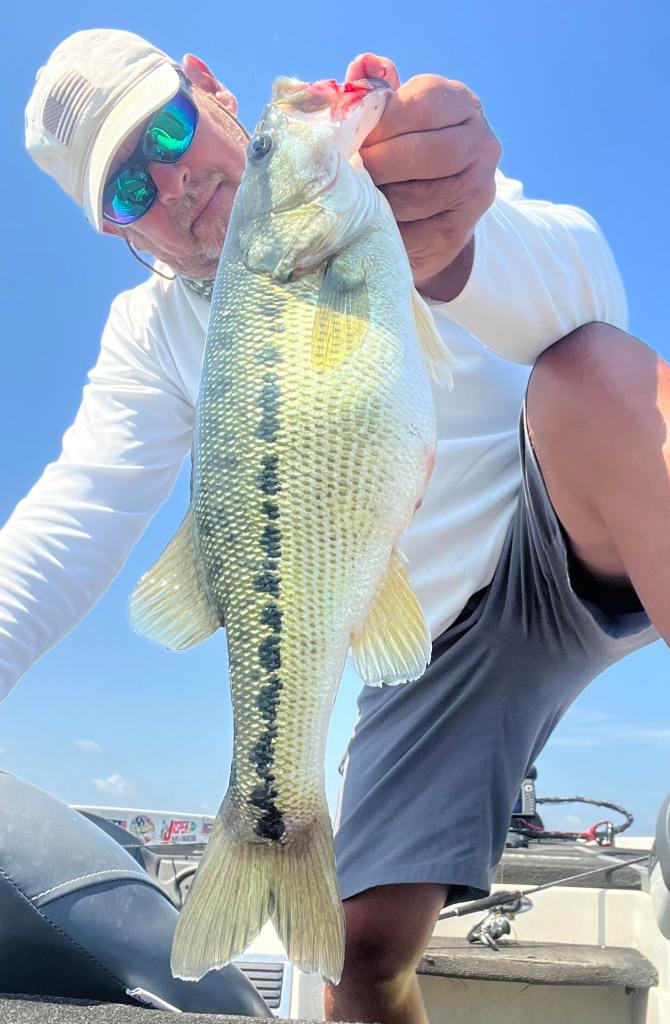
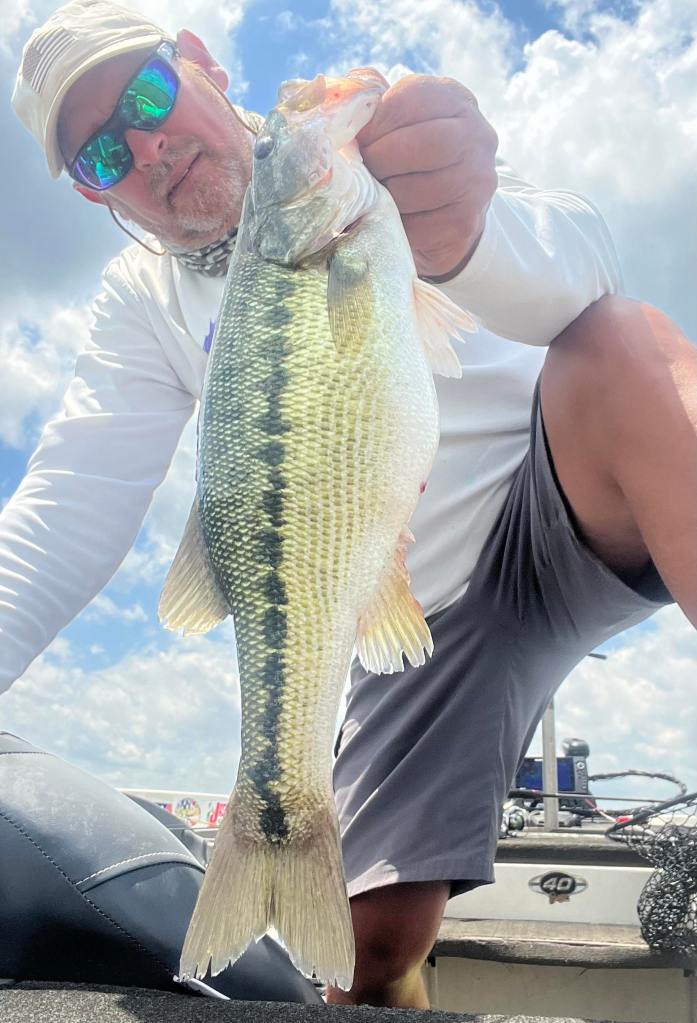
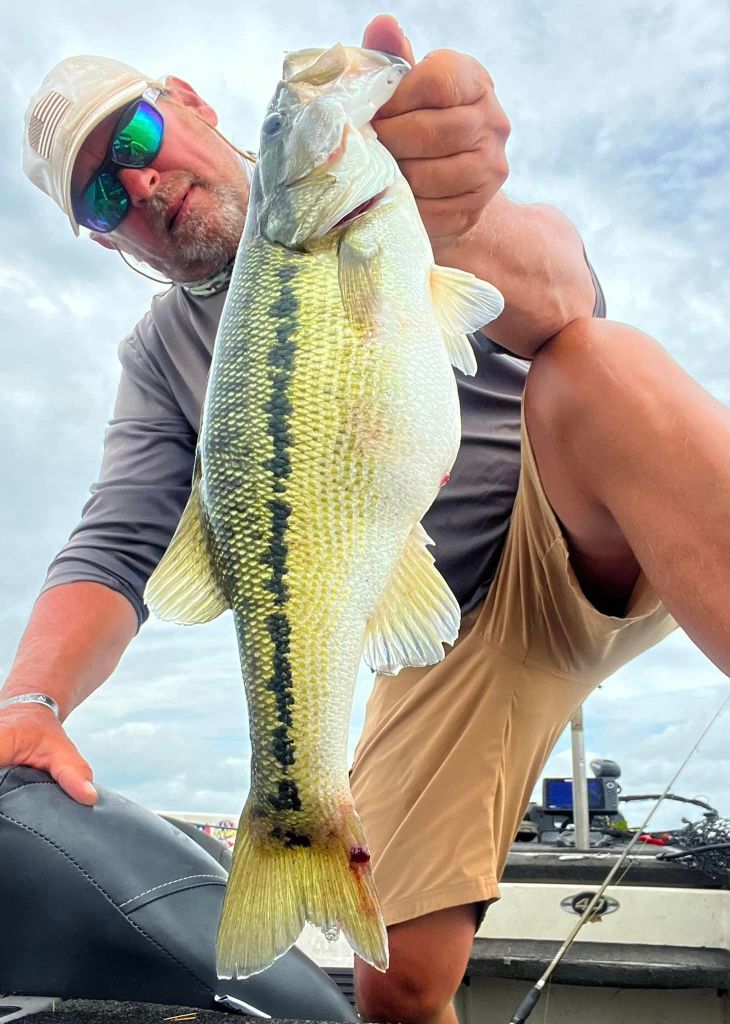
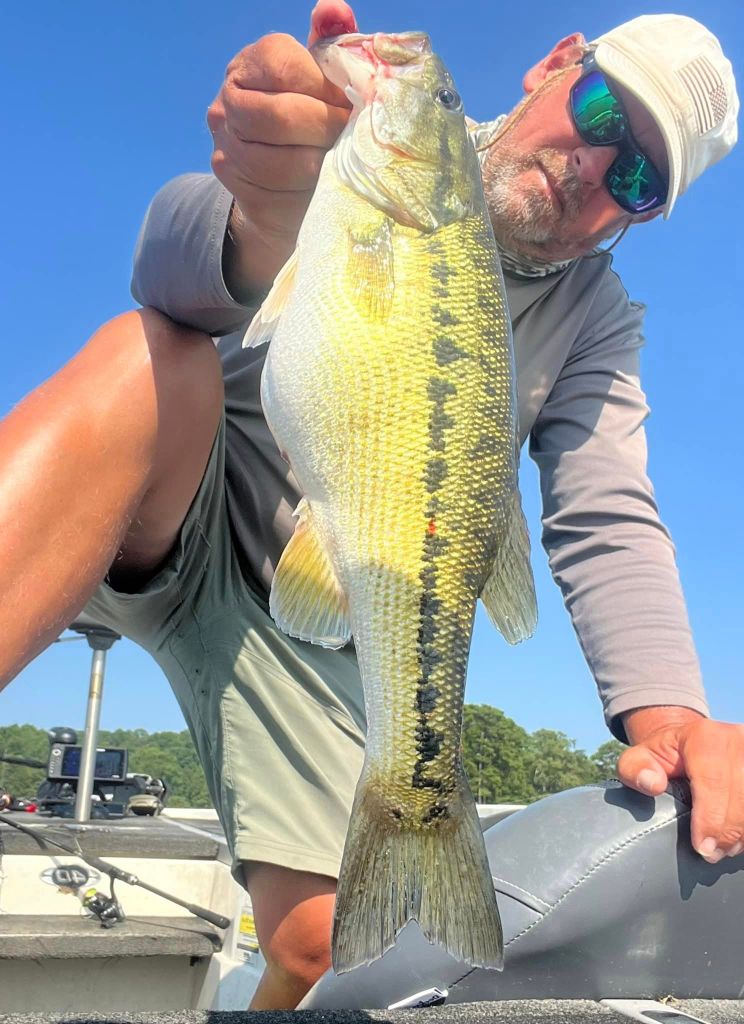
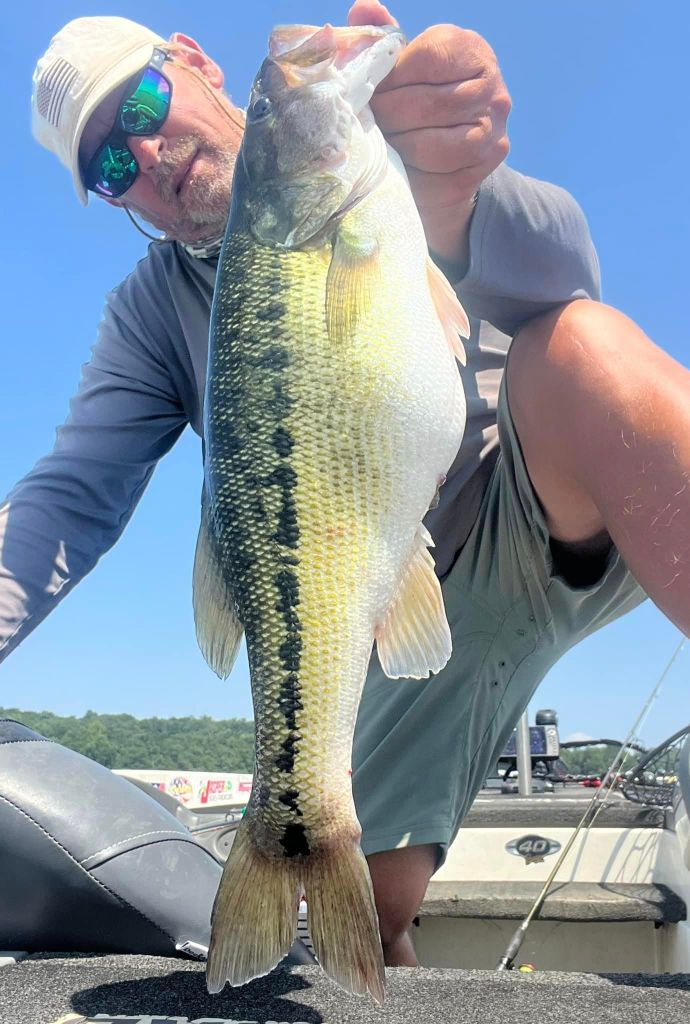
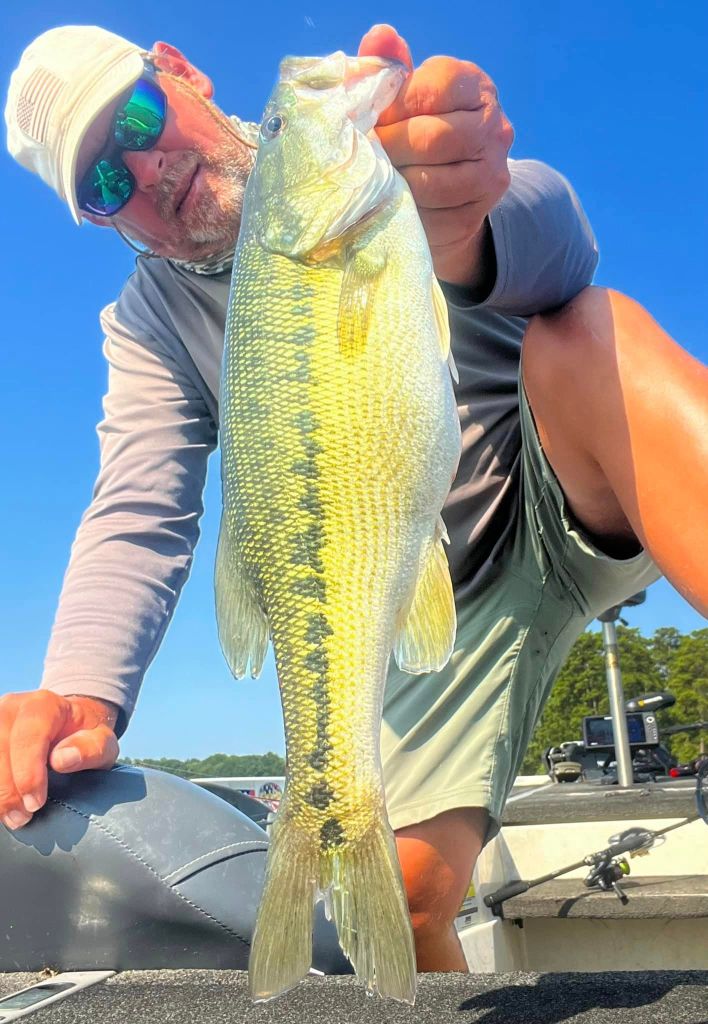
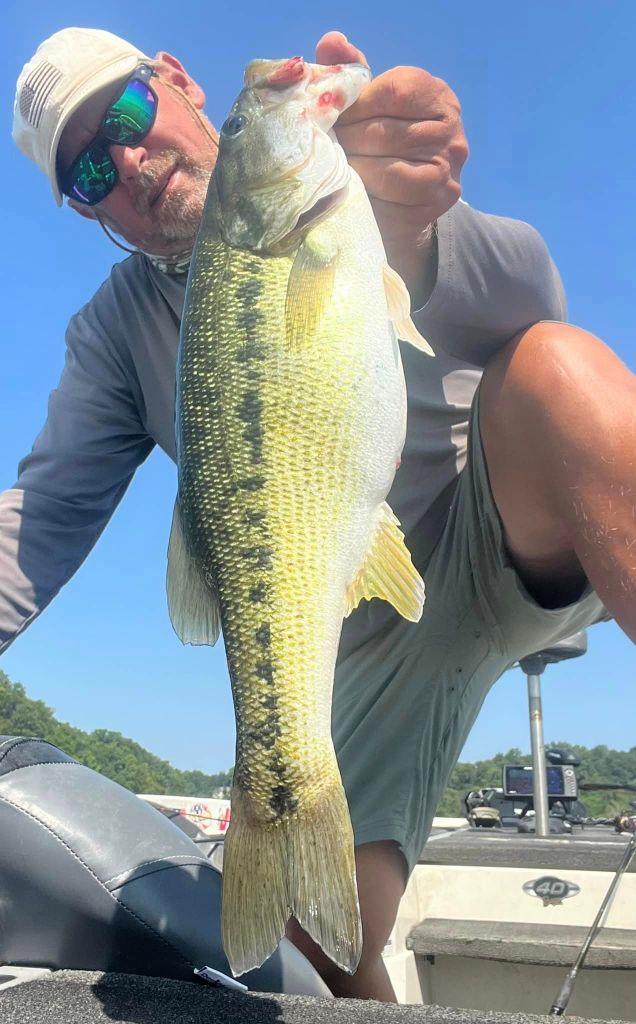
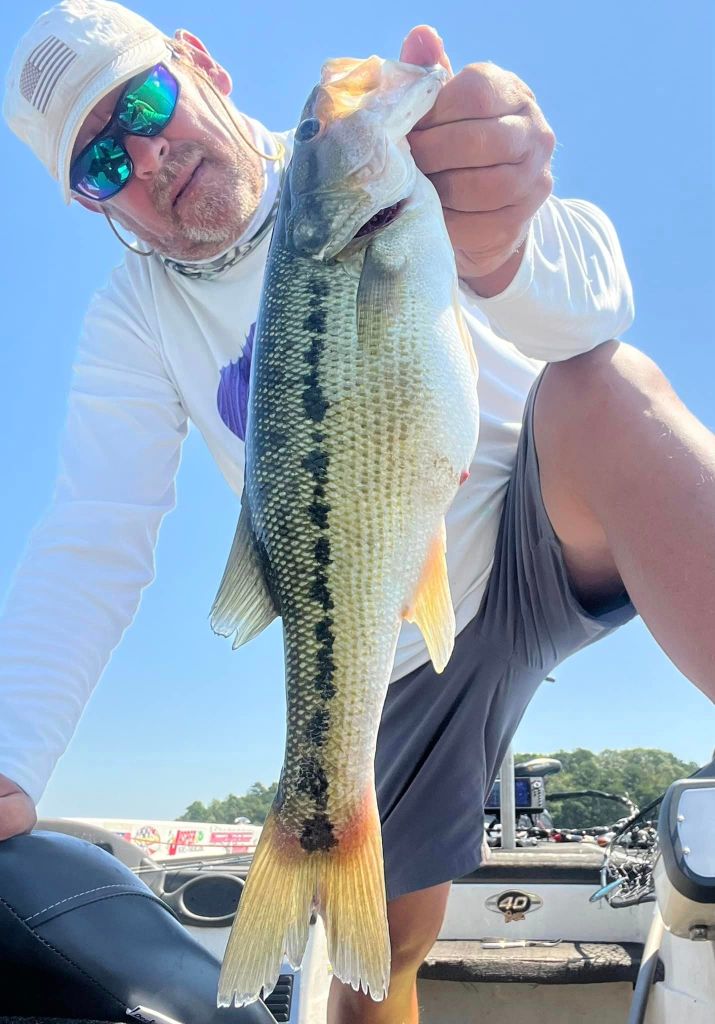
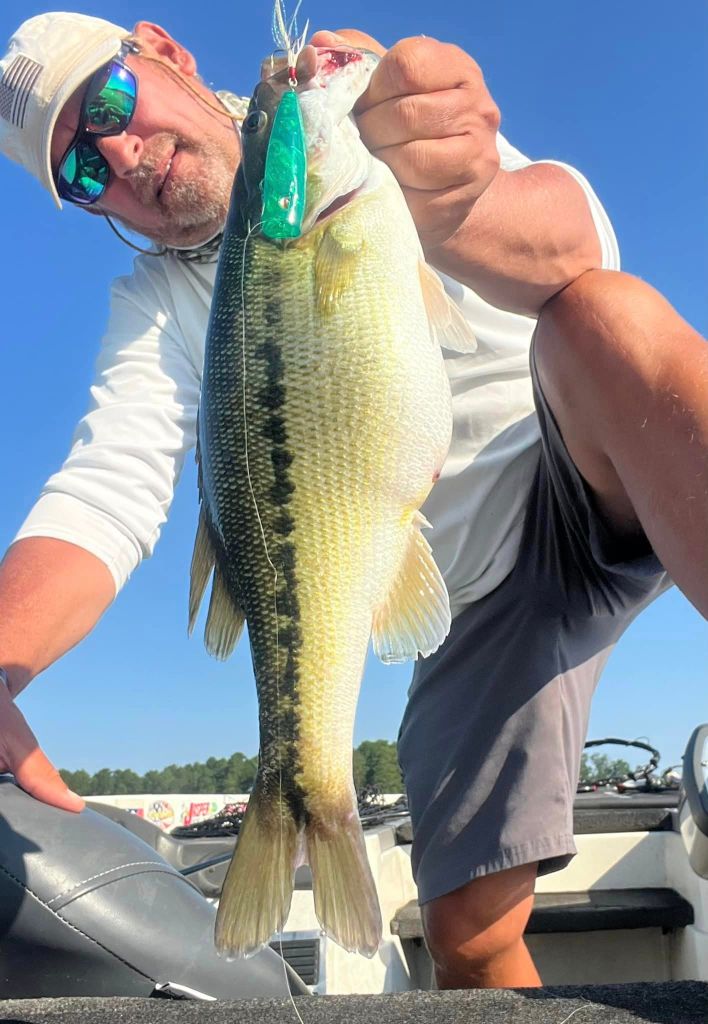
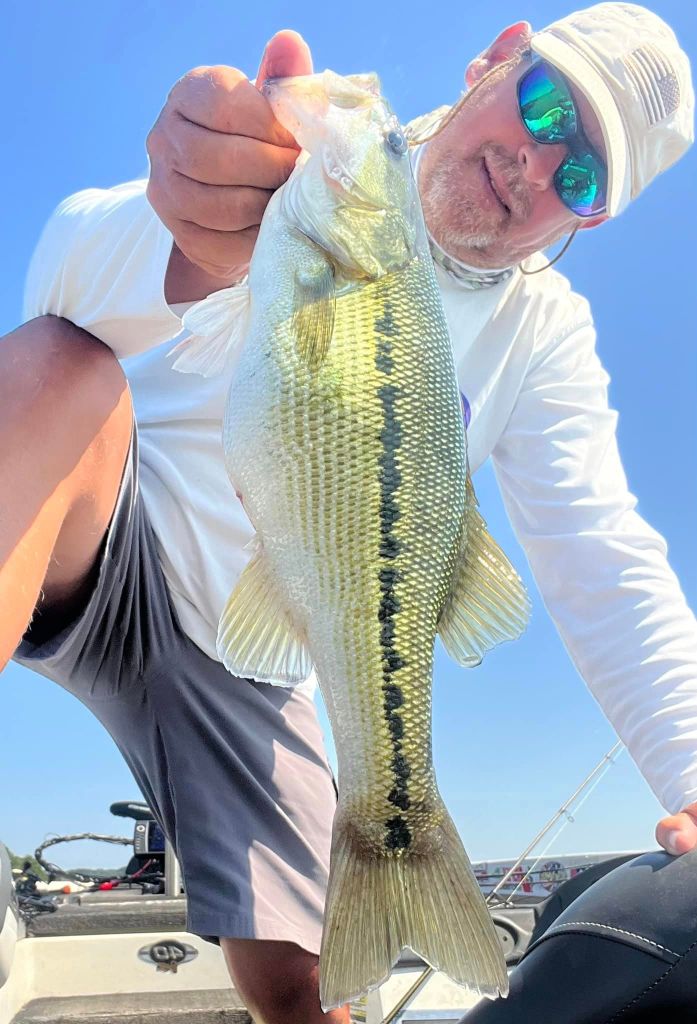
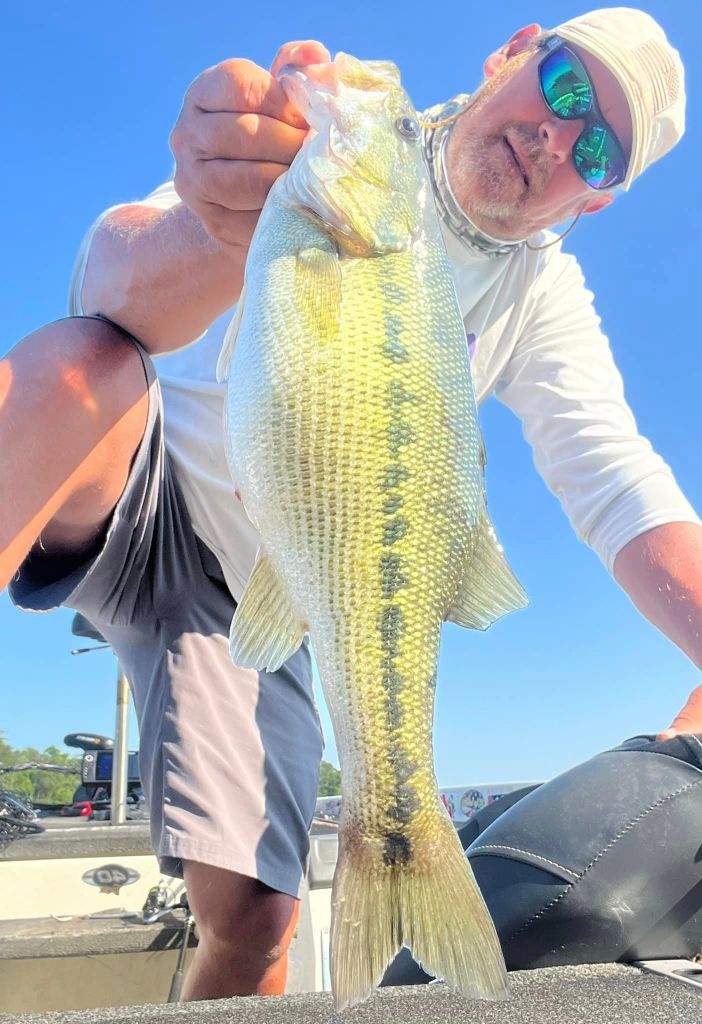
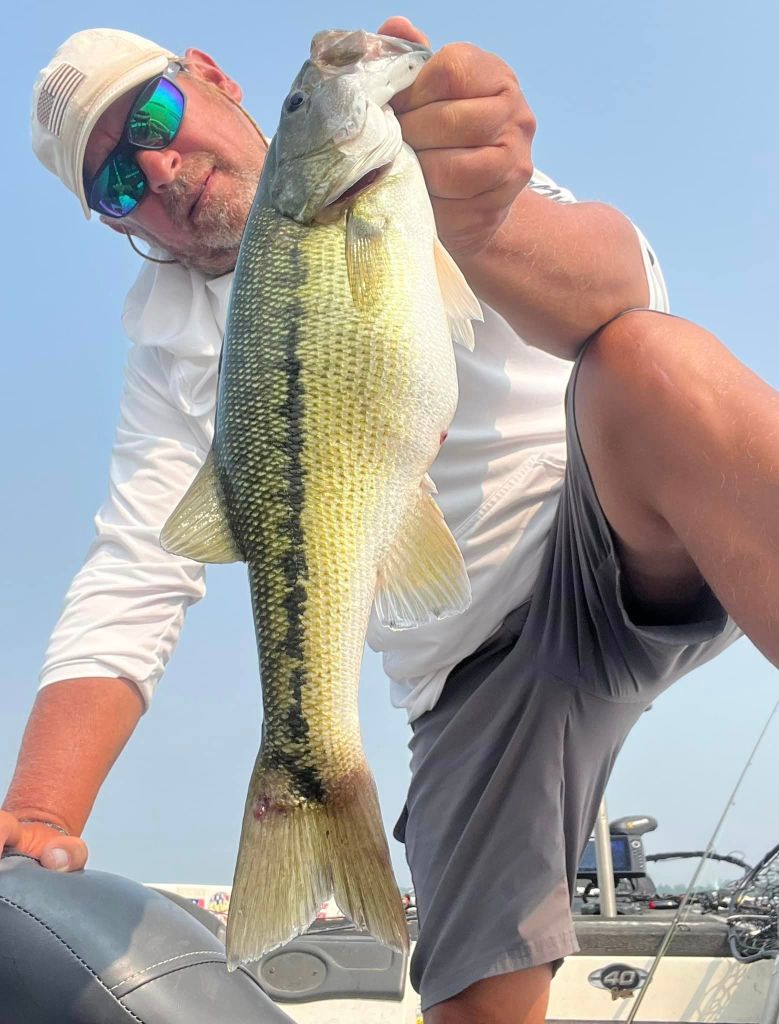
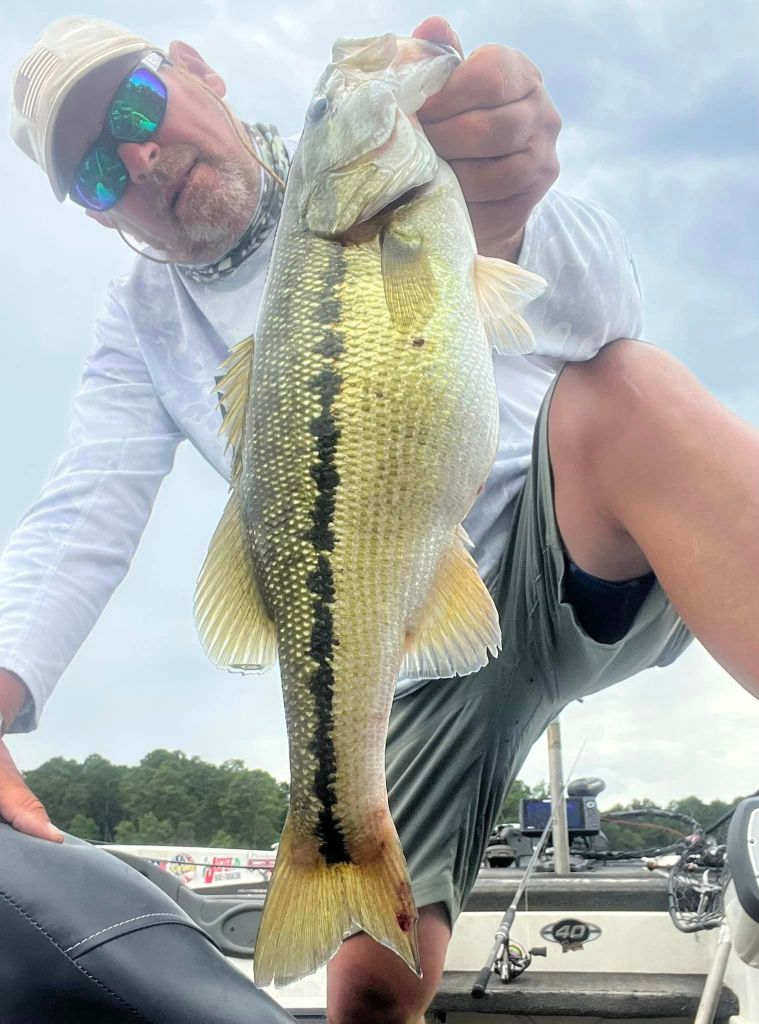
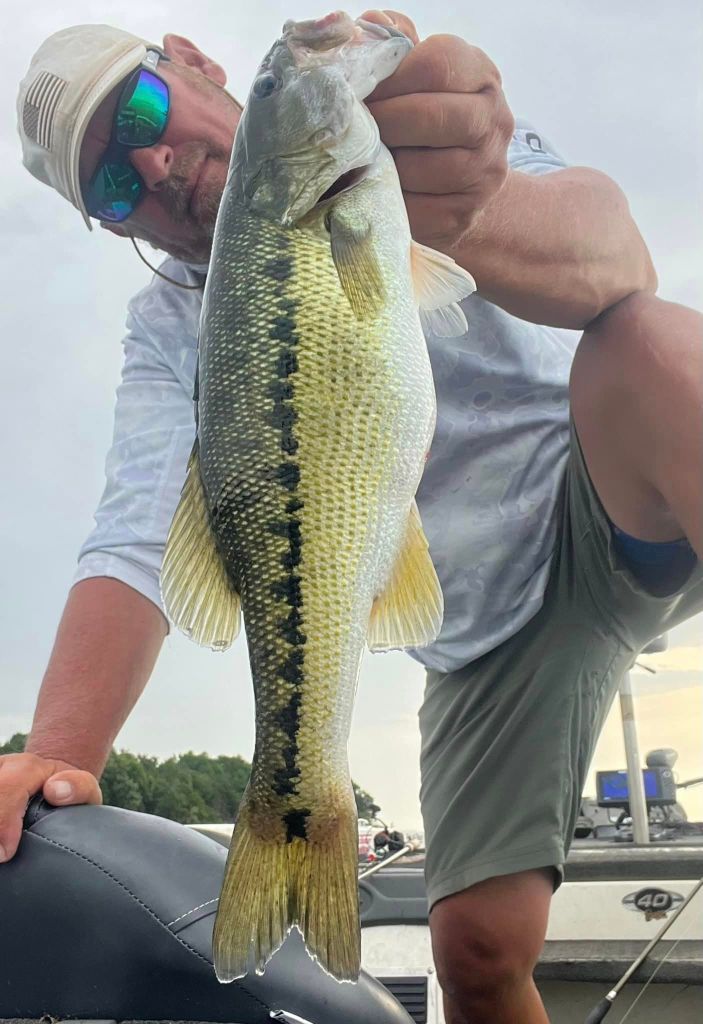
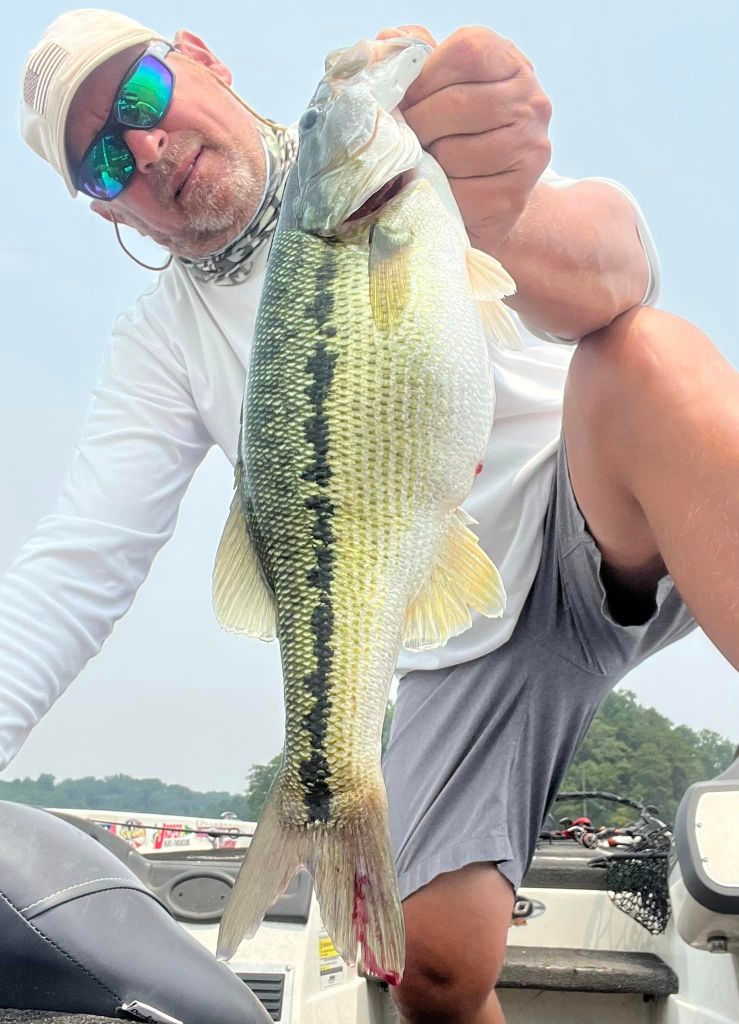
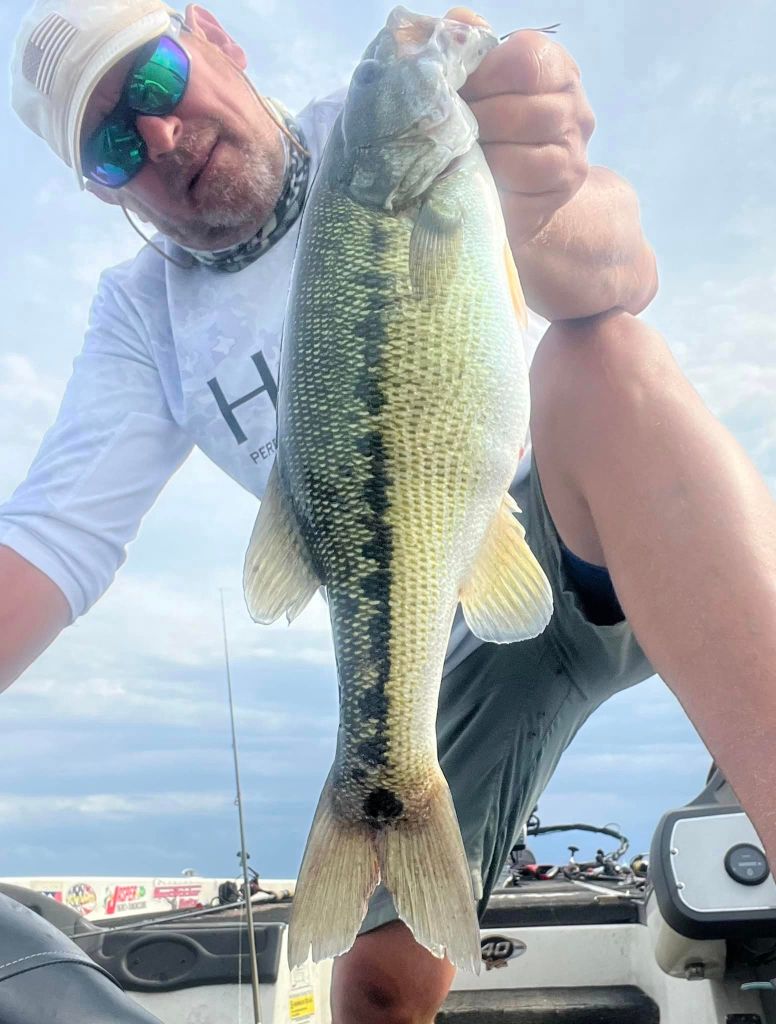
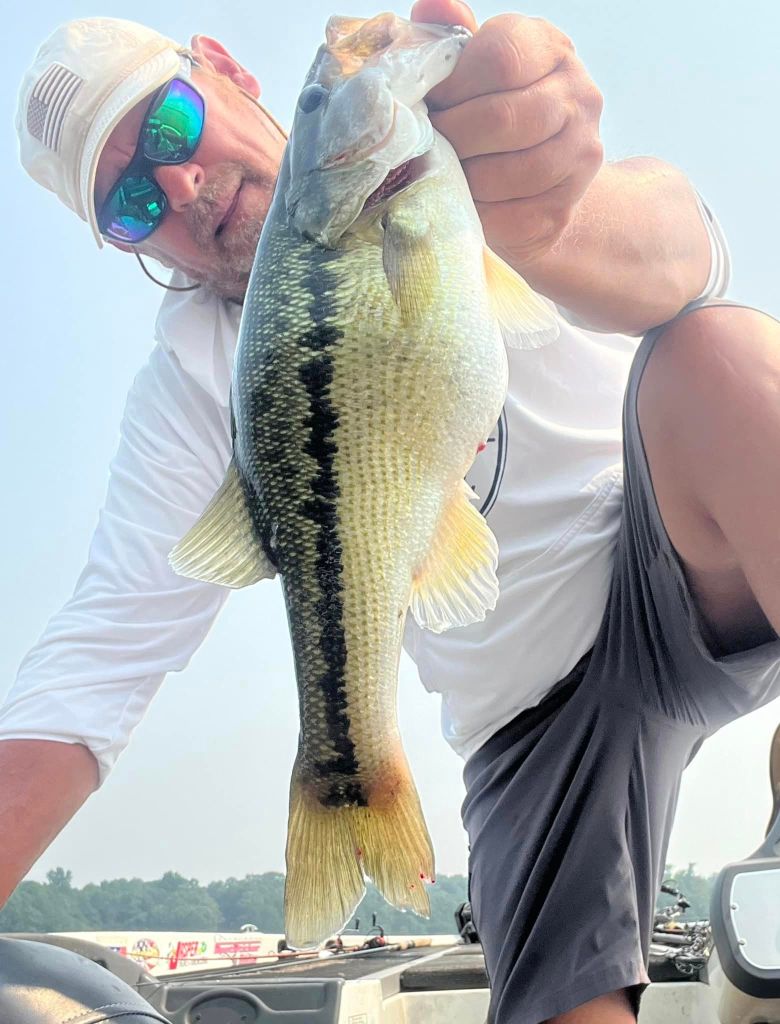
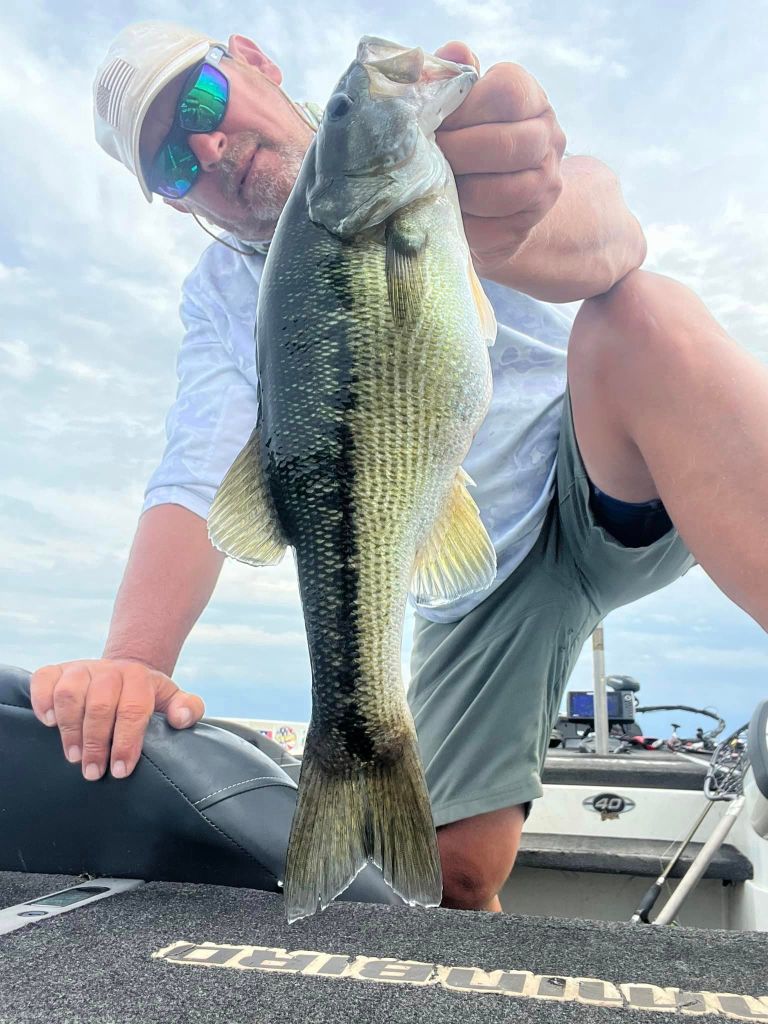
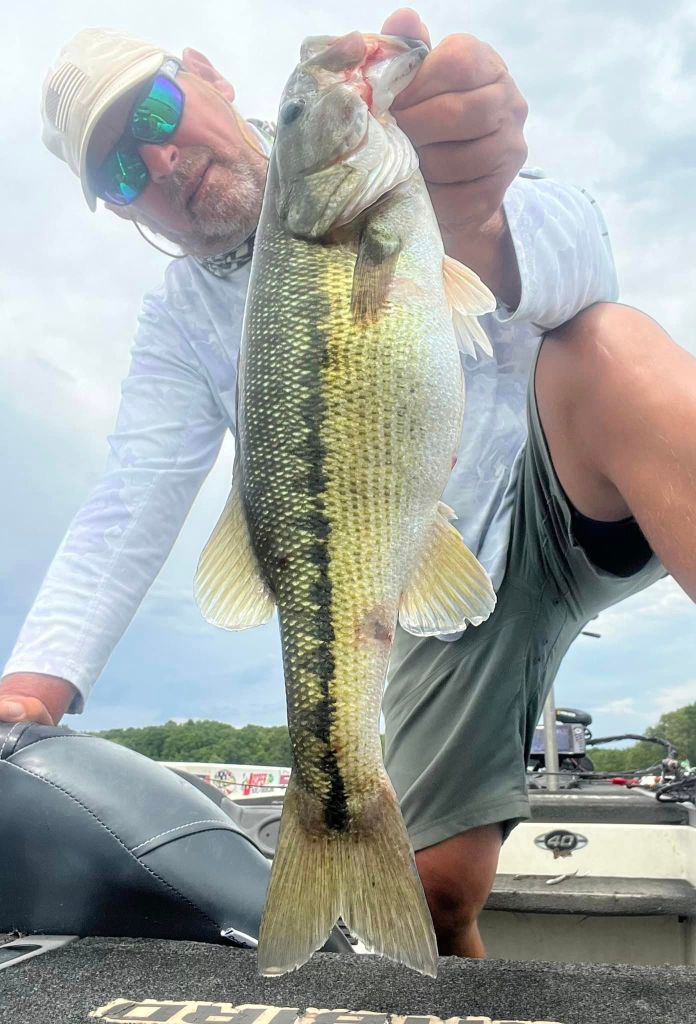
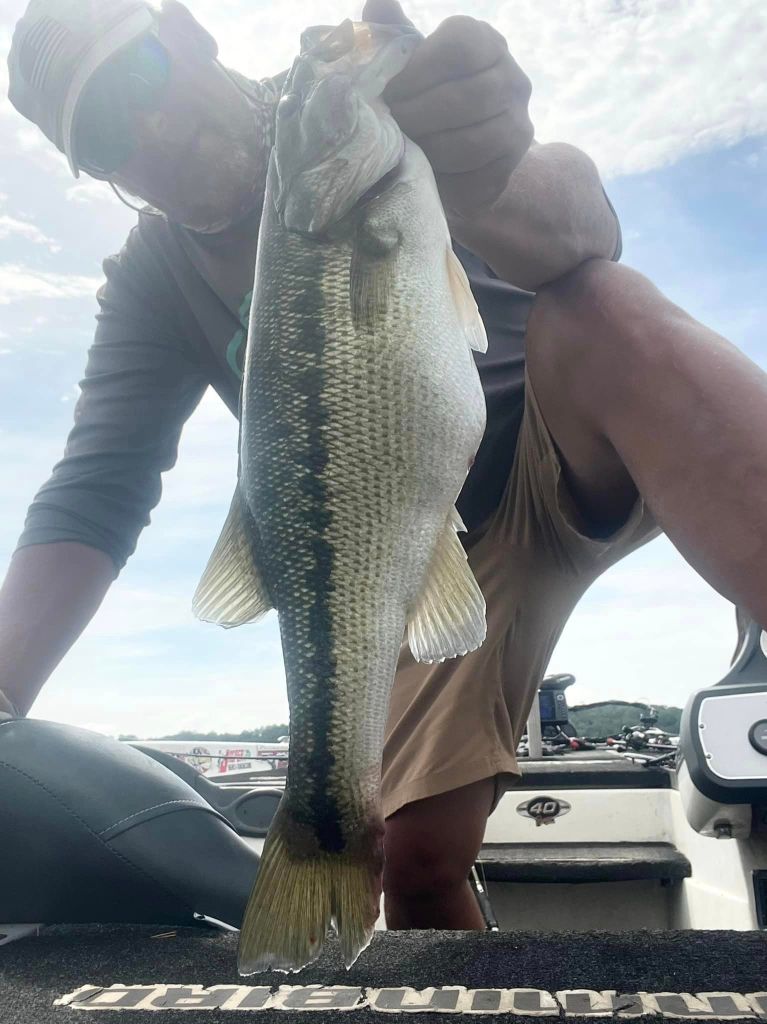
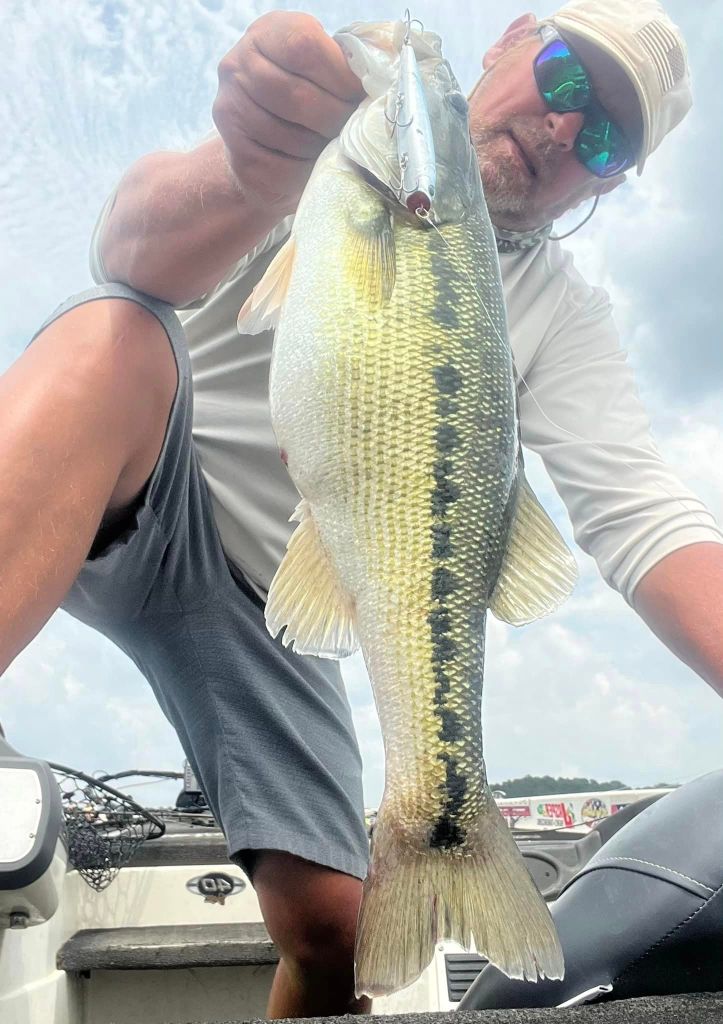
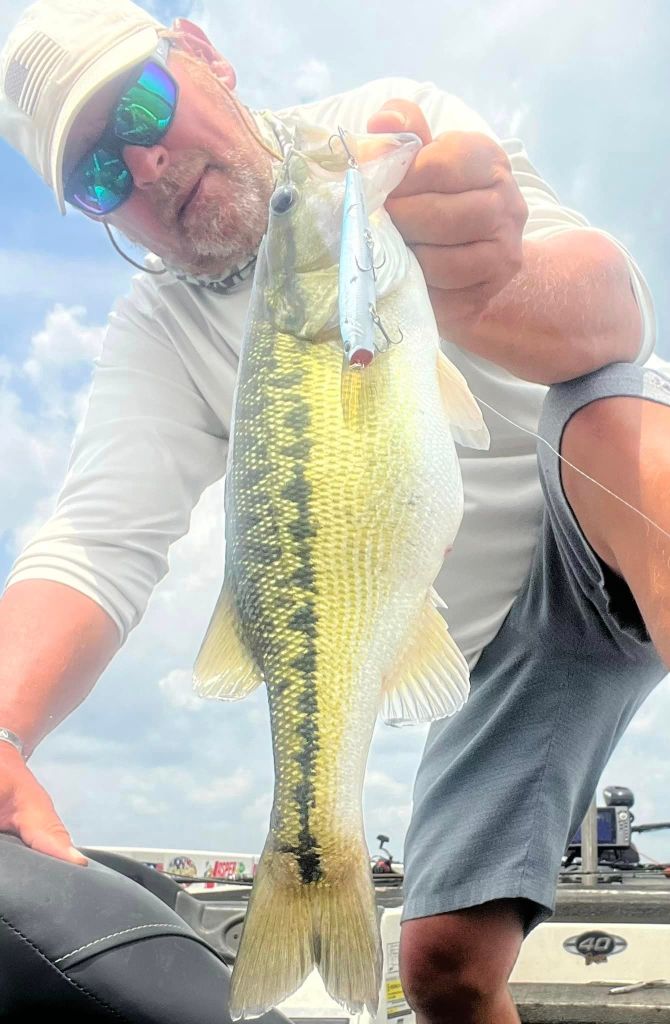
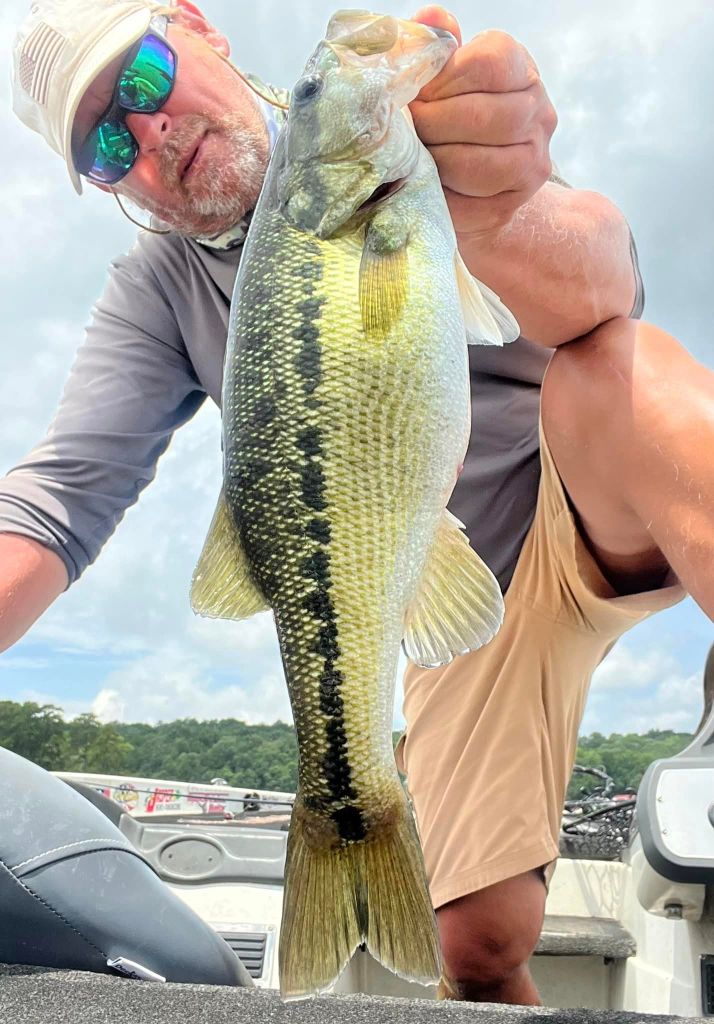
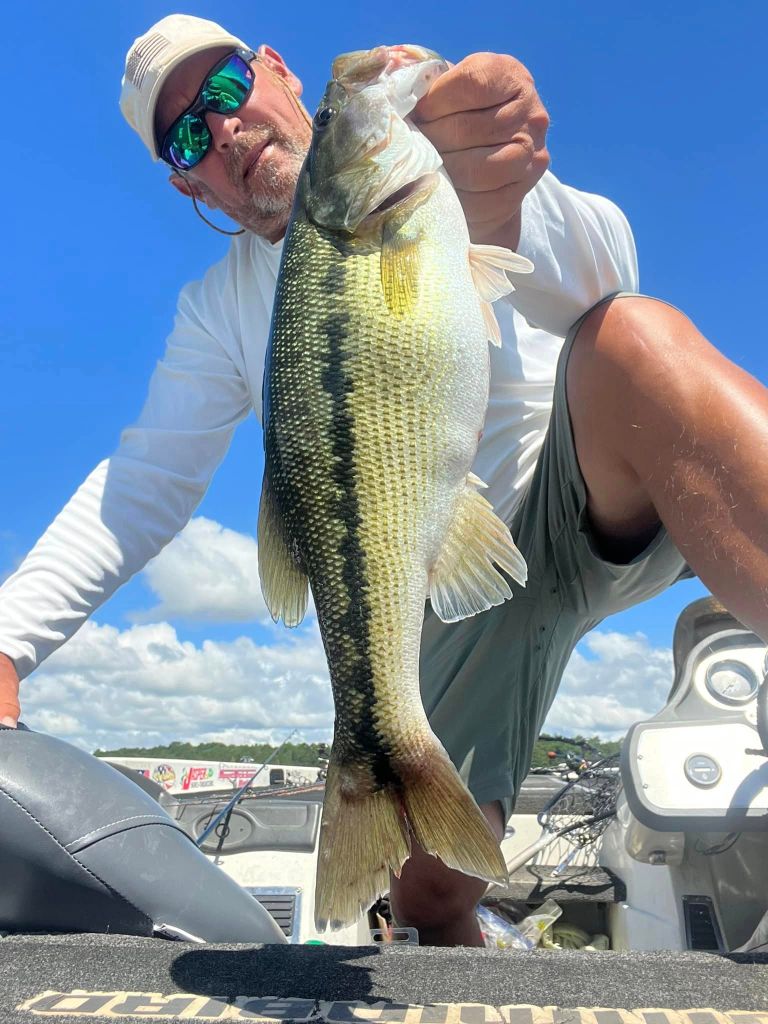
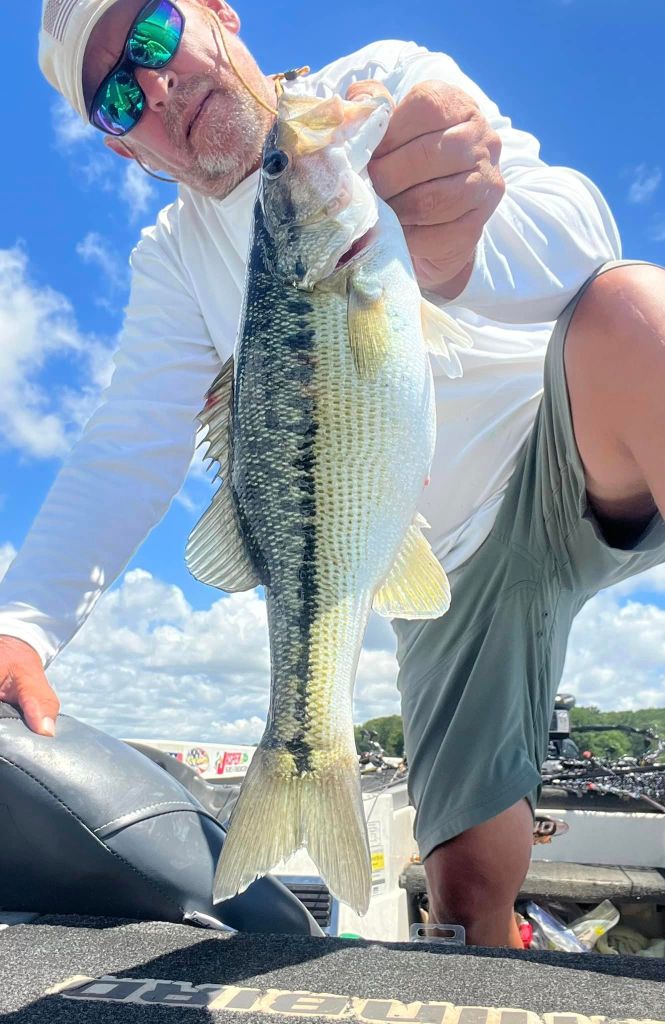
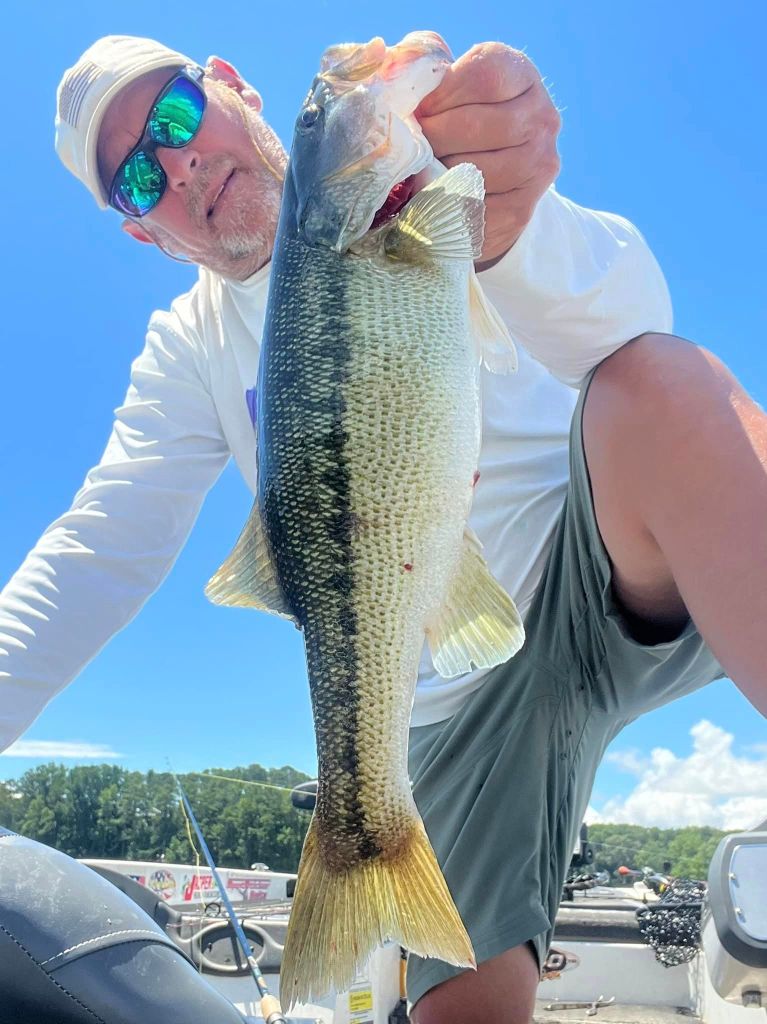
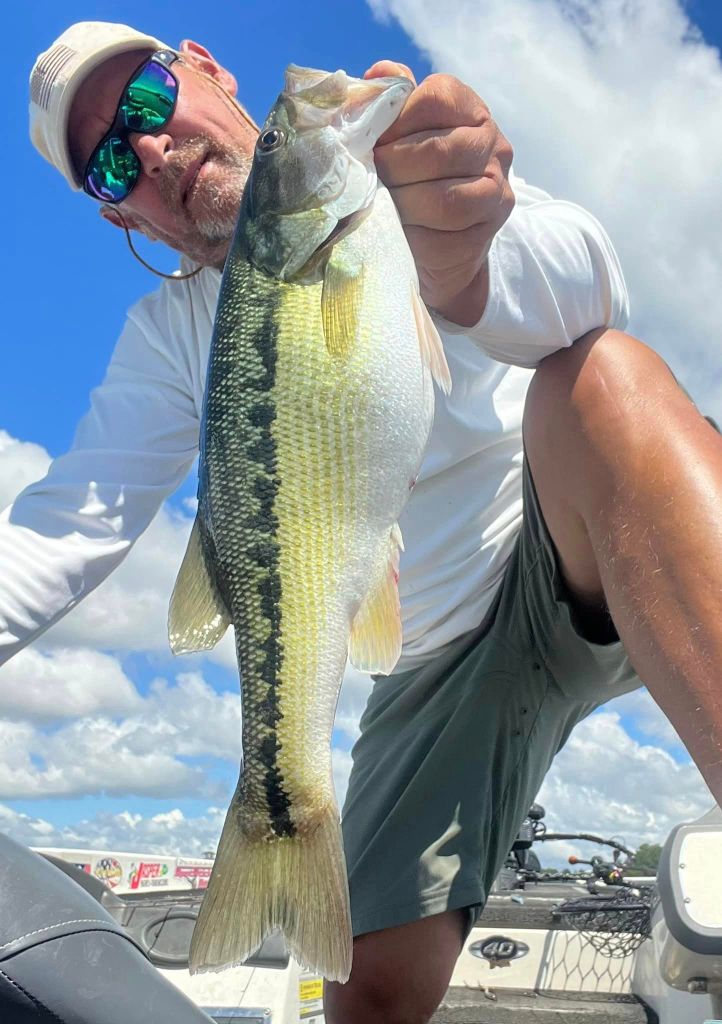
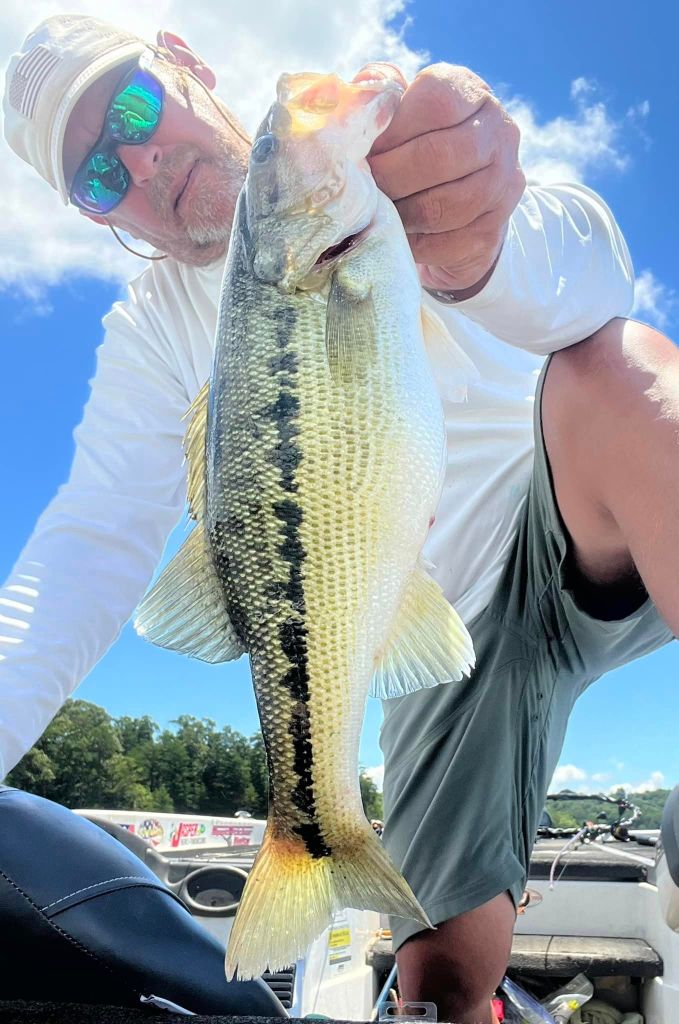
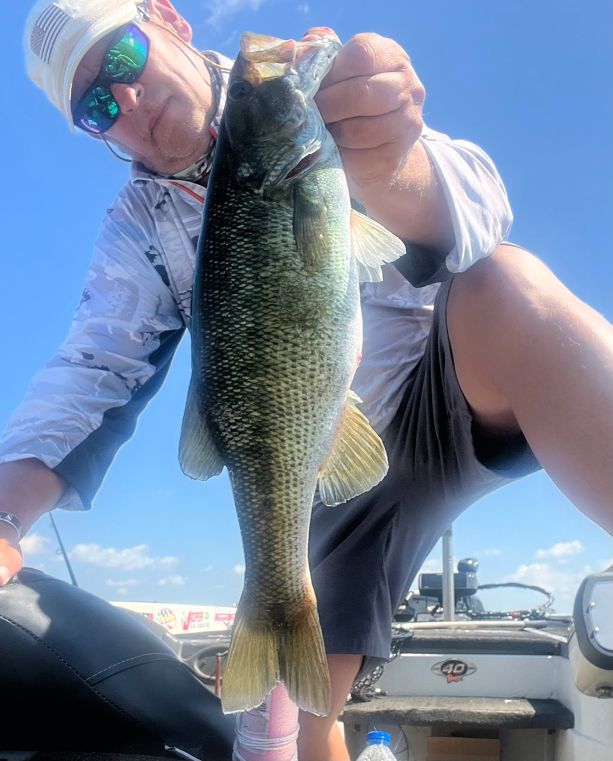
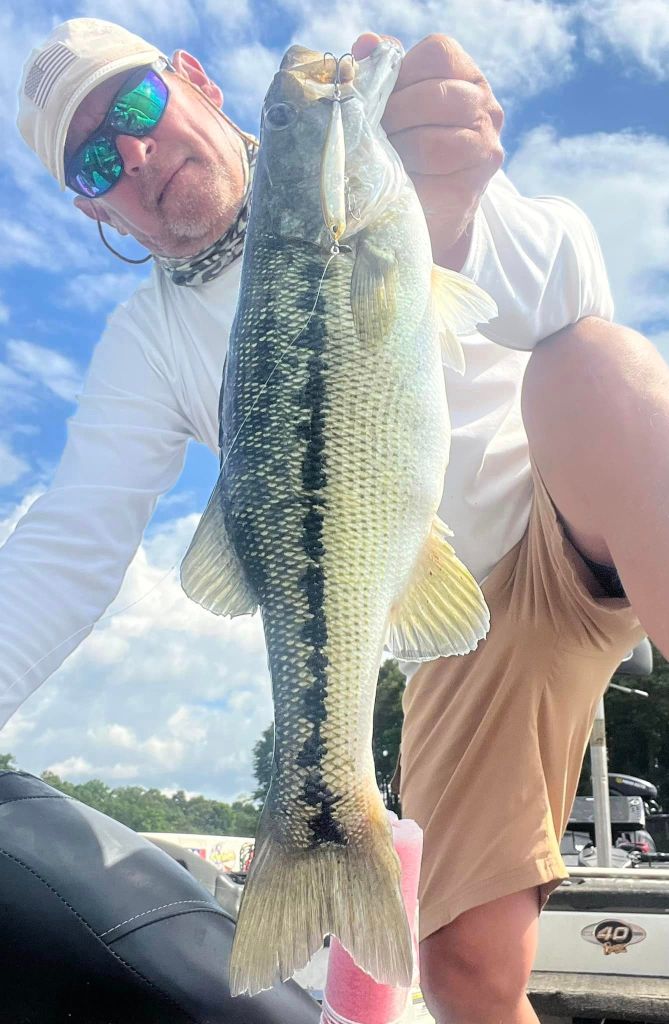
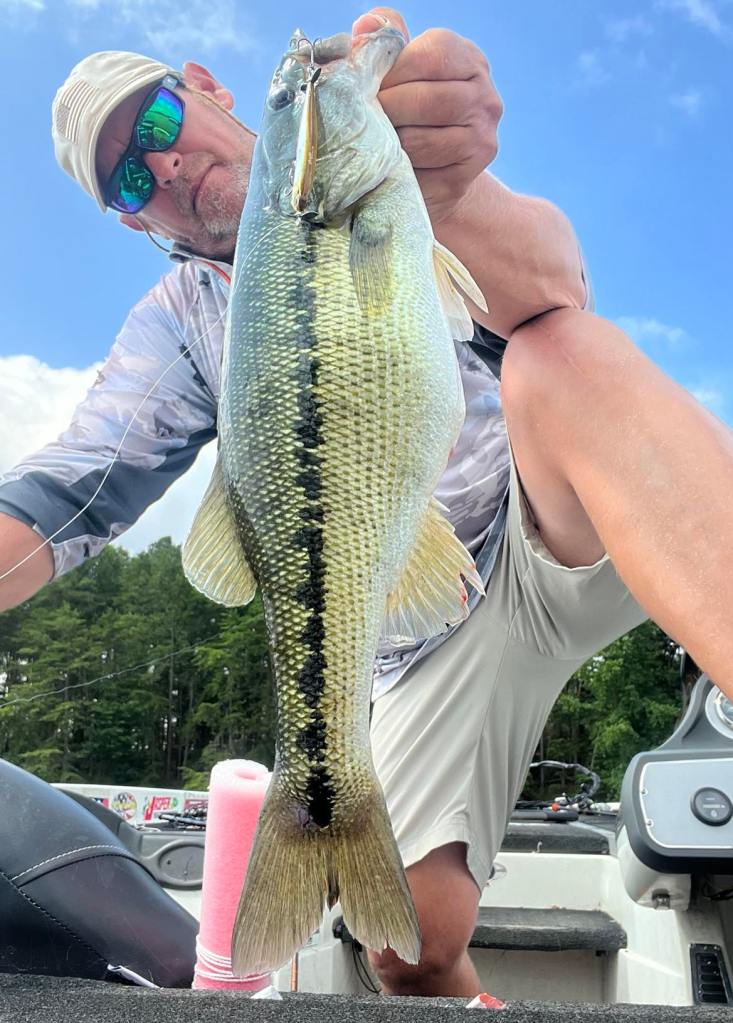
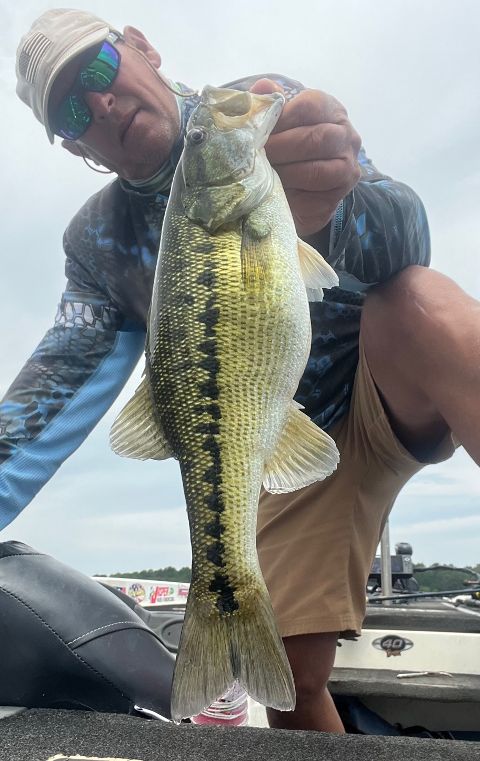
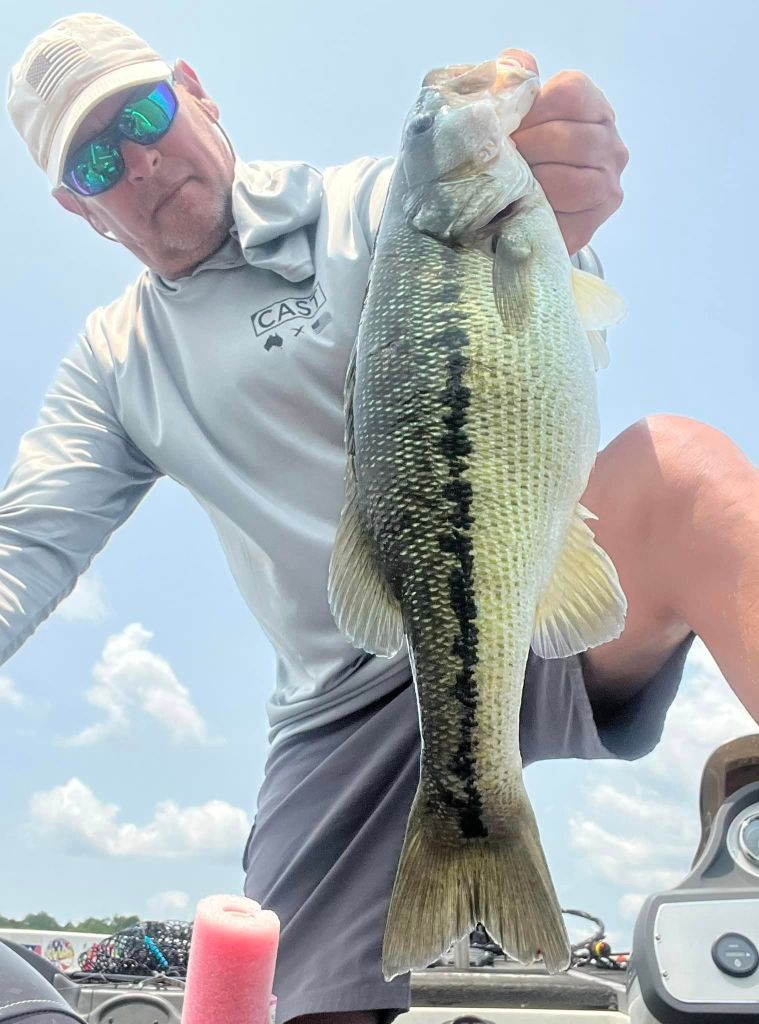
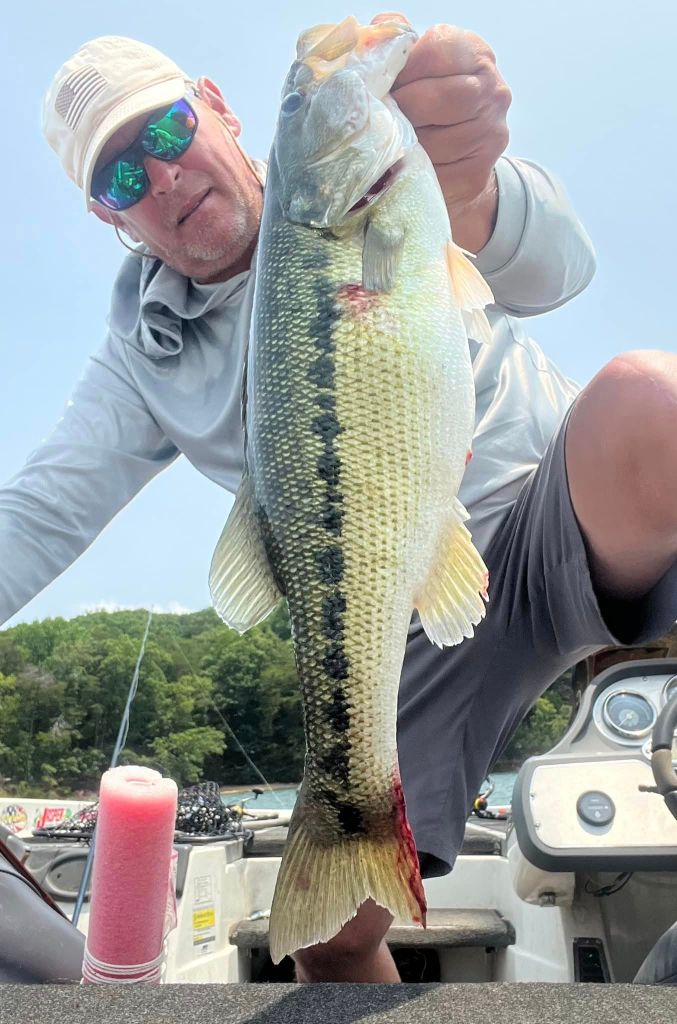
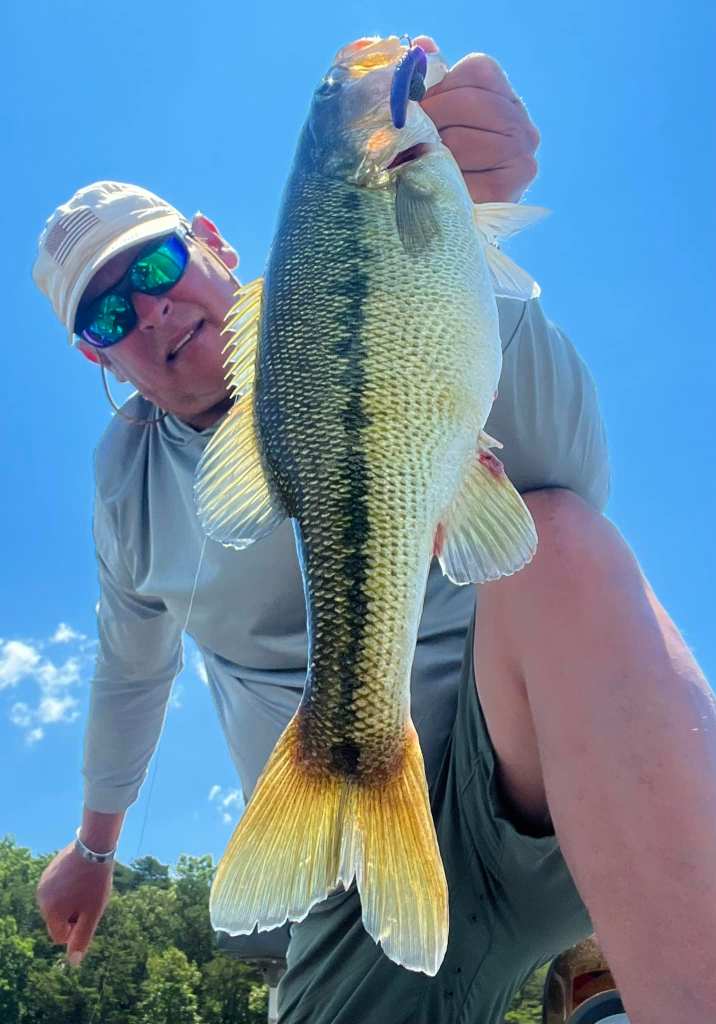
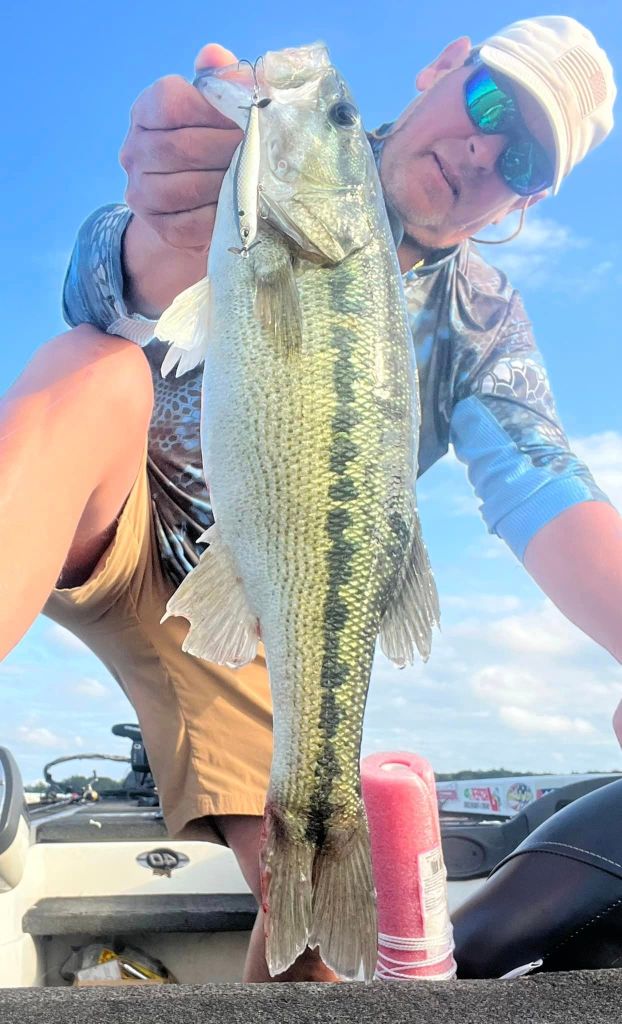
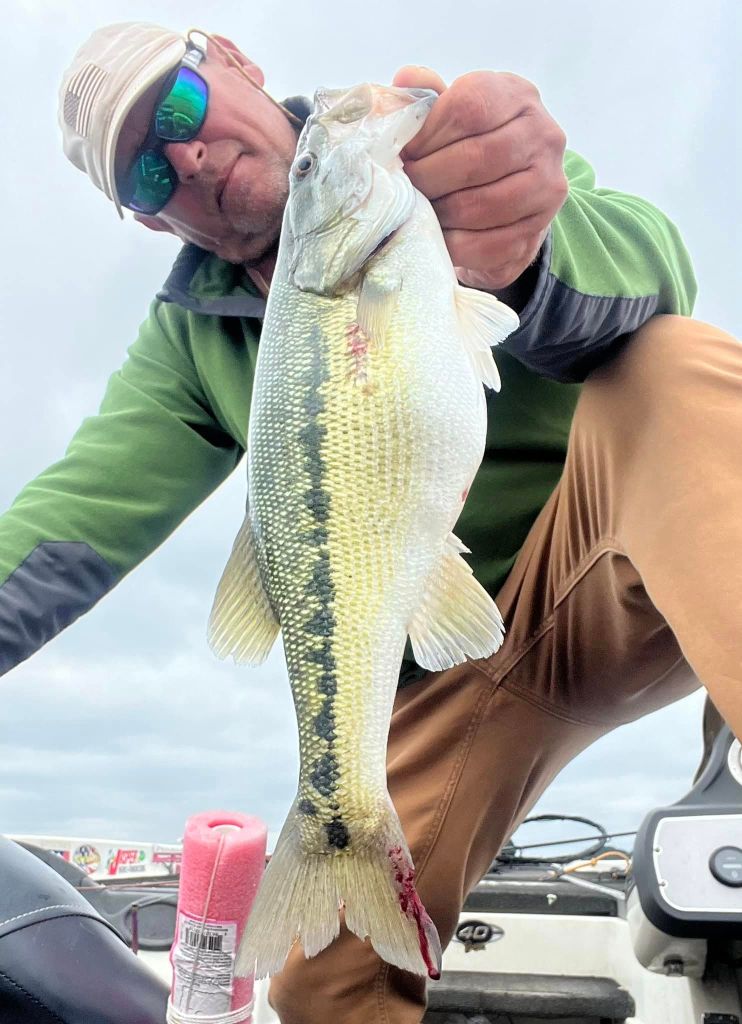
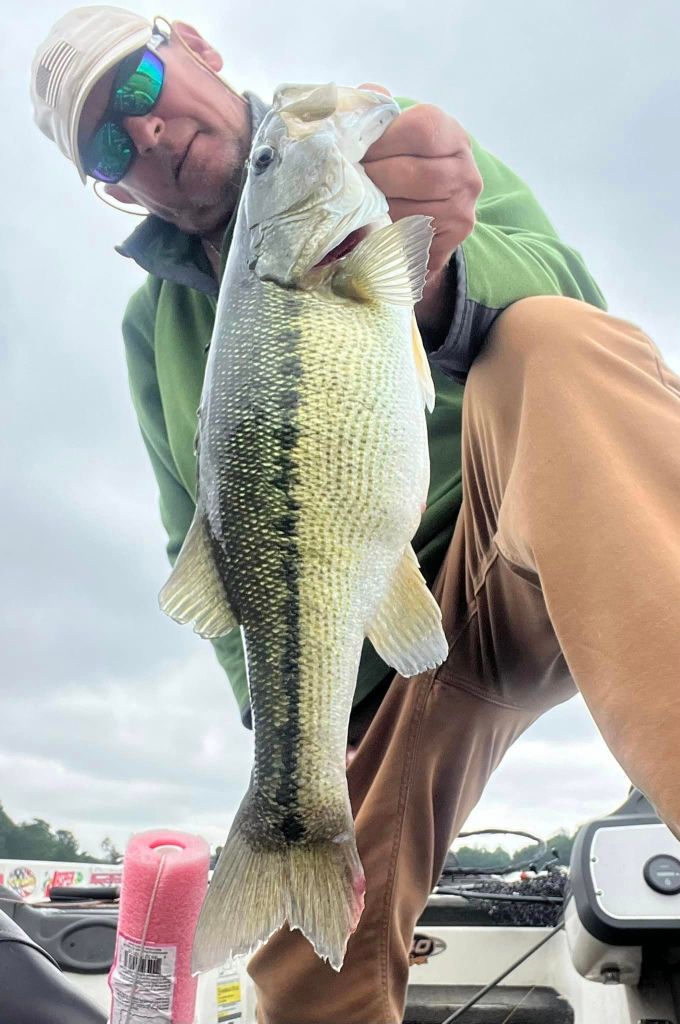
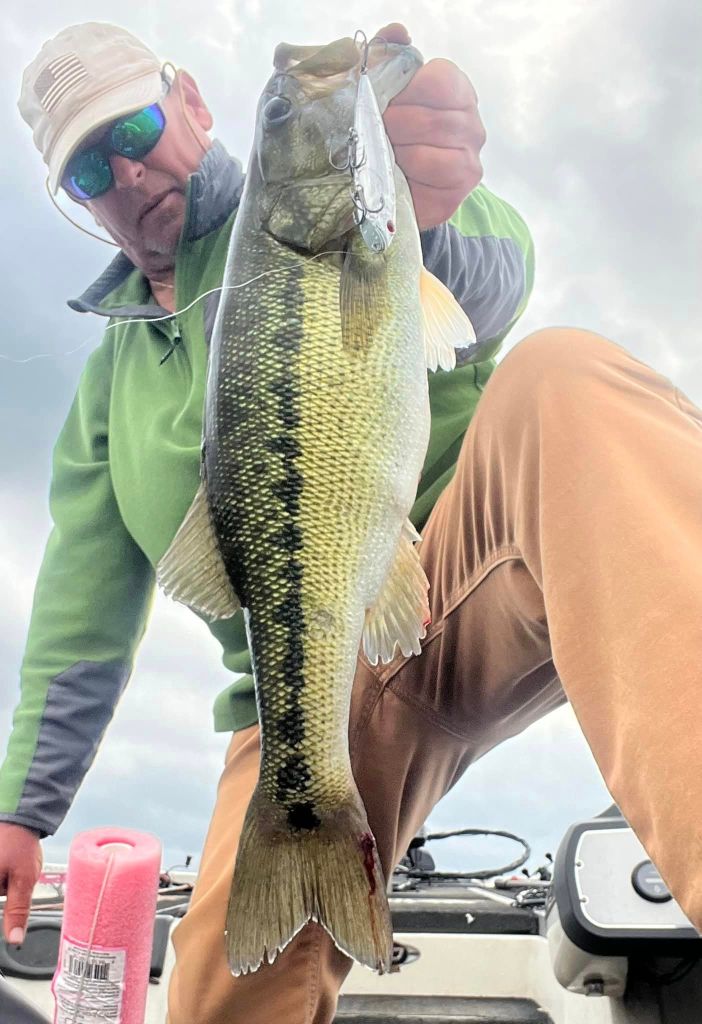
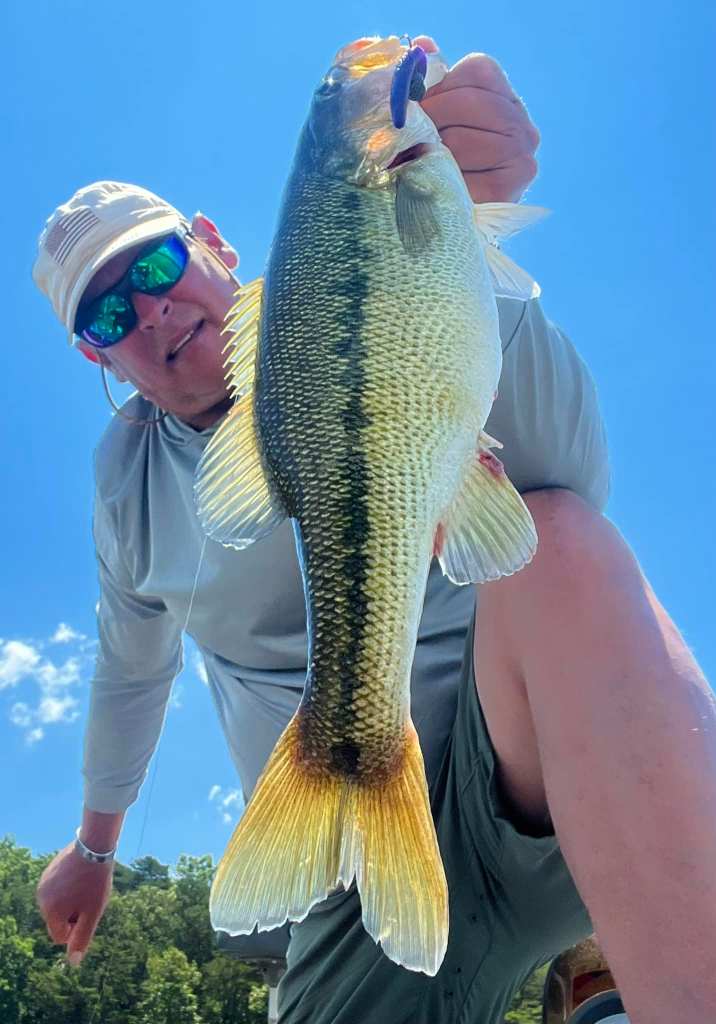
It’s the middle of August and it’s hot without much relief in sight but look on the bright side, in just a few short weeks we may start to feel a little weather relief and football season is right around the corner. The lake is about 2 and a half feet below full pool and I gotta think the water temps are in the mid to upper 80’s. Stay covered and hydrated out there! Here’s a few topwaterfish from Monday and Tuesday.
This is the second week since the ole Ranger took another hit in the battle with the spotted bass. Last week I lost my front sonar function on my Humminbird, which I suspect is the transducer mounted to the trolling motor. At a quick glance I saw some chaffing and nicks in the shielded wire going down to the transducer and I’d almost bet that is the cause of my front sonar going out. To top it off, the whole front unit died so I had to take my console unit and put it up front. Since the transducer is fried, I only have mapping up front which presents more of a challenge. 2D sonar is good to have this time of year to see underneath you, especially if you like to shop brush piles and drop shot but forward-facing sonar is great for locating fish near the boat and targeting topwater and suspended fish in 360 degrees. Since I didn’t have sonar, I had to alter my plan a bit but to be honest, I really don’t need sonar to catch fish right now. The only thing I’m running is mapping and faith.
It’s been 30+ years since I worked on the F-14 Tomcat, but I can still remember working on the complexed systems that kept the jet in the air. They say it took 72 manhours per flight hour to maintain the aircraft and I believe it. We were always fixing something, and the jets were constantly breaking. The more they flew, the more they broke. One thing we had to discern was whether the aircraft could still fly and complete a mission without a certain system if that system was inoperative. Things like air-conditioning or maybe autopilot were nice to have but not critical to the mission so if the pilots air conditioning didn’t work the jet may be “partial mission capable” but not “non-mission capable” and not quite “full mission capable”. For the past 2 weeks I felt like my sonar wasn’t really mission critical to getting the job done as long as mapping still worked, but I couldn’t do all the things I like to do with sonar, so I was “Partial Mission Capable” and running nothing but mapping.
For the past two weeks it’s been hot, but I’ve been on a pretty good topwater pattern lately. We’ve basically had the same kinda days where it was very sunny, hazy, hot and humid and the morning topwater bite was kinda slow but early in the morning there was usually some wind to work with out on the main lake, so I was chasing chop. The way it started out each morning was that the creek was slow for surfacing fish. You might see one come up here and there but there was very little chance to call a fish up. To me, the main lake has been fishing much better than the creek in the morning and early in the morning there are a lot of bass boat transients around the points and humps in the creek, so I’ve been heading out to the main lake to start my mornings. My target early in the morning is the main lake points and humps. To me, the fish are much more active chasing bluebacks early out on offshore stuff and the creek really doesn’t get cranking till after lunch when the bass start chasing bluebacks near the surface on certain points and humps. That usually works out well because I can be the first one to hit a lot of the productive humps out on the main lake before the bass boat traffic gets bad and by 11am or so, a lot of the morning creek bass boat traffic has moved on. I can work my way through the creek, and I can be back at the dock for a late lunch.
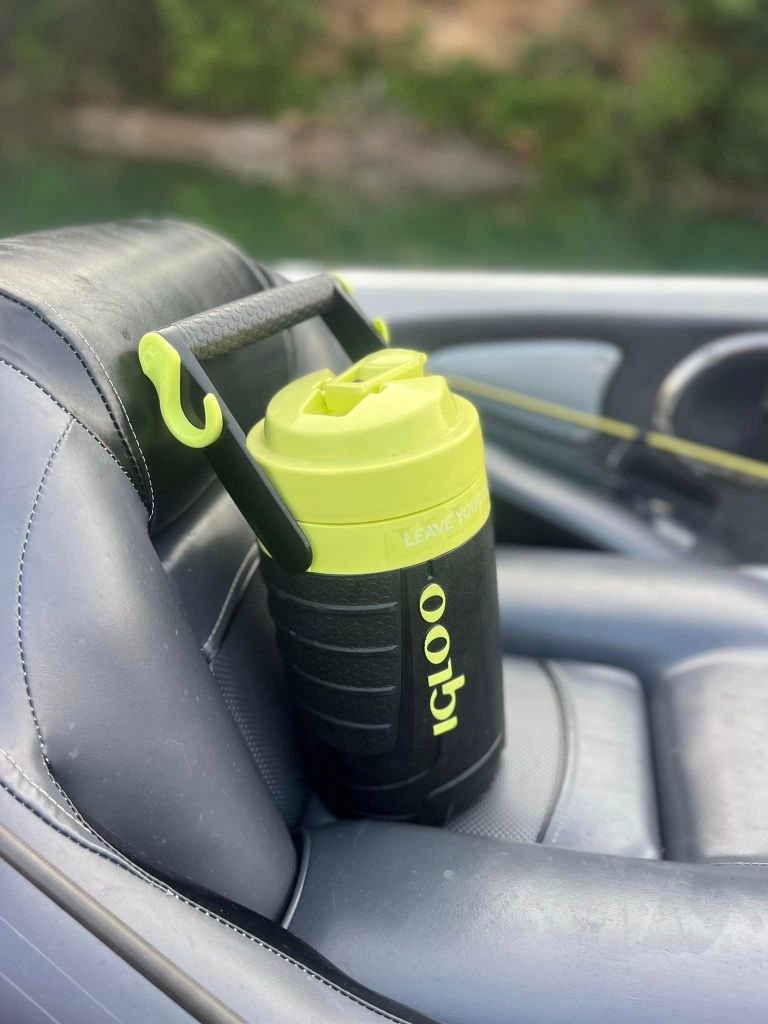
Last summer’s topwater bite is turning out to be just like this summer’s topwater bite. It’s just a matter of finding the choppy surface and matching it with the areas that produce fish. Just about every morning for the past few weeks it’s been the same weather pattern, light and meandering winds throughout the morning. There are moving veins of chop on an otherwise flat surface out on the main lake and my goal is to match the veins of chop with the productive areas, whether it’s a long point or a hump. The good Lord has blessed me with good eyesight, looking from a distance and I can usually find the areas that are productive and have a vein of chop over them by just driving up lake and looking around. If I see an area that has been producing and it has chop on it, I’m going to ease up on it from upwind and make my casts down wind into the area. I usually hit Spotlock and fan-cast the area. If there are active fish there, success usually happens quickly, and I usually don’t spend very long at one place. Within a few minutes the fish usually figure out what’s going on, and especially if you release a fish or two. After a release or two the bite quickly shuts down in most cases and I’m moving on within 5-10 minutes. The water is very clear, and the fish can see very well so usually after a catch or two a lot of fish have chased or followed your bait and seen the big scary boat, so they shut down and head for the safety of the bottom. With the extreme heat right now, moving every few minutes helps tremendously also. For that reason, I’m probably averaging 25-30 stops per 5-6 hour outing and I carry a big Igloo water jug with ice water to keep hydrated. I sit in a steam sauna for 30 minutes 3-4 times a week and the temp in the sauna tops out at 160 degrees, so the heat doesn’t really bother me as long as I stay covered and hydrated. To be honest, I think the bigger fish have felt more comfortable feeding in the hottest part of the day so if you can stand the heat the rewards have been great for the past couple weeks.
I gotta brag on the gear and bait I’ve been using for the past few weeks. I’ve been having success with some bigger fish lately and my gear has been put to the test more than once. I’m running 15lb braid and an 8lb flouro leader about 6-8 feet long. The braid to leader gives me the longest cast and when casting downwind with the braid to flouro system I can cast a mile. I had been using a Diawa Fuego spinning reel for a while and here lately I noticed the drag system on the Fuego was floating or backing off randomly during the course of a few casts. It was really turning into an issue, so I replaced the reel with a Shimano Stradic 2500 and I coupled it with my winter shaky head rod, the 7′ medium Shimano Zodias. I really like the medium rod for my little topwater bait for a few reasons, one being longer casts and another being more rod flex when fighting a fish and they make those bulldog runs that big spotted bass on Lanier are known for. The pairing of the rod and reel worked great and having a reliable drag system is a must, especially this time of year when you have a good chance of hooking a bigger topwater fish.
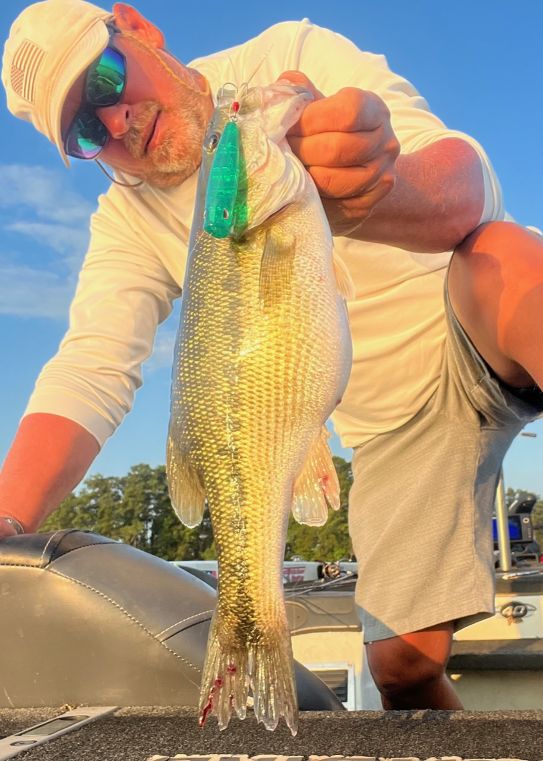
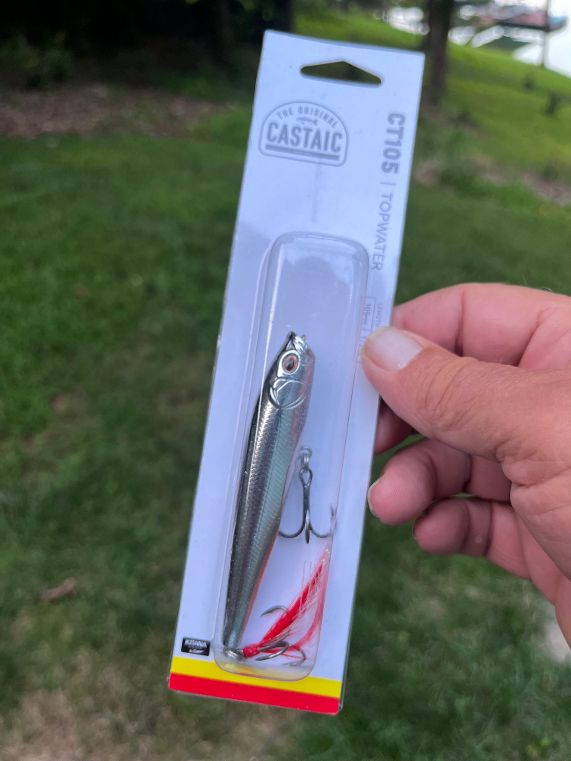
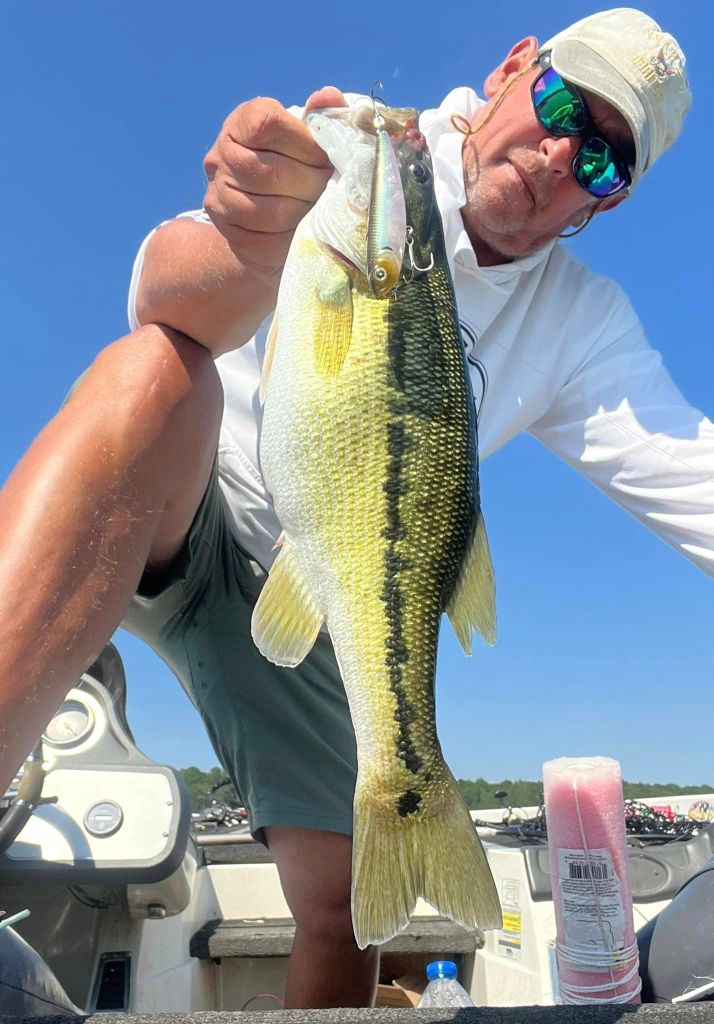
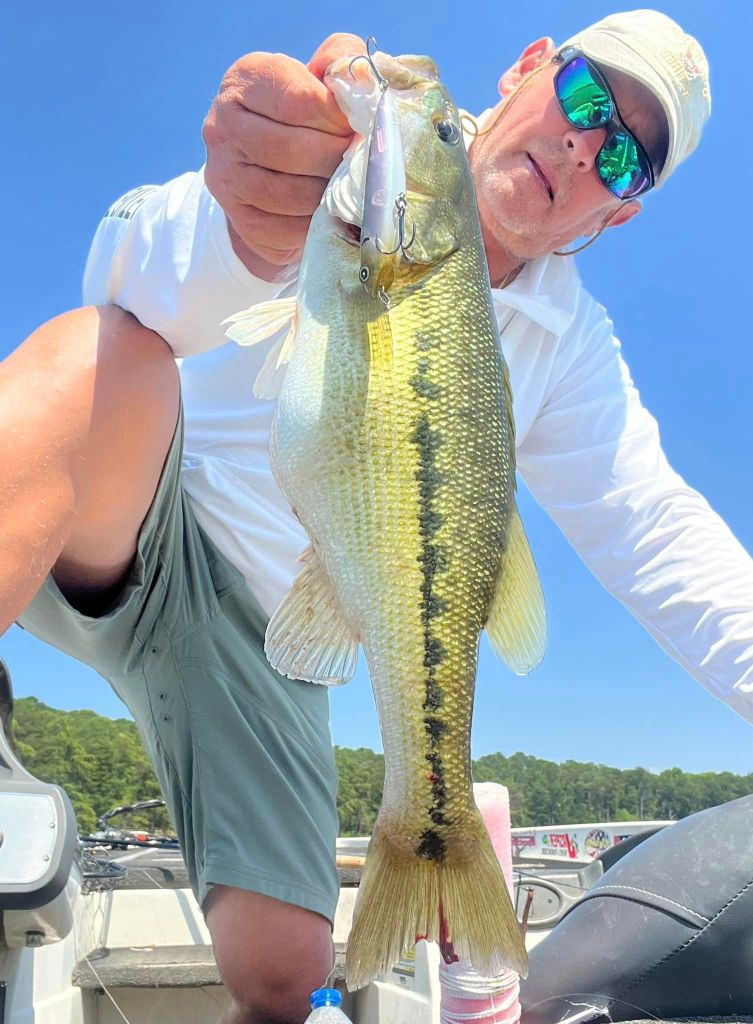
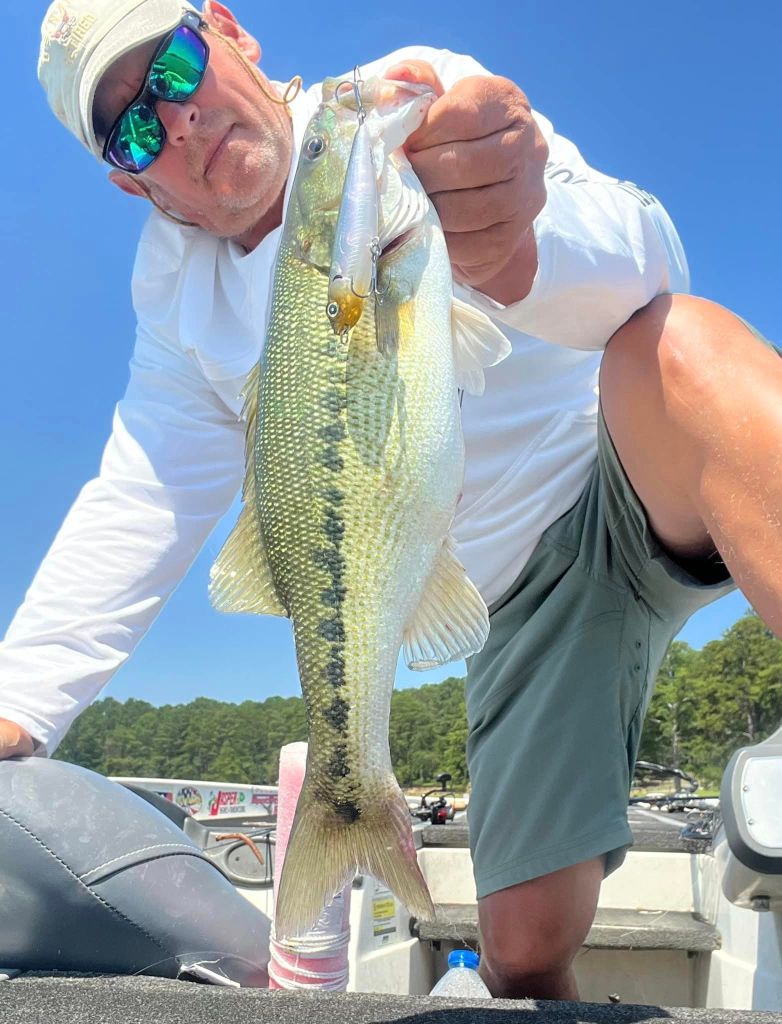
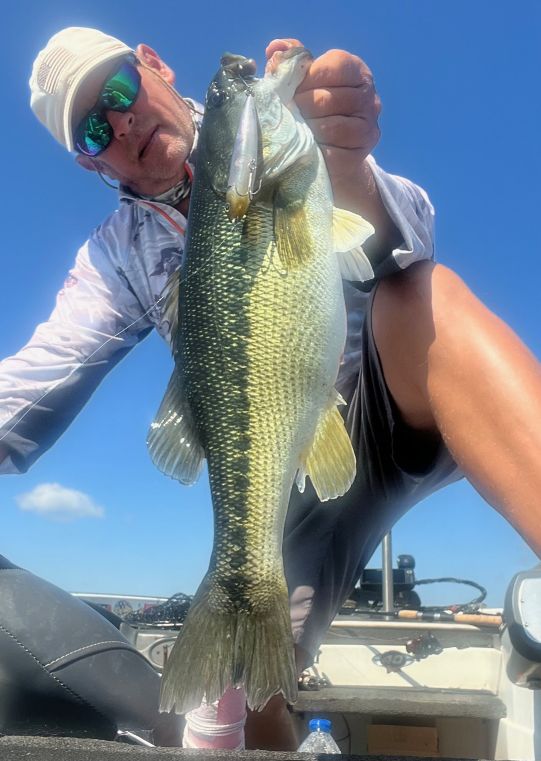
My bait selection has been pretty basic, I’ve been running a 95 Gunfish in Aurora Black for the past few weeks, and it has just flat out produced. I mixed in the Spro emerald colored popper early in the morning with some success, especially in a no-wind situation. I also used a Castaic CT-105 chrome topwater bait and I also threw a plain chrome 95 Gunfish with success but the noticeable size difference was in the color. The CT-105 and the plain chrome Gunfish produced numbers but the 95 Aurora Black Gunfish produced the size. It was just a matter of finding the right cadence that the fish reacted to best and once I hit that right speed and cadence the bigger fish responded well, especially around noon and into the afternoon. The Aurora Black fooled them the best into thinking the Gunfish was a fleeing blueback on the surface. The key was to keep it moving and not give the fish a chance to get a good look at it. Even if they were schooling under it, it was best not to stop it but keep going no matter what the fish did. A lot of times they would swat at it to see the reaction, but I’d just keep moving it and usually they would get frustrated and attack it.
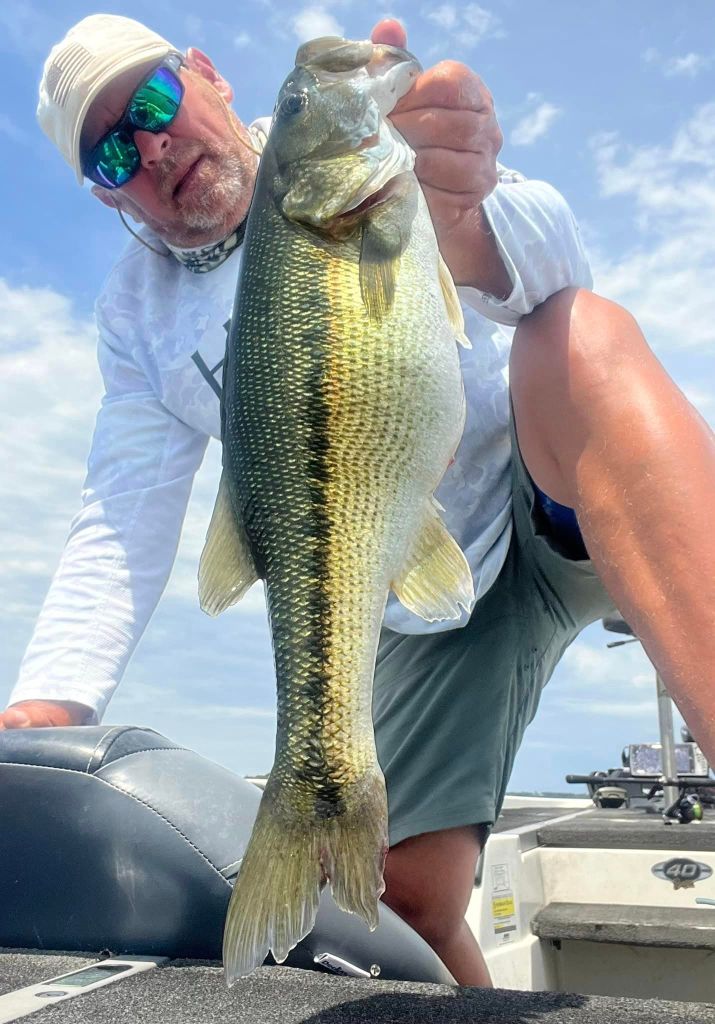
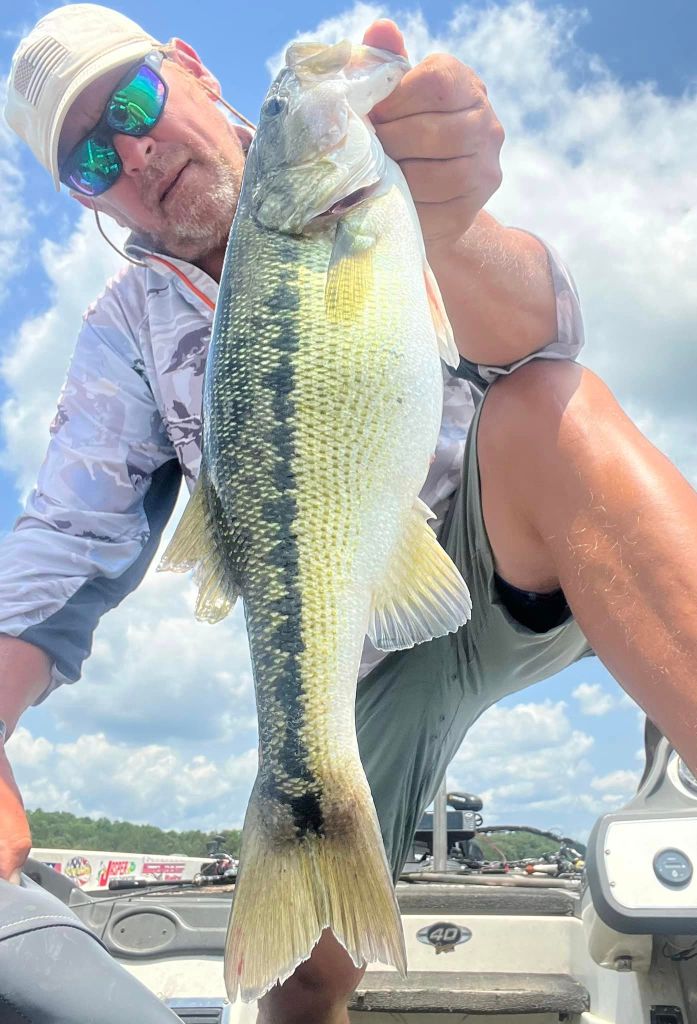
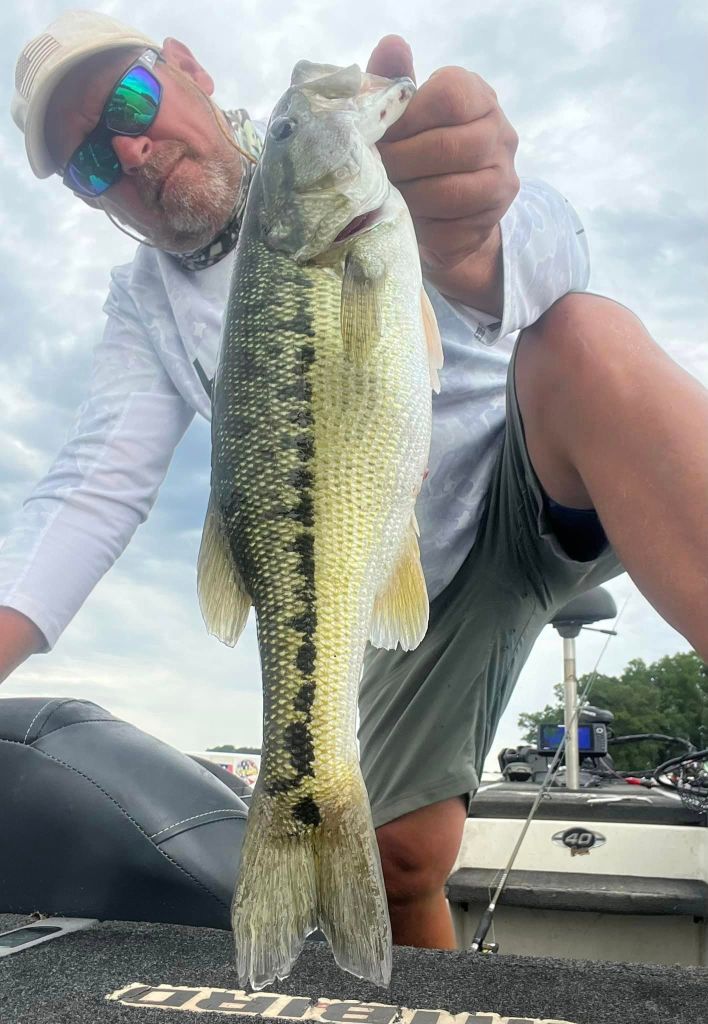
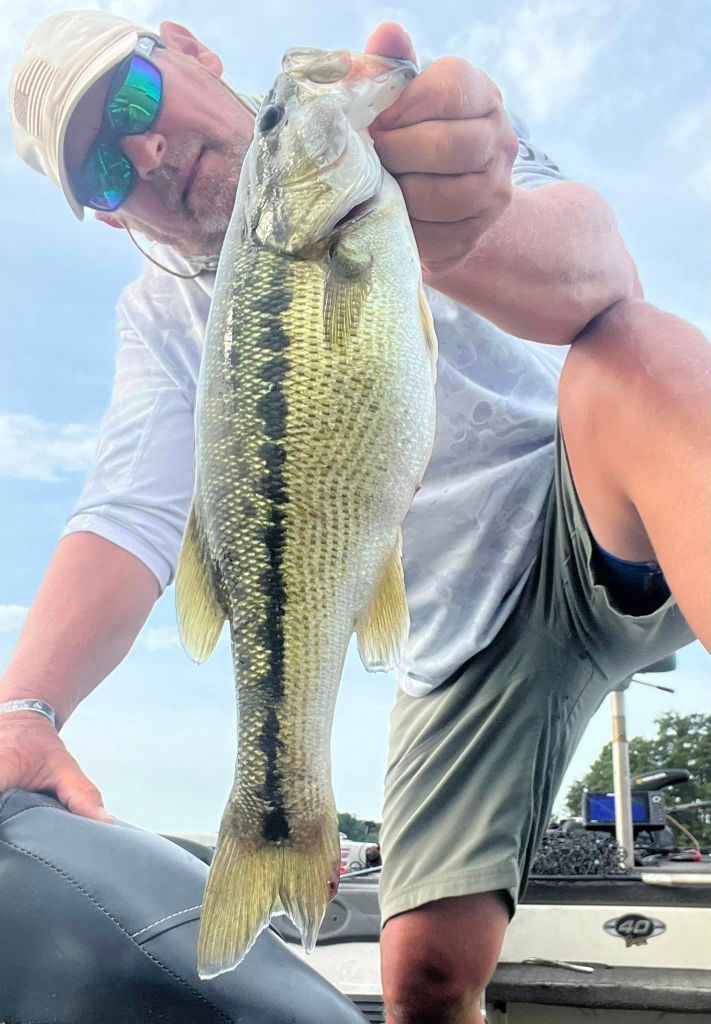
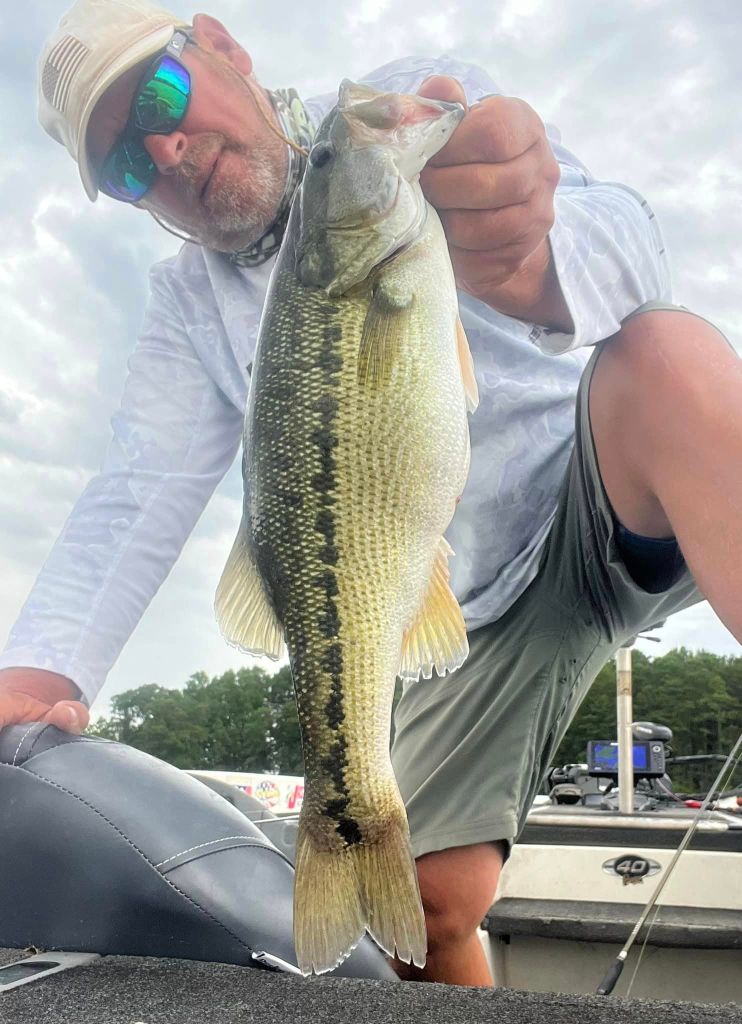
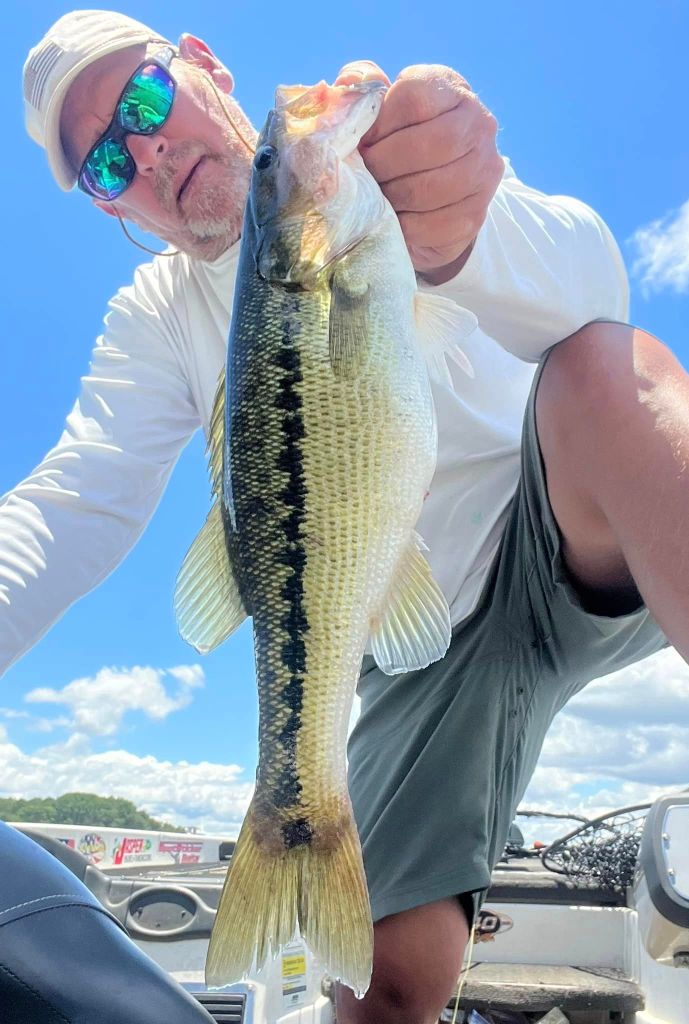
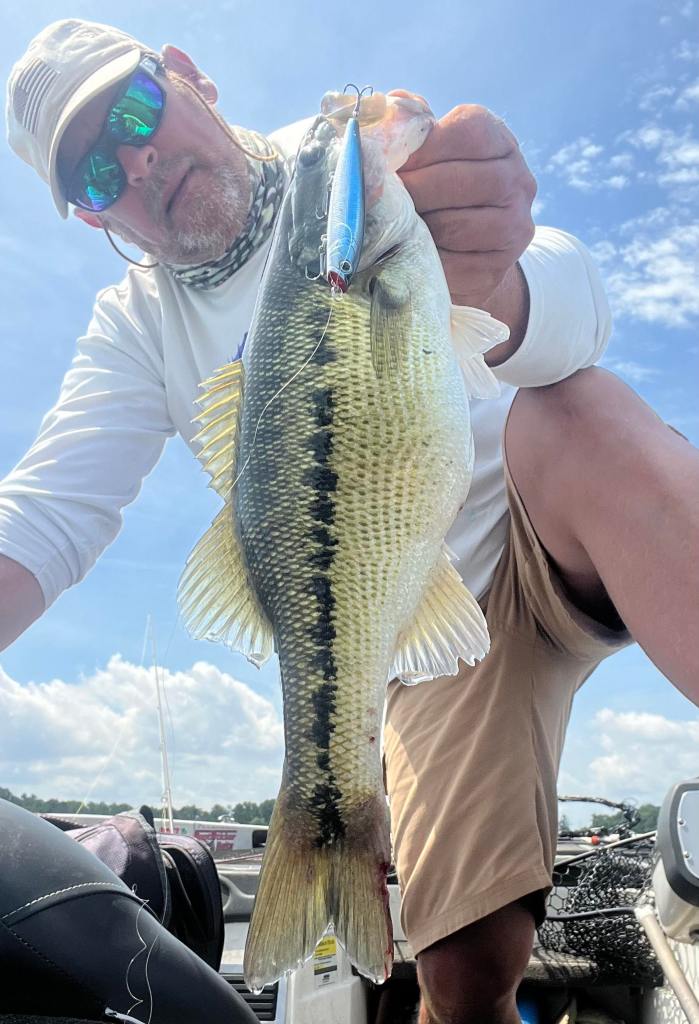
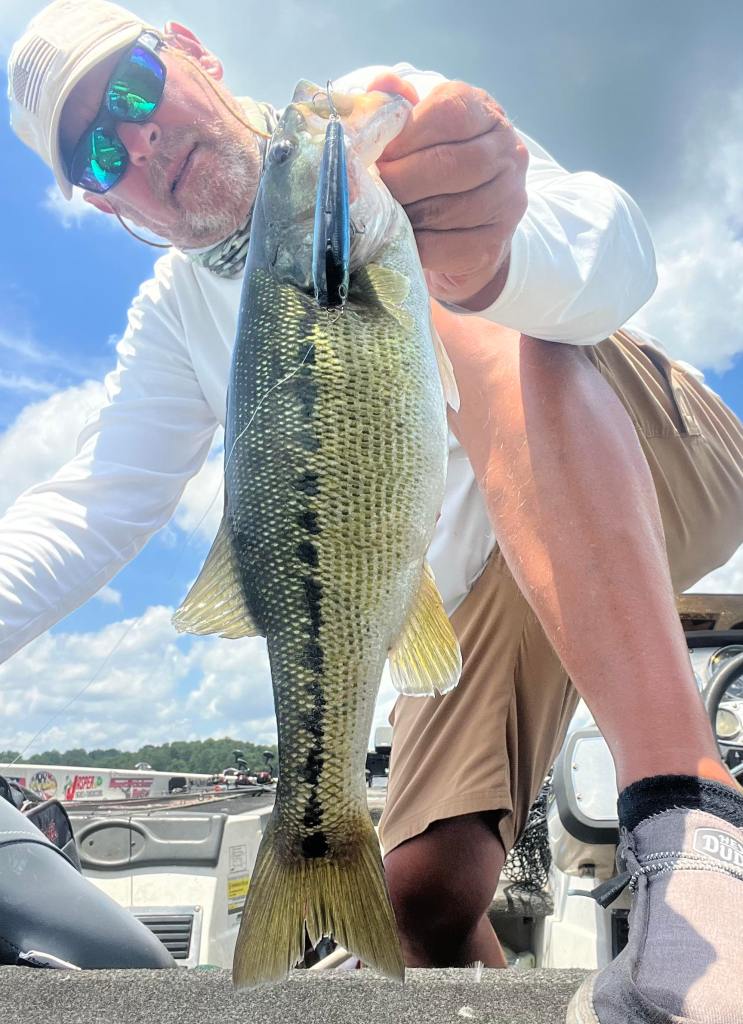
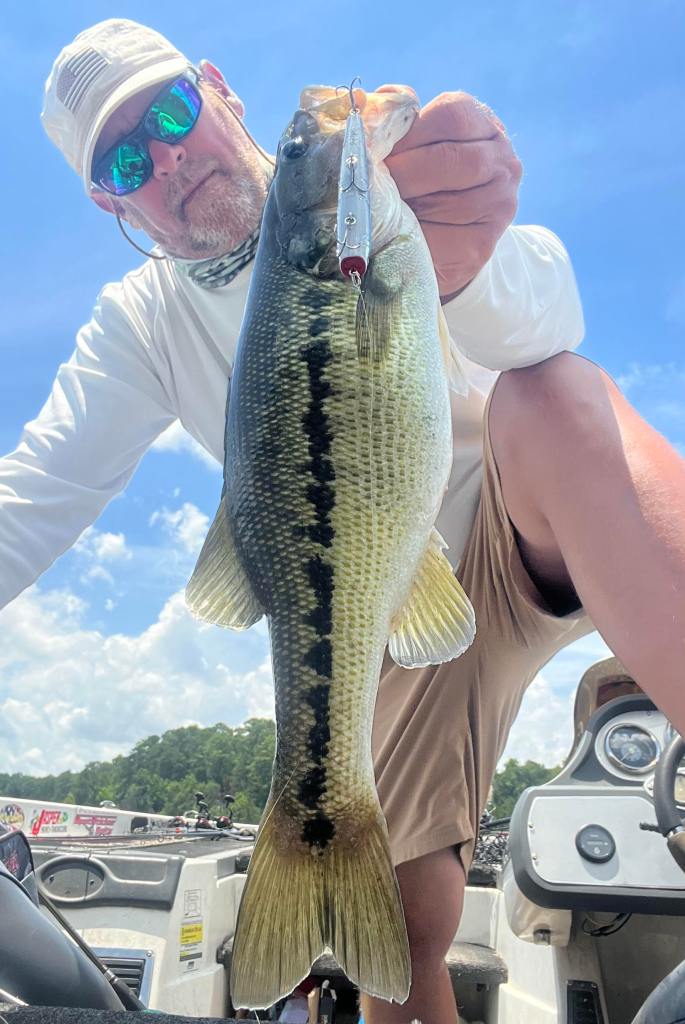
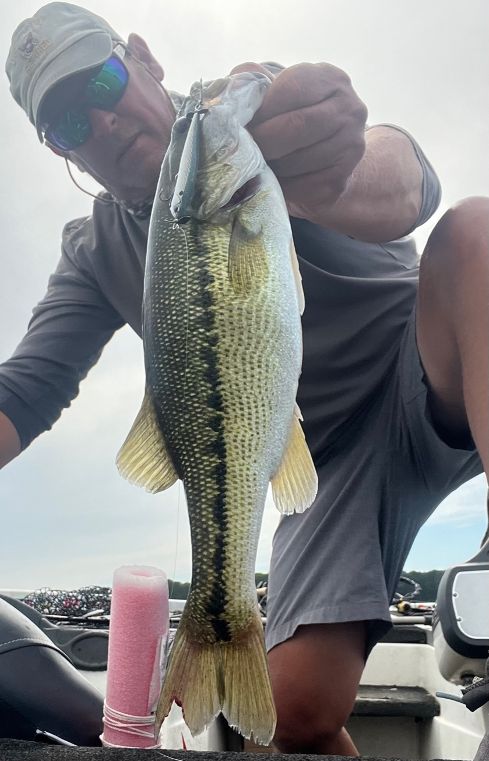
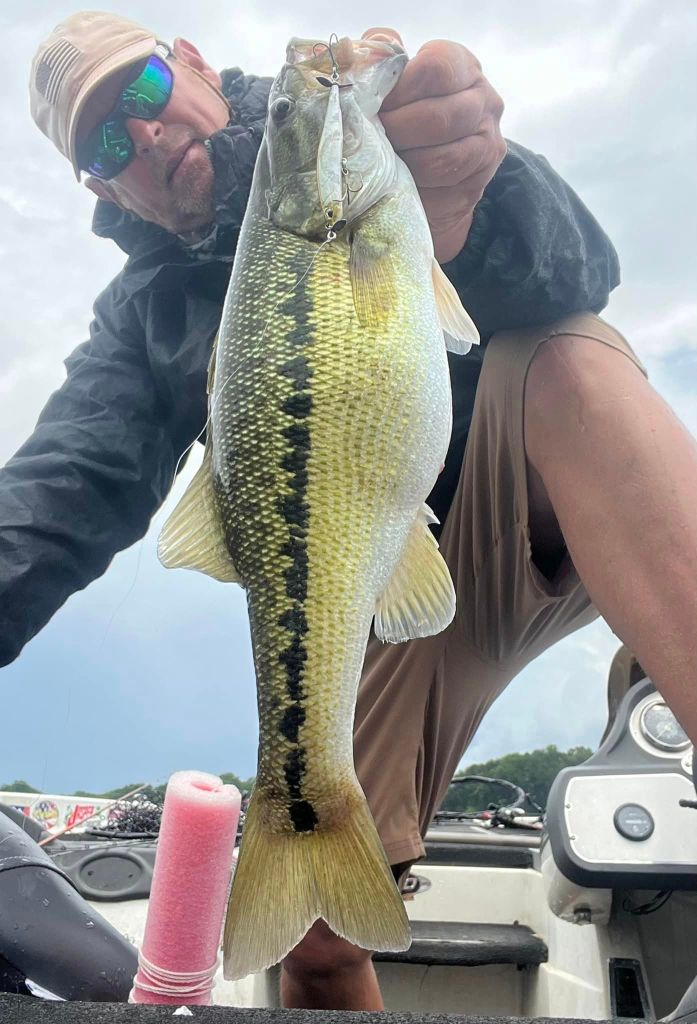
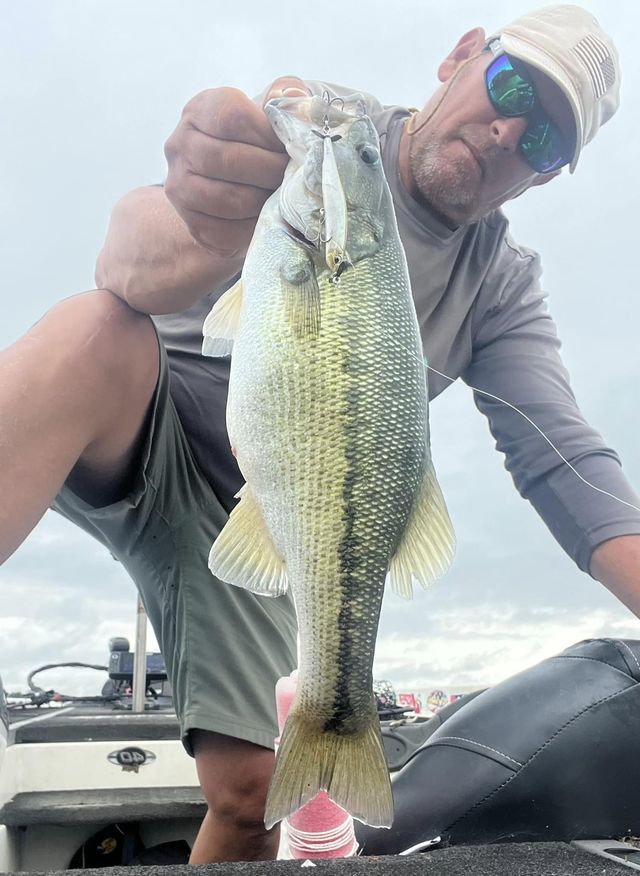
Basically, the past two weeks have been running and gunning out on the main lake chasing chop using nothing but mapping and a topwater bait. I really haven’t checked the water temps lately, but it has to be in the mid to upper 80’s and it looks like we’re just a couple feet below full pool and dropping. I haven’t been able to access the corps release site, but I’ll bet they are moving water for a few hours during peak power usage during these hot days. I don’t expect much to change anytime soon as far as the pattern goes but I may be closer to getting forward facing sonar very soon. If that’s the case, that should make my summer more interesting. We’ll see. Here are some memorable fish from last week’s outing and this week’s outings.
This week I had a lot going on and I was very limited to my time on the water, (which is a good thing sometimes) because I need a break to rest these old bones. On Monday I got to fish for a good 5-6 hours and for a few of those hours I felt like a rockstar. Same with yesterday, different day, different bait but same result. I felt like I could catch a fish on just about every cast. For the past few weeks, I’ve been gravitating towards a topwater or bust mentality, mainly because I’ve lost a lot of confidence in the spybait for bigger fish, and I’m not fully committed to the drop shot or spoon bite just yet. Right now, it’s hot out and there hasn’t been a whole lot of wind to play with if you want the topwater to work the best so my remedy is to keep moving and keeping my stops short. It’s mainly been up to the fish as to whether I get bit or whether I move on and usually that happens rather quickly.
I’m going to get this out of the way before I get to the fishing this week and chat about the topic of Livescope and it’s place in fishing imho. I’m sure some kind of forward-facing sonar will be on the bow of my boat soon but I’m going to wait a bit longer to make sure there aren’t any long-term negative mental effects or crossed eyes from the addiction. Just joking! I had the opportunity to fish with a friend in a tournament this week and we relied heavily on Livescope for our success. It’s not the first time I’ve fished in a tournament with a friend who used Livescope, both for winter and summer fishing. I’ll never forget the first time I saw it, right after it came out when my Friend Jesse Tacoronte from the Bassmaster Elite series pulled up to my dock and let me check it out around our cove. Jesse told me it would be a gamechanger and he was right. He said that if you’re not using it on Lanier, you’re behind the power curve. Fast forward a few years and what Jesse said has come to fruition and I’ve gotta say this, “if you are in business or competing in tournaments on Lanier, you’d better have it”. That “power curve” Jesse was talking about was strictly from a business perspective and that’s the mentality of some fishermen these days. They see an opportunity that tips the scale more in the fishermen’s favor so why not capitalize on the newest technology.
I’m by no means a technology denier by any stretch of the imagination, after all, to be perfectly honest, I’ve seen technology that would make the technology of Livescope resemble the design technology of a baby’s rattle. Sitting in the cockpit of a real modern-day fighter jet running diagnostics while staring at 4 different screens to figure out a complexed weapons system problem involves technology at a whole other level. I always enjoyed learning the new technology. The whole idea of technology in a military sense is to give the edge to you verses the enemy or adversary. Same with Livescope, it gives the fishermen more of an edge.
If there is an argument to be made about Livescope, it would be a “where do you draw the line” argument. A good example of drawing the line is Major League baseball and the Houston Astros scandal back in 2019. The Astros used technology to tip the scale in their favor, but MLB stepped in and drew a line by making a new ruling to counter the use of technology to tip the scale. Something similar happened in the NFL a few years back and the NFL stepped in and drew a line. NASCAR drew a line with restrictor plates when teams were using technology to tip the scale. It’s not uncommon for the implementation of rules to throttle back technology.
Right now, the Livescope transducer is tethered to the boat or the trolling motor but in my technical mind, it doesn’t have to be. Sound travels very well under water so it’s only a few years before we could possibly have wireless systems like smaller drone or pods to go beyond what you can see on Livescope at present. How about a much stronger transducer that can reach out for hundreds of feet and see beyond the next point in high definition? How about a fish ID that can analyze this fishes size with a high degree of certainty. It’s possible, and technology will continue to tip the scale in the fishermen’s favor as long as there is money to be made, but where do you draw the line? Is it when a sport changes from a sport to a business? Recently I was reminded once again by someone half my age that “if you’re not scoping, you’re hoping”, and I once again had to chuckle at that one. It’s the absolute truth but I have all day to hope because I’m retired now, live on the lake and I have well over 50 years of fishing knowledge under my belt. I really wouldn’t call it “hope”, after all, we’re all hoping to get bit and that’s entirely up to the fish, not Livescope. I’d call it “faith”, faith in my wisdom in fishing. Speaking of definitions, my definition of “sport” is leaving a hook straightened or smashing the barbs of my hooks to give the fish more of an edge after all, to be honest, that 4-pound spots brain is the size of a chic pea and figuring out what fish want isn’t exactly conquering the splitting of atoms. Why not tip the scale more towards the fisherman, but where do you draw the line?
This week I started on Monday with a pretty good trip once I figured out what the fish wanted. When I first started out around 7:30 Monday morning I realized that my sonar on the front unit wasn’t working and I had no way of seeing my actually depth or what was beneath me, so I just relied on mapping and shading to hit the spots on my milk run. I started out with the Z dog again and I learned very quickly that the fish had grown tired of the walking action. The mornings are a little tougher for the topwater because the fish aren’t schooling well in the early morning hours like they do in the sunny afternoons. I gotta say that I spent the first 3 hours of the morning on Monday fishless. I tried all kinds of different techniques and baits but just couldn’t connect. Around 11am I tyed on the little chrome chug bug and started tossing that around areas where I could find chop over long points, humps and brush out on the main lake. I hadn’t really used the little chug bug that much in the last week or two because the Z dog had been so successful, but I’ve learned that sometimes the fish need a little coaxing like splashing or popping to bring them to the surface. The little chug bug did the trick and for a couple hours the fish were absolutely locked onto the chug bug. I could just about call my shot at the height of the bite. As the early afternoon progressed, I realized that the fish were schooling just as well with no chop as they were with chop. Sometimes they were blowing up on the chug bug while it was just floating around without any action on the bait whatsoever.
One of the biggest reasons the little chug bug is so successful in the summertime with our gin clear water is because of that little dressed hook on the back. A few years back I proved that point on an afternoon much like an afternoon this week when I literally wore the dressing off the back hook after catching a lot of fish on the bait. Once the dressing on the back hook was gone the bite percentage dropped drastically and it picked right back up when I replaced the dressed hook. I realized that the holographic mylar dressing was the key to triggering the strike. Same with the original emerald popper, once the holographic dressing was gone the bite percentage went way down. These bass we have react to flashy things due to their curious nature and catlike predatory instincts. Another reason the little chug bug works so well is because of the chrome. These fish see the chrome as a possible blueback flashing on the surface in the sunlight and they react to it. Although the bite died off around 3pm and I headed home, I had a solid 2-3 hours of success using the little chrome chug bug again. Here’s a few fish from Monday.
I didn’t fish on Tuesday but I jumped in the boat with my buddy Matt O’Connell for the Hammond’s tournament on Wednesday and we did pretty well. Matt relies on Livescope a lot this time of year and when you’re using Livescope while tournament fishing, it’s pretty interesting. It’s much faster paced than I’m used to and reading the fishes posture is very important to success. Matt could read the fish we were scoping, and he could tell with a lot of certainty as to whether we would be successful just by the way the fish were positioned. Sometimes my old crusty butt was barely out of my seat when we were moving on. I won’t get into specifics but working together with Livescope is very important in a team setting. Each person has a roll and it’s not like beating the banks and covering unproductive water. The better you work together with Livescope, the more fish you’re going to catch. Matt and I were very consistent with the 3+ pounders at just about every stop but there was just a lack of connecting with the bigger class fish. We had opportunities and we were in the right places but sometimes that 3lber jumps on just before the 4lber. Nonetheless, I learned a lot, as I always do when I fish with Matt, however old and stubborn I may be, we still came close to the win, and I had a lot of fun.
Yesterday I was back at it, hitting my summer milk run and once again I was greeted by the early morning topwater grind. One thing I learned from fishing with Matt on Wednesday was that the fish were not reacting to the little chug bug as well as they did on Monday. On Wednesday, they would follow it, but rarely would they strike out at it. It was like they were growing weary of the chug bug. Matt threw an array of baits on Wednesday but one bait he threw triggered my memory of a couple of baits I bought back in June after having a conversation with Jeff Nail and his success with the Gunfish topwater bait last year. I told him that I had great success with the Aurora Black jerkbait pattern on Lanier for the last few years so that same pattern would probably work well as a topwater pattern and it kinda looked like the chrome chug bug. I had ordered two of the 115 and two of the 95 sizes, but I’ve had so much luck with the chrome chug bug and Z dog the new Gunfish stayed on the tackle box till yesterday when I tied it on and figured out a cadence that the fish couldn’t resist. That Gunfish flat out put them in the boat at every stop from lunchtime till mid-afternoon, but the problem was that I only had one and the other was back at the house. After a good run with the bait a big striper took the Gunfish down into the timber and it was time to head back to the house anyway, so I called it a day. Here’s a few pictures from the Gunfish run.
That’s it for me this week. It’s time for boat maintenance so I’m off the water for a few days. Right now, water temps are in the low to mid 80’s and the lake is a foot and a half below full pool. The corps is generating for a few hours a day during peak usage.
I think I’ve gotten out every day this week, at least for a few hours each day and it was a polar opposite of the week before. Last week we were enjoying the lower temps and some overcast days with wind to help the bite and this week we were greeted by sweltering heat, beating sun and glassed over surfaces on the lake. The topwater bite is good if you’re in the right place at the right time but it’s been kinda hard for me to call them up. A few weeks back, I wrote about the difference between the fish feeding up and the fish pushing bait up. This week was another week where the fish are pushing bait to the surface and quickly retreating back down to the depths. Not uncommon for our lake, especially in the summer months when the thermocline is setting up. There isn’t a lot of oxygen at the surface right now so when the fish does surface, he’s taking care of business quickly and is generally focused on one bait. If I was lucky enough, I could make a cast to the fish while he’s still up or within a few seconds of the fish going back down and connect.
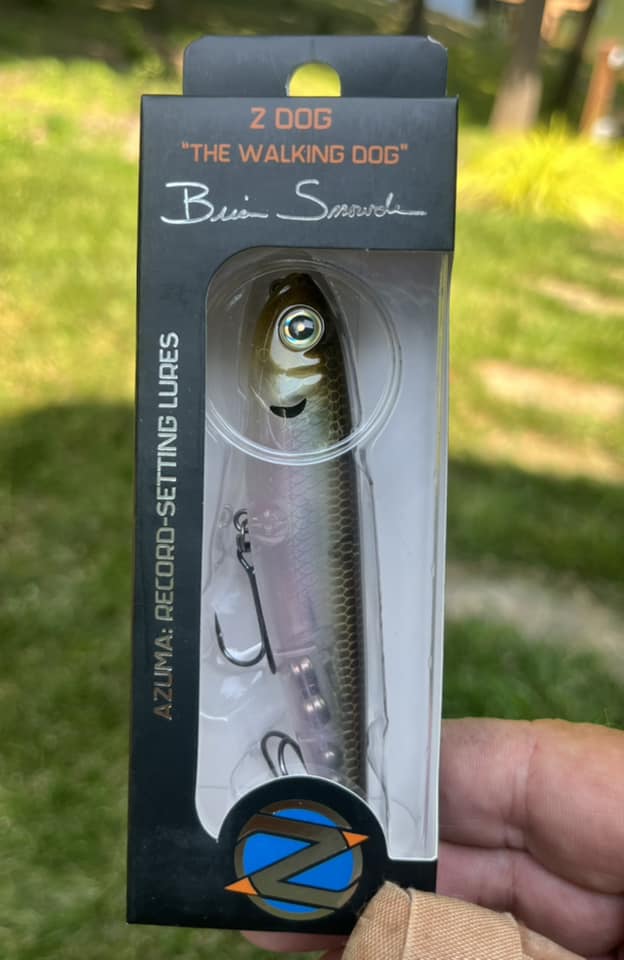
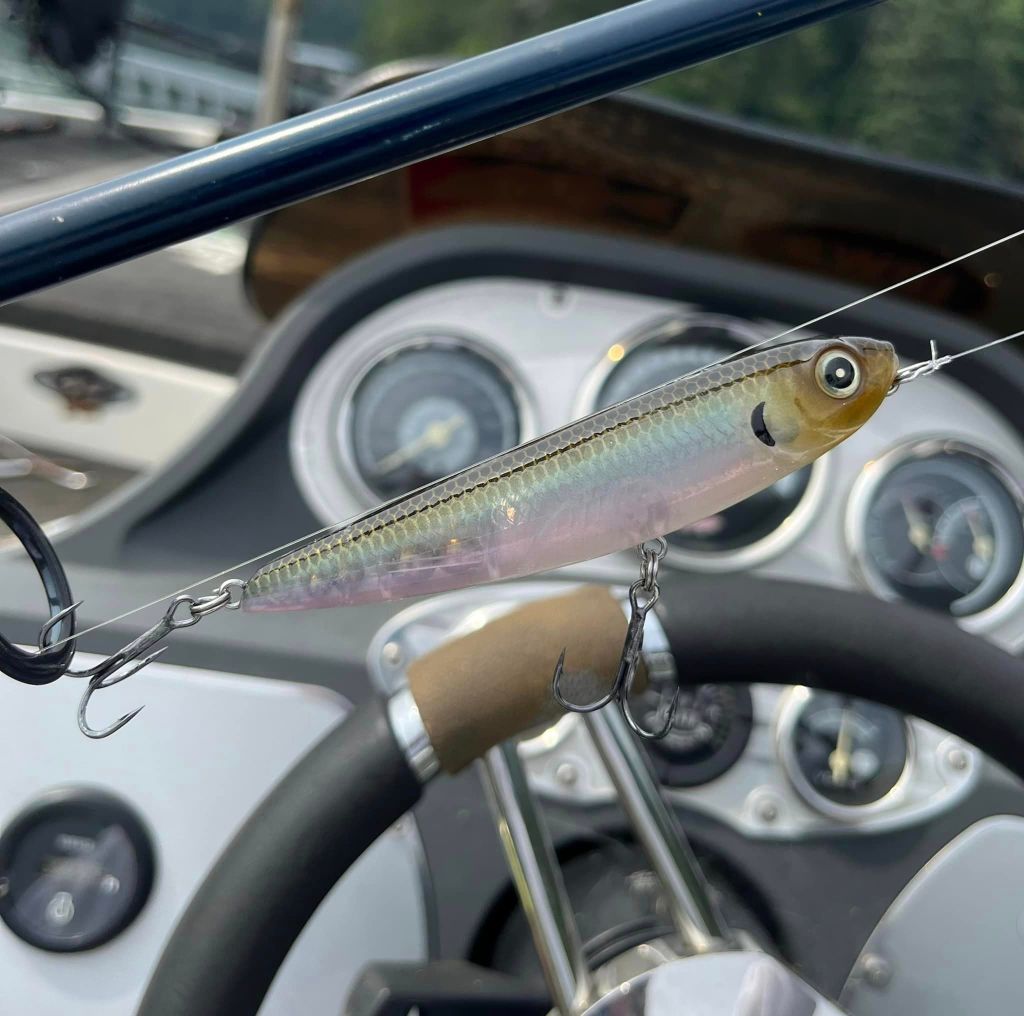
It’s hard to fish topwater with any kind of hope of success when the fish just aren’t coming up when you call them so the next best thing for me this week was the spybait. The spybait bite was good this week and it was a good way to fill my time while waiting on surfacing fish. It was very important that I had my topwater bait handy and ready to cast if a fish or a small wolfpack of bass came up within casting distance. That’s how I caught the majority of my topwater fish this week including the big striper pictured above when a massive school of stripers and bass started blowing up all around me at 2:30 in the afternoon, in the sweltering heat on a main lake hump. I gotta brag on my little topwater bait this week and once again the little Azuma Z dog got it done for about 90% of my topwater needs this week. In the movie Titanic, one of my favorite villain actors, Billy Zane said, “I believe in making my own luck” and with the Z dog I had to make my own luck to call them up this week. Back in Oct. of 21 I wrote a report called “Shake and Bake in the Chop” and I explained the technique I used to make the Z dog work for me in tough times for topwater bites. I explained that instead of a traditional “walk the dog” fashion I increased the speed of the bait to a quick skipping across the surface and just slowing it briefly. The reason being that I didn’t want to give the fish a good look at the bait, and I wanted to make it look like a fleeing bait in distress much like the bluebacks I see every day skipping across the surface while being chased down by a bass. The predatory mentality of a bass, however small, reminds me of the predatory mentality of a cat. The bass are also very competitive and if they see a bait being chased down or a quick moving bait, they are drawn to it. All I had to do was speed up the cadence with the Z dog, so it turned into a reaction strike. If you’re not familiar with the Z dog Here’s a picture of the Z dog I’ve been using for a few years now and it continues to put them in the boat.
About the only other topwater baits I used with success this week was the little chrome chug bug, a chrome Livingston walking bait and a chrome Whopper Plopper. I used the chrome Whopper Plopper with some success very early in the morning but any other time I tried it, it didn’t work for me this week.
Spybaiting was good but the fish were a bit more finicky to the spybait this week. I had to change colors mid-week but I was still able to do well. I will say this about the importance of line size and even line type. I bought a spool of 6lb Inviz x and I spooled both of my spybait rods with it and I was rocking along just fine but experiencing some break-off here and there. Probably more break-offs than I’d like since the baits are 13 bucks a pop so I decided to up the line size to 8lb Inviz x since that’s what I’ve been using lately for my topwater leader. I used the 8lb Inviz x Wednesday afternoon and yesterday morning and the whole time I didn’t get one fish to even sniff the spybait with the heavier line on it. It just didn’t work at all for me, and I was losing 20 feet in distance on every cast. Distance is very important when spybaiting. I dug around my shop and found some Tatsu 6lb and spooled it up at lunch yesterday and within five minutes of going back out to try the Tatsu I was back in business with the spybait. Moral of the story is that I highly recommend the 6lb or even 8lb Tatsu for the best success with the little G-fix 80 spybaits. Technique is everything with spybaiting and there are all kinds of different spybaits out there now. I’ve used every size of the Duo Realis spybaits and I’ve caught fish on every size spybait by Duo Realis. They are a lot of fun during the summer months and if the fish aren’t coming up the spybait and drop shot combo is a great duo. I posted this a while back in a report, but I thought I’d put it out here again to explain the spybait technique in a little more detail. Here’s a video I made of the spybait breakdown.
Here’s another good spybait video with some cast to catch and technique stuff.
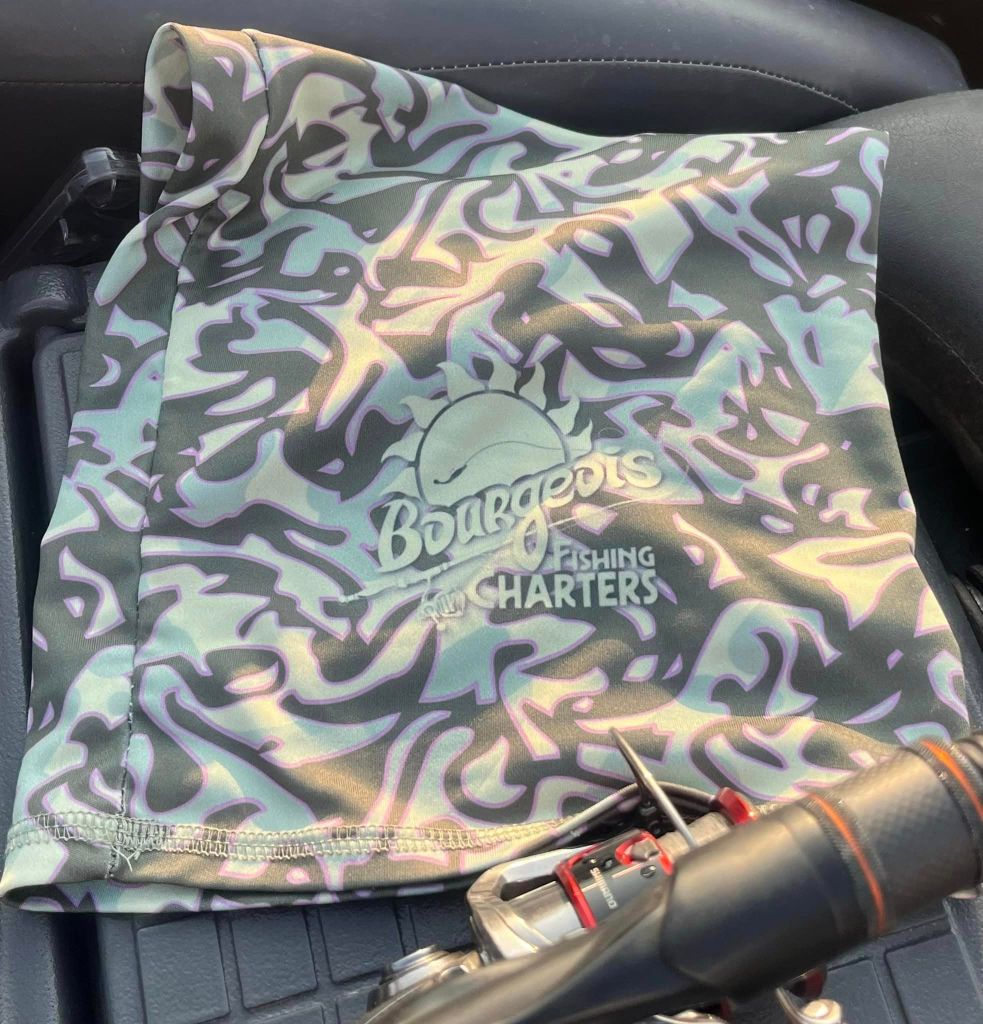
I haven’t broken out the drop shot rig yet but it’s coming very soon. I’ve seen all kinds of fish hanging out in and around brush for the past few weeks and if the topwater bite kinda fizzles this summer there’s always the spybait and drop shot bite to pass the time. A few things to keep in mind this summer out in the heat is to stay covered, stay hydrated and keep moving. I don’t spend very long in one spot in the heat of the summer, and I’ve always got plenty of water. I highly recommend a good buff and it never hurts to wet it every so often to help keep you cool.
Before I forget, I wanted to give an update on Chigger and our little Wren in the fern, Caroline. Chigger is plugging along and he’s slowly getting it together. We heard him barking for the first time in weeks today and he seems to get a little more excited when we come back from being gone. His eyesight is getting bad, but he can still see squirrels in the trees and stray cats in the driveway, so he isn’t exactly blind. He’s gotten back to eating a little more every day and it looks like his back legs are working better. We’re just taking it day by day with Chigger but he seems to have a little more pep in his step this week. On another note, our little Wren momma Caroline, who lives at the front door added another egg to her clutch for a total of 5. I’ve been leaving her alone with her eggs but hopefully I’ll get a picture of some little Wren chicks soon. I finally was able to snap a quick pic of Caroline this week.
Back to the fishing, I had it narrowed down to just 2 baits this week with a couple others that get honorable mention. First off, when it came to topwater it was lights out Z dog time with a little shake and bake action on the Z dog, a close second was the Duo Realis G-fix spybait in American shad. The two are pictured below. Thos two baits accounted for about 95% of my fish with the chrome chug bug, a chrome Livingston walking bait and a chrome whopper plopper getting honorable mention.
The corps is only generating an hour or two a day right now and the lake is about a foot and a half below full pool. Water temps are hovering around 80 degrees. Here’s a few of the memorable fish from my week.
What a treat this week has been. Normally, late June has a habit of bringing in some of the hottest temperatures of the year but this year the temps have been mild, and I’ve actually been wondering if I’m under-dressed rather than cooking off in the brutal humid heat. Yesterday the weatherman said that the average temps are around 90 for this time of year and from looking back in my logbook, he is correct. Early this week we saw a big upper-level low pressure system drop down into our area and it just sat over us spinning and drawing in moisture. One of the benefits to a low-pressure system is the drop in barometric pressure and the effect it has on fishing. My rule of thumb has always been that low pressure brings the fish up and high pressure pushes the fish down. It’s that simple. This week we had low pressure and with the mild temps and constant cloud cover it meant no pressure fishing. Just a few baits on the deck got it done this week.
Monday seems like a decade away, but I did make a quick lap around the creek and found a nice chop and some cloud cover about mid-morning. I’ve been looking for the Choppo bite to pick up and with the cloud cover and choppy surface, slinging a bone 105 Choppo around was a no brainer. As soon as I ran that thing across the crown of an offshore hump, I found what I was looking for in a topwater explosion. Even though conditions were right for topwater I decided to start throwing the spybait around brush out on the ends of points and on humps and put the topwater away. I kept my topwater rod handy just in case there was some surface activity within casting distance, but I found it was best to approach the area in a stealthier mode and start out with the spybait rather than throwing the topwater. Reason being is that when I would start out throwing topwater in an area, it scattered the fish after a few casts. Maybe a few would come up and hit the topwater but chances were that the fish would follow the topwater but not commit to it and when they would see the boat, they would go straight down to the bottom. After a few casts of this happening with the topwater the fish would be scattered and non-committal and by the time I started throwing the spybait, the bites were scarce. Starting with the spybait and forgoing the topwater netted me a lot more fish this week. Don’t get me wrong though, if the fish were chasing bluebacks on the surface where I was fishing, I would definitely throw the topwater. If I was approaching an area where there was no visible surface activity, I would start with the spybait. Here’s a couple nice fish from my quick trip on Monday.
After my discovery on Monday, I was back out Tuesday morning and I had two things in mind, topwater and spybait, but mainly spybait. I have a ton of confidence in the spybait right now and I feel like I can get bit at every stop. I want to explain the spybait technique with a little more detail and the importance of details when you’re learning the spybait technique. First off, the difference between success and failure in spybaiting is often found in the details. It’s important to have the right equipment for using the spybait, just like it is important to have the right tool for the job. I highly recommend the following gear to spybait. First is a medium rod. I’m using a 7’3″ KastKing medium Speed Demon spinning rod. There are a lot of good reels out there and the most important thing about the reel is the drag system. Get a good reel with a dependable drag system. You’re going to need it. I like 6lb fluorocarbon line and you’re going to want to use a small diameter line to help with the action on the spybait. The heavier the line, the less action you’ll have on the spybait. If you want to bump up the line strength, I recommend 8lb Tatsu because it has the diameter of most 6lb fluorocarbon lines out there. The 8lb Tatsu is pretty durable and dependable also. I just load my spool with straight fluorocarbon, no braid with a leader but straight 6lb fluorocarbon. Setting the drag for 6lb test is very important because these bigger bass can make hash out of 6lb test if your drag is too tight. If your drag is too loose, they can take you down to the brush.
I like to make a long cast with the spybait and the medium rod can really whip it out there. After I make my cast, I immediately bring in all the slack line and then let the bait fall. It’s important to bring in the slack right away because if you don’t, the bait can run over the slack line and foul itself as it’s falling. I generally give it a 10-15 count on the drop and then I use a slow and steady retrieve back to the boat. The bait drops at a rate of a little under a foot per second and I keep my rod tip low to the water’s surface, so with the right speed the spybait should be running horizontally. If your retrieve is too slow the bait will drop and snag the brush and to fast, the bait will rise. The two propellers on the spybait help to slow and stabilize the bait as its running through the water and if you have the right speed the bait should rock back and forth coming through the water. The rocking action is what triggers the strike. If the bait is running too fast, you won’t get the rocking action and if your line diameter is too large you won’t get the right rocking action. If I hook a fish, I immediately raise my rod tip to keep the fishes head up and keep him from swimming down to the brush. Another little trick the bass will do after keeping his head up, is he will shoot straight up and jump to try and shake the spybait out of his mouth. Generally, the bigger fish use the two tactics to evade being caught. Having the drag set right is very important because one of the last moves the bigger bass make is a pile driving run straight down after they see the boat. That’s usually the drag burning run and if your drag is to tight, it can’t keep up with the speed and the line will snap so it’s very important to have the drag set right. One other tip is to check your line often. Just a little nick can cause a break. Be sure and check out my YouTube page for spybait videos. I think I have several spybaiting videos that can help you.
Tuesday I was back out early in the morning, and I went right to work with the spybait and I think the little spybait saw action at just about every stop. Sometimes I’d pick off a 10-inch fish and in the next cast I’d catch a 3lber. It was really hard to say whether it was going to be a big fish with the spybait or a small fish but you can definitely tell the big ones from the small ones when they hit. I really boated a bunch of fish on Tuesday, and I had some very nice fish as well as quite a few smaller fish. Here were a few of the better ones from my morning.
Wednesday the weather was a little rough and we had rain off and on. I did get out briefly and caught a few fish on topwater and spybait but I broke my trolling motor lanyard and came back in early. I did have a few nice fish but there was a lot of rain and drizzle, so I left the phone covered up. Yesterday was more of the same and I started shaking off a lot of my fish on the spybait. Most of the fish were barely hooked and shaking them off at the boat was pretty easy. I did run into my buddy Matt O’Connell in the creek, and I got a chance to chat with him a bit about his 2nd place finish in the All-American and pick his brain about Forward facing sonar. I’ve known Matt for about 6 years now and have fished with him a few times. I’m always learning from Matt and spending a few minutes chatting with him is always an educating experience. Here’s a good one that I caught on the spybait while out yesterday.
Today I fished from about 8-1pm and lost count again on the spybait fish. I did have a few topwater fish including a nice striper this morning on the Zdog in the Casper shad pattern. I had to head back to the house around 1pm but I had a good morning and caught fish on the spybait again at just about every stop. Here’s a pic of my last fish this week. This was a great way to end the week! Water temps are mid to upper 70’s right now and the lake is less than two feet below full pool. The corps is only generating an hour or two a day this week.
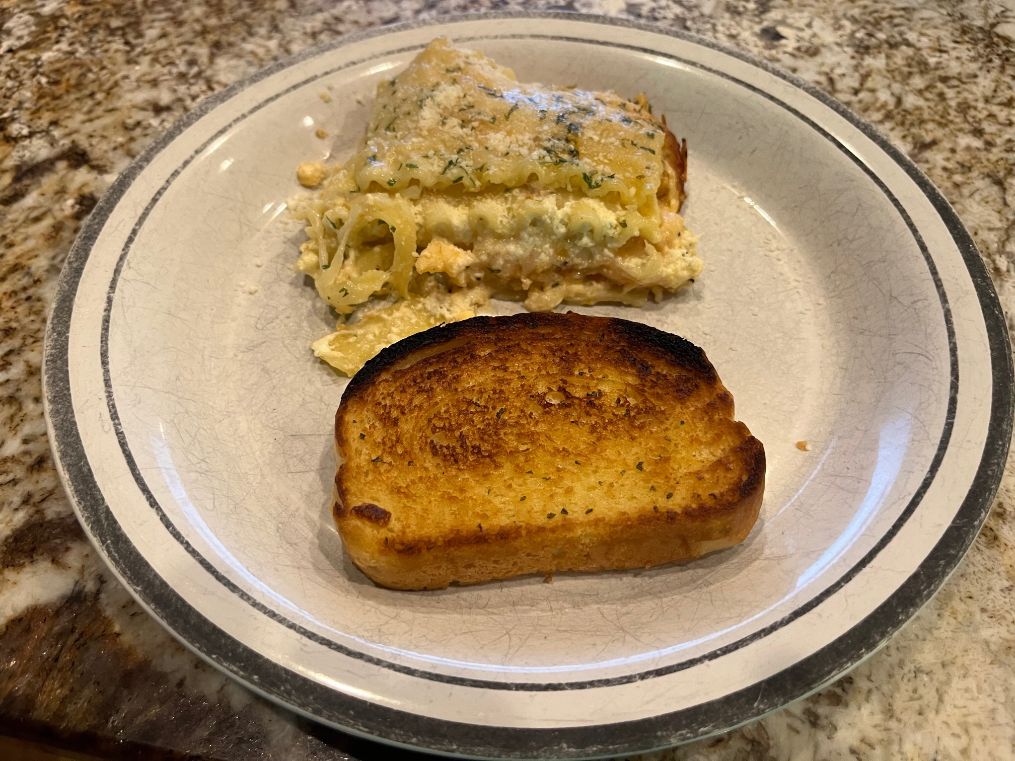
This seafood recipe is a little tough to make but the outcome is always delicious. It’s probably not something you put together at fish camp or deer camp but it makes a great meal at home. I used Louisiana crawfish to spice it up a bit and cooked the seafood in a Cajun seasoning before mixing it in. It gives the lasagna a little hint of Louisiana. Here’s the breakdown on how I make it.
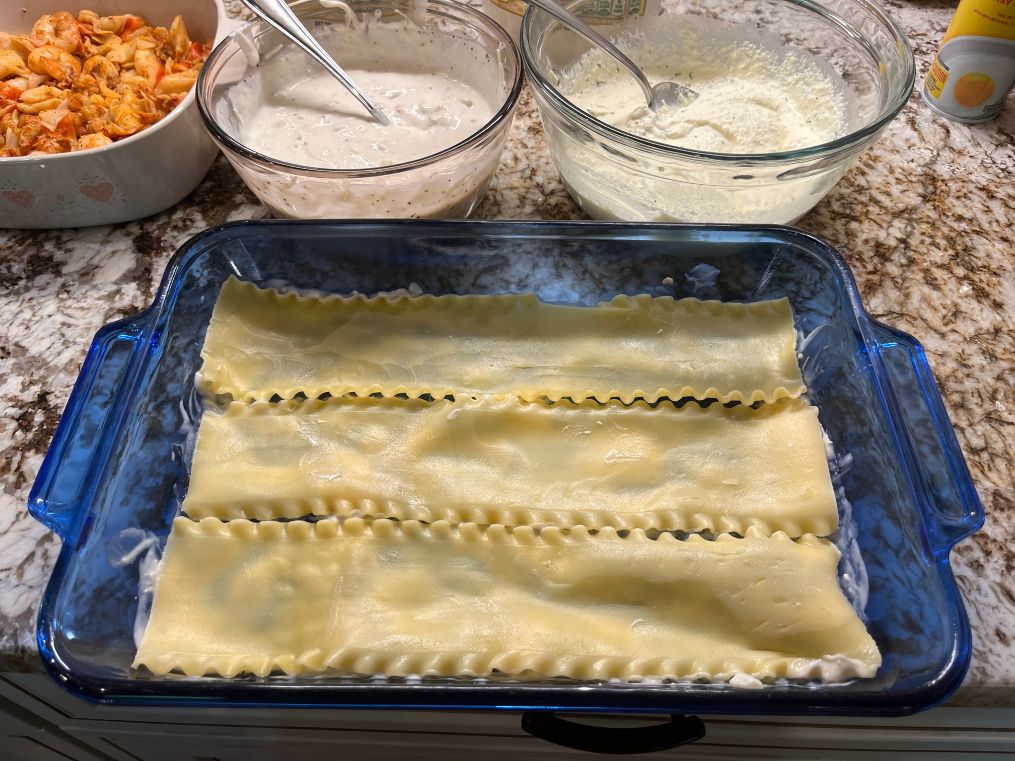
First off, I boil my lasagna noodles. I use 9 noodles for my 9×13 baking dish, but I do boil and extra noodle or two just in case. After boiling the noodles as instructed on the box, I set them aside till later.
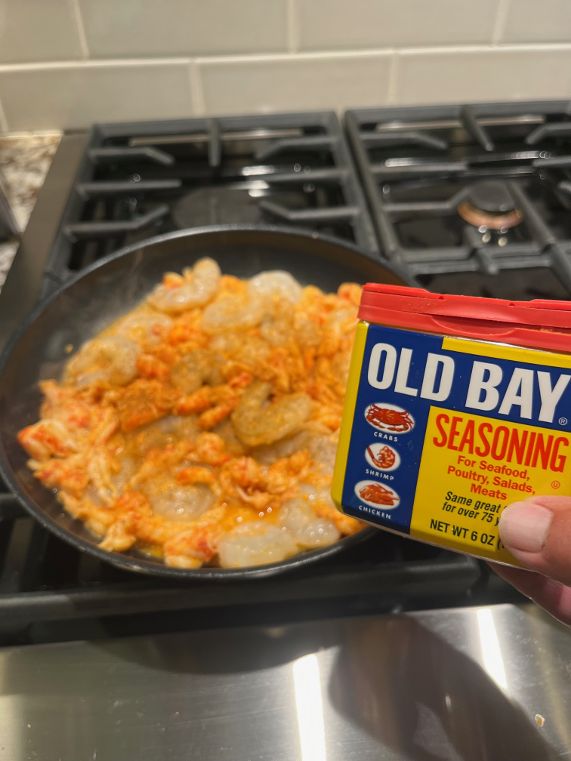
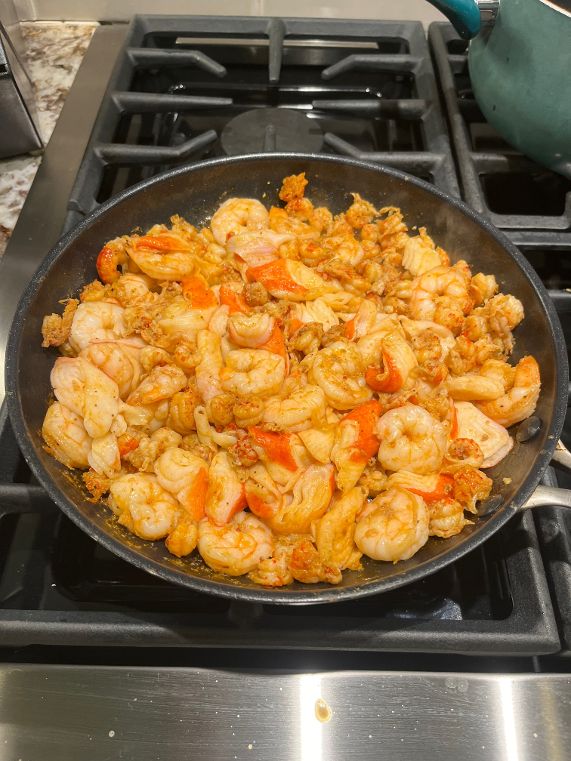
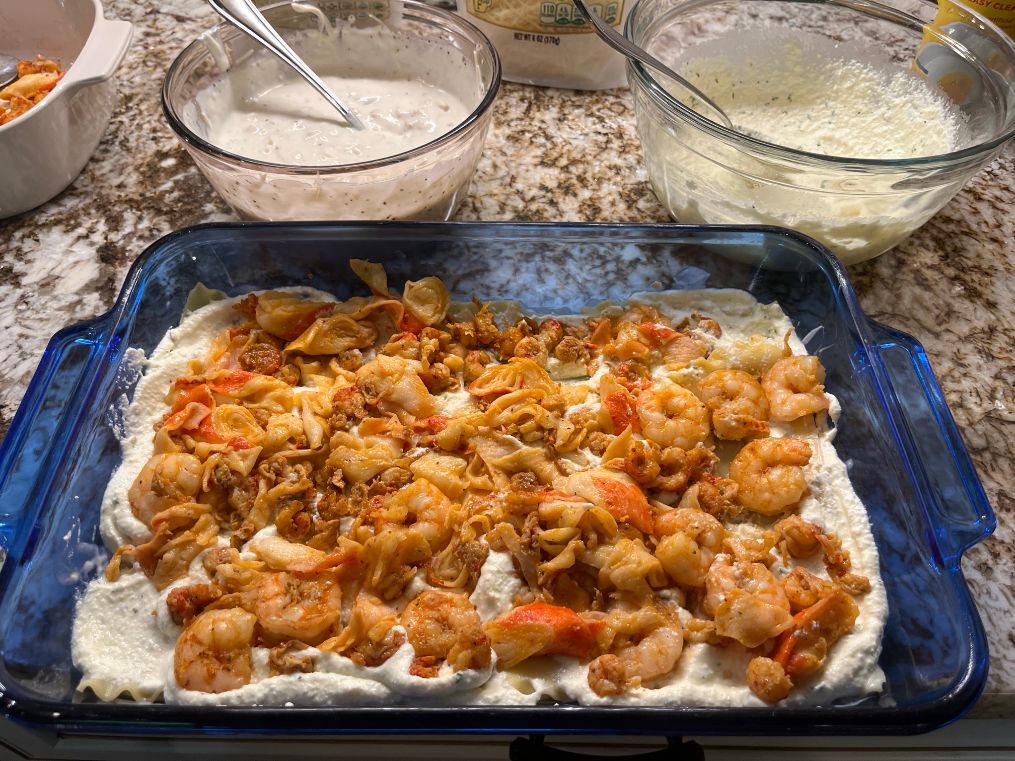
Now I’m going to prep the seafood layer. I used about a 1/2 lb of raw, peeled shrimp. Your call on the size but keep in mind that if they are larger shrimp, I usually cut them down to a smaller size. I use 1 package of peeled Louisiana crawfish and you can usually find the crawfish at the Walmart at highway 400 and 369. They are in the frozen seafood section. I also throw in a couple cups of imitation crab meat. The crab meat gives the seafood mixture an interesting taste. I start with a little butter or margarine because everything starts with butter or margarine. And then I add the shrimp and crawfish. I use the juice in the crawfish bag also because that juice is just full of crawfish flavor. Here’s how it goes:
For the cheese layer I like to use 16 ounces of Ricotta cheese so I mix the Ricotta with 1 egg, 3 tablespoons of fresh or dried parsley, 1 tablespoon of minced garlic. I mix the ingredients thoroughly and set it aside.
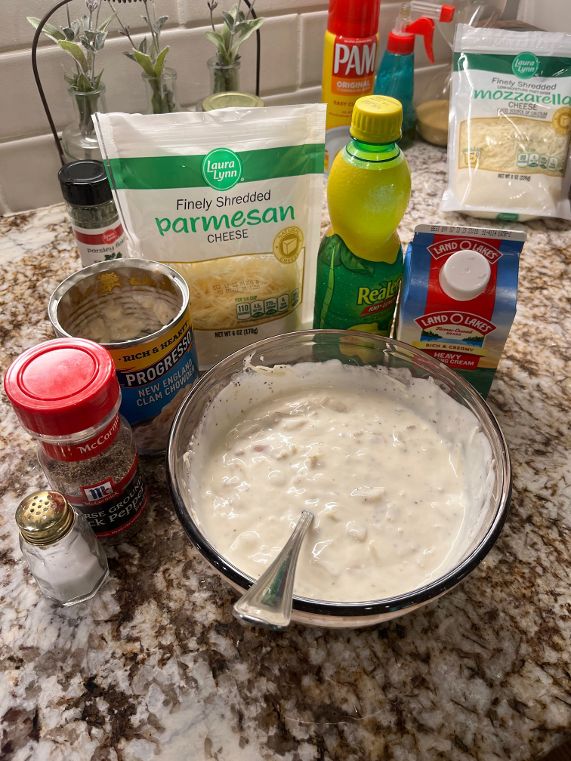
Next is the main sauce and I start with a big can of Progresso Clam chowder. I add 2 cups of heavy whipping cream, 2 tablespoons of lemon juice, 1/2 cup of grated parmesan cheese and a dash of salt and pepper.
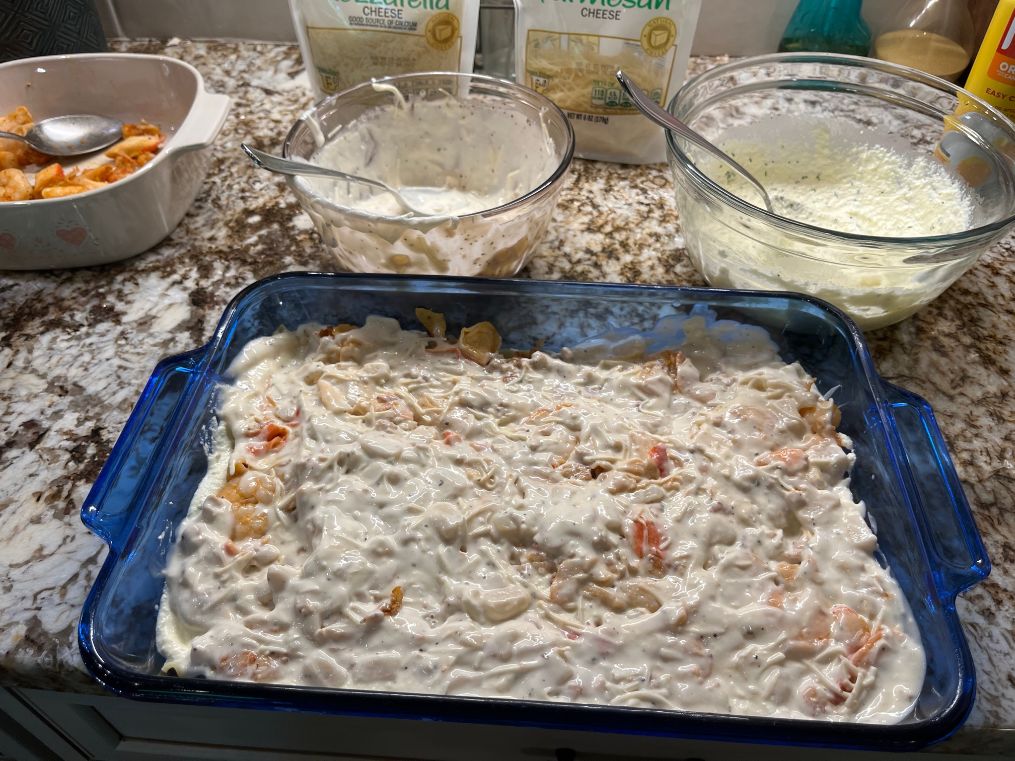
So now I’m ready to start putting it together. First, I spread a little bit of sauce all over the bottom of the pan to keep the lasagna noodles from sticking to the pan. I put a layer of the Ricotta cheese mixture down which should be about half the total mixture. Then I add half the seafood mixture and cover it with half of the sauce mixture. I then spread a half of a cup of grated parmesan cheese and half of a cup of mozzarella cheese on top of the mixture. I add another layer of lasagna noodle and repeat the layering with the remainder of the ingredients. Top it off with a final noodle layer and a little more parmesan and mozzerella cheese. I sprinkle a bit of parsley flakes on top for garnish and I cover and bake the mixture at 375 for 30 minutes. After 30 minutes I uncover and bake at 350 for another 15 minutes.
Give it a few minutes to cool after you remove it and you’re ready to serve. I usually serve it with Texas toast. Enjoy!
Recently I had a discussion with a friend about some issues with our early summer topwater bite. As is the case sometimes, we are stymied by a lack of interest in our topwater offerings in early summer and the frustration can be maddening. Even when fish are busting all around the boat, you just can’t seem to connect no matter what you pull out of the tackle box. It’s been a problem of mine over the years, and I’ve spent hours just trying to figure it out. Today was no different but understanding why it happens and making the proper adjustments can be the key to success when all seems lost. I know it’s happened to you because it happens to me very frequently, especially throwing topwater early in the morning and late in the evening. I see a fish come up and I immediately throw my bait right where the fish surfaced but the fish is gone and not coming back. It could also be a group of fish blowing up but not even touching your topwater bait, even if you throw it right on top of them. Here’s my top two reasons this happens:
First being the “match the hatch” theory. Right now, we are early in the summer and a lot of the bait that is out there right now is small. I probably saw it at least half a dozen times today alone; the baits that the fish were chasing measured about1-2 inches in length. The little bait would be skipping across the water with a nice sized bass hot on its tail. Early in the morning and late in the evening the threadfin shad schools tend to come closer to the surface and right now the shad are still small. That big ole 4–5-inch topwater bait or swimbait I’m throwing looks nothing like the 1–2-inch threadfin shad that are scattering everywhere and being chased by the bass. Usually, it takes me a hot minute to figure it out but recently I’ve been combating the “match the hatch” problem with my little Duo Realis G-fix 80 spybait. Another suggestion would be a 1/8-1/4-ounce bucktail but I don’t tie or use them like I use to. I just run the spybait around the area the fish are coming up and usually it doesn’t take long to feel my little spinning rig load up. When a big fish hits the little spybait, the rod feels like the bait just hit a brick, then the brick pulls back. It’s a great feeling and a good early morning option when the bass are chasing threadfin shad early and late. Here’s a picture of my first two bass early Tuesday morning using the little G-fix spybait.
The second theory I have about why the fish aren’t coming back or coming up to hit your topwater is my looking up vs pushing up theory. There’s a difference between the fish looking up to get their meals and a fish pushing up a bait to the surface to eat it. A lot of times the fish get hyper focused on one baitfish and it’s hard to distract them. This happens a lot when there isn’t sufficient oxygen at the surface and the fish does not intend to stay up on the surface any longer than he has to. The bass has pushed a specific bait to the surface, and he intends to eat that bait a get back down to the more oxygenated water column as soon as possible. Sometimes, when there is sufficient oxygen at the surface the bass know that the bait will be up above, so the bass tend to look up for their meals. Generally, this happens during the afternoon when the bass are out searching for the larger variety blueback herring or hanging around a brush pile waiting on bluebacks to drift over the brush pile. Wake making baits, popping baits and splashing baits are good choices when the fish are looking up for a meal.
After my morning fun on Tuesday with the spybait I went to work on the topwater and found it to be hit or miss till about 9am and then I would hit a grind. The spybait and topwater would slow to a crawl till about 1pm and when the herring chasers would show up for some awesome topwater explosions. I only used 1 bait for topwater this week and that was the little chug bug. I tried a few other baits but I had the most confidence with the little chugger so I just rolled with it. The main lake humps are starting to produce for me and when the creek isn’t too busy I can call them up there too in the afternoons. Here’s a few more from Tuesday afternoon.
Tuesday afternoon Lisa text me and told me that our little Rat Terrier “Chigger” had a stroke or a heart attack and she thought he was dying. I rushed home and Chigger looked bad. He could barely walk and his breathing was very labored. Lisa had to go out for a while and I sat with Chigger as he slept. It wasn’t long till he stood up, fell over and locked up, yelping and having a bad seizure. He finally passed out and I thought he was dead for a second but then he started breathing again and opened his eyes. He kinda regained his senses but then it happened again about an hour later and all I could do was hold him until it was over. Chigger is 17 years old and is nearing the end of his quality of life. We were told by our vet that Chigger could live 2 weeks or two months, but his liver was failing, and he was near the end. That was 4 years ago and up until 2 days ago he was still chasing cats and barking at squirrels through the window.
Right now, Chigger is still trying to get it back together. I had scheduled to have him euthanized at 3pm yesterday because I just didn’t want to see him go through anymore seizures and he could barely walk. His eyes glazed over, and he was just staggering around, very confused. He quit eating and drinking after the episodes but yesterday morning he ate and drank enough to convince us to cancel the euthanasia. He slept last night and finally drank some water and ate more food this evening. As long as he’s comfortable, not in any pain and eating we’re going to just keep an eye on him and see what happens.
With the dog being sick, I spent a little more time at home this week, but I did get out a few times and I threw the chug bug a lot. I mixed it up with a little spybait and shaky head but yesterday and today the big-ticket bass came on the chug bug over brush and out on points in the afternoon. It’s by no means on fire with the topwater and chug bug right now but being in the right place at the right time is key to catching some nice topwater fish. Another key is patience, not every brush pile is going to produce but if you run a few you’re going to connect and if you get lucky enough to call one up in the afternoon, chances are it’s going to be a good one. I also saw some good schooling this afternoon and sometimes multiple fish would get after my little topwater bait. That’s always a lot of fun to see multiple bass fighting over your bait and then connecting with a big one.
I’m not much help this week and I didn’t get to spend a lot of time on the water, but I did have a good time with the chug bug this week. Water temps are in the mid 70’s and the lake is a little over 2 feet below full pool. The corps is only generating a few hours in the afternoon. Here’s a few bigger fish from yesterday and today.
When I want a little taste of the Big Easy, this is one of my favorite Cajun comfort foods. This is one of the many reasons I keep going back to the Louisiana marsh in search of redfish year after year. This recipe is a combination of redfish and crawfish with the flavor of the deep south and each bite I take brings back another memory of my time in Sportsman’s Paradise.
On my last trip to Louisiana, we caught and kept some smaller redfish in the 2-4lb range which was perfect for the way I wanted to cook them. We did catch some bigger reds that I will specifically grill on the half shell but these smaller ones I wanted to filet and blacken on our Blackstone. Lisa and I freezer packed the redfish in 4 filet servings.
The redfish filets were prepared by removing any remaining bones, skin and scales. I cleaned and dried the filets before cutting them into smaller pieces and applying the blackening seasoning. They are now prepped for the Blackstone and ready to cook.
Next, I’m going to prep everything for my crawfish cream sauce. This cream sauce not only goes great over redfish but as an appetizer, it is awesome over toasted French bread or our favorite, crostini toast.
Here’s a list of ingredients for the sauce mix. (We like to purchase our crawfish at the Walmart at 369 and 400):
Ingredients:
12-ounce bag of clean crawfish tails
1/4 stick of margarine
2 cups of heavy whipping cream
1/2 cup of chopped sweet onion
1 tbsp. minced garlic
1tbsp. Worcestershire sauce
1 tsp. Cajun seasoning
1 tsp. Old Bay seasoning
2 tbsp. all-purpose flour
1 tbsp. parsley
salt and pepper to taste.
First, on medium heat I melt the margarine and add the onion. I then add the crawfish and let the crawfish and onion cook down for a few minutes. I then add the minced garlic, Worcestershire sauce and seasoning, mixing thoroughly. Lastly, I add the flour to the mixture and mix thoroughly again before adding the whipping cream. After adding the whipping cream I bump the heat up a little till the mixture starts to simmer. I turn the heat back down to low simmer and continue to stir until the mixture thickens to a creamy sauce.
At the same time, I’m starting the Blackstone and preparing the redfish filets. I start with a few slices of bacon to help season the grill and cook the asparagus. It doesn’t take long to cook the fish and I only flip them once. Of course, cooking time depends on the size of the filets but the cook time for our filets around minutes.
Once the filets were done, we had a little appetizer with the crawfish creamy sauce and then dinner was served.
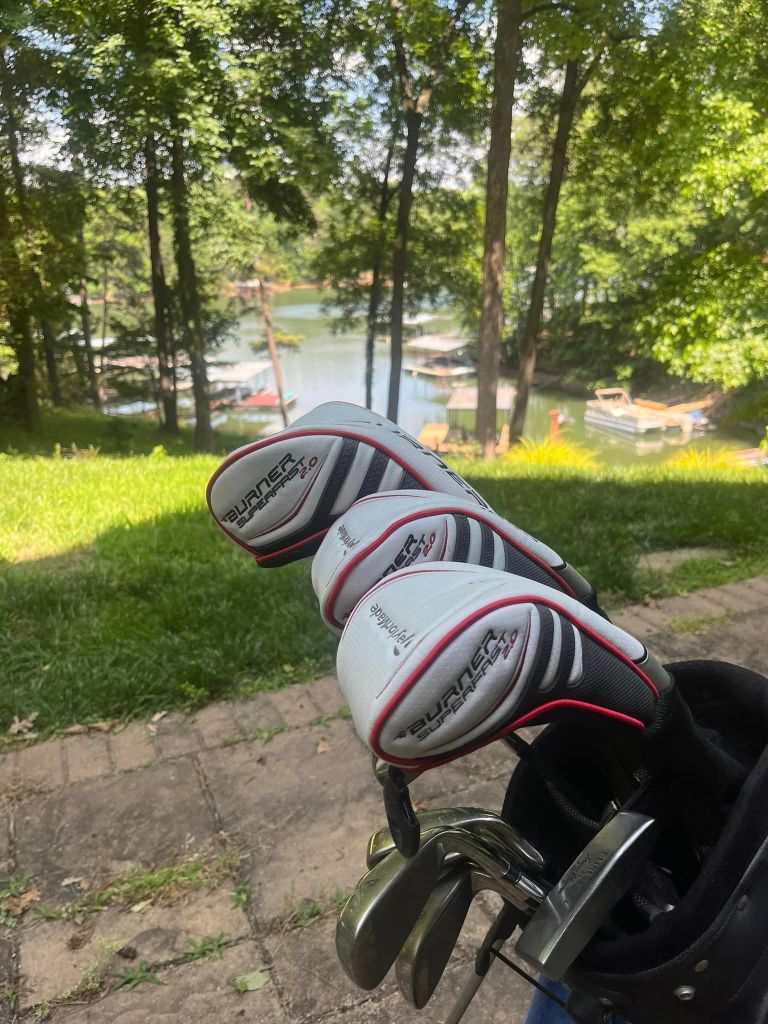
As a kid growing up in the 60’s and 70’s I developed an interest in all sports. A friend of my father was giving me his used weekly (back when it was weekly) Sports Illustrated magazines every Tuesday, so I’d ride my bike into town and pick them up from a little wooden stand that stood in the foyer just inside his front door. I wore all those magazines out soaking up all the information. Back then I got to read about the greats like Pete Rose and the Big Red Machine. I got to read about, and watch “Wilt the Stilt” play in his prime, as well as “Kareem” and the sky hook. I watched Mohammed Ali and Joe Frazier go at it and I’ll never forget the lightning speed of Sugar Ray and Julio Ceasar Chavez. I went and watched Lou Brock in his final year and got a Birthday cake for a drunk Bill Russell, from the LA Dodgers, at a grocery store I worked at in 1978. My heroes were multi-sport athletes like Babe Dedrickson and Jim Thorpe (there’s 2 names you don’t hear about anymore). How about Bo Jackson, Neon Deon and Michael Jordon, three of the most talented players to every play. I really took an interest in golf after watching some of the greats from back then and my dad bought me my first set of golf clubs in 1972. It was a left-handed Tom Weiskopf starter set from Northwestern and I wore those things out in our little 5-acre pasture pretending I was in the final round-dead heat with Arnold or Jack, at the Master’s when they were in their prime. Although I played many sports I really took to golf, and I’ve played off and on for over 50 years now. Golf is the only sport I’ve found in which you compete against your own mistakes, and it is a fierce competitor. I bought my dad his first set of clubs when he was around 45-50 years old, and he eventually got good enough to beat the brakes off of me in some epic matches at his home course in south Texas before his passing. After that it was hard for me to find a reason to keep that handicap low, so I pretty much put away the clubs. This year I have made a vow to kick-start the bad habits of my golf game and try and play a little more golf in the infancy of my retirement. This week was the start of that so I’m spending a little more time on the course and less on the lake.
Monday was Memorial Day this week and it’s really a very distant memory at this point but if I remember correctly Lisa and I got out for a bit before the traffic got bad. We cycled through the usual stuff for this time of year and I was able to capitalize on a surfacing fish with my little Azuma Zdog topwater walking bait. We were mostly checking brush out on the ends of points before the traffic started going over these areas. There’s something that I’ve been noticing from the start of the week and even going much further back than that and that is that a lot of the fish are relating to the bottom right now when the sun gets up about mid to late morning. Early, the fish are doing their thing and chasing bait around the brush but around late morning they start to chill, and I’d hit a dead spot. During the early morning hours, I could convince a few to come to the surface or pop a few by backing off the brush and throwing the spybait around the area of the brush. The little G-fix 80 from Duo Realis is the only spybait I use, and the American Shad pattern can be deadly in the early morning hours or when it’s overcast. My rule of thumb for spybaiting is light solid colors in low light and translucent colors on sunny days. Here’s 4 of our biggest from Monday and Tuesday using the topwater/spybait pattern.
When I got up Wednesday morning the wind was out of the east, and it was getting it pretty good. The skies were overcast and to me it looked like it was setting up to be one of those awesome topwater days. I’m not advocating for anyone to get out on the main lake when the water is white capping and you’re the only poor soul out there looking for big spotted bass, because there is an element of danger and help may be hard to find on rough days. I’ve just come to the realization that fish are less cautious when the chop is beefy. That’s where I headed on Wednesday, into the beefy chop with my white pearl walker and the chrome Sexy Dawg. I spent the first 2 hours of the morning fending off stripers and the occasional big Blue Heron or Osprey from my walking baits, to try and connect with bass. You really had to stay on your toes with the stripers. Those suckers would wait till the bass started school under the bait and then they would come out of nowhere to steal the prize. You had to be quick with that little white pearl walking bait. I found that the stripers were a little more reluctant to hit the chrome Sexy Dawg, so I mainly stuck with chrome after fending off stripers for a while. I was back at my dock by lunch and had a nice morning of topwater in the chop under cloudy skies. Here’s some of my fish from Wednesday.
I’ve been hitting a few golf balls in the evenings at a nearby driving range so Thursday I finally played a round of golf with a good friend, Jeff Williams, after finding out he plays golf. Jeff’s like me, a passionate competitor and I’ve always had fun fishing with Jeff with that competitive spirit. I found out very quickly that he was very good at golf and just what I needed as a goal to improve my game. I had a blast getting a thorough beatdown from Jeff and after these aching muscles heal, I’ll be back on the range to make some adjustments.
I’m saving the best for last, and I’ll put my week together in a nutshell. The absolute best bait we had this week was the shaky head and if you’ve been following my reports, you should know exactly what we’re using for the shaky head. Lisa and I would go out in the evenings after work, and we wore them out during the generation periods this week. From about 5:30 till 8:30 we targeted the brush in 15-25 feet on the ends of points and humps in the creek and we had a blast. It’s a very good idea to hit the bottom with the baits during generation right now. Yesterday I went out into the creek before the generation period just after lunch to see if the shaky head bite was going well before they started generation and just as I had thought that worm bite is much better during generation. So, in summation, my best pattern this week has been the topwater walking baits during low light and windy/choppy conditions with the occasional spybait mixed in if they aren’t coming up but after the sun gets up, there starts to be a transition to spybait/underspin type stuff for the suspended herring eaters. Then in late afternoon when the boat traffic kicks up, the best thing we did was go to the bottom with the shaky head or drop shot. Here is a picture of my last fish yesterday, a nice shaky head fish from a brush pile in early afternoon before calling it a week. I couldn’t have scripted the weeks end any better and thank the man upstairs for another great week. Water temps are in the mid 70’s and the lake level is more than 2 feet below full pool and dropping fast.































































 Cast Away's Blog